 Add to Chrome
 Add to Firefox
 Add to Edge
GeoTrace: Geometry-Aware Trajectory Token Compression for Video Large Language Models
Jul 10, 2026
Although Video Large Language Models (Video LLMs) have shown strong performance in video understanding, their efficiency is still limited by the large number of visual tokens. Existing video token compression methods typically rely on frame-wise saliency or heuristic token merging, which can over-focus on locally salient regions and produce ambiguous fused features. To address these issues, we propose GeoTrace, a training-free spatiotemporal token compression framework that decomposes video evidence into exact skeleton tokens and traceable residual event tokens. Specifically, Contextual Farthest-Point Anchoring (CFPA) preserves salient, context-consistent, and high-coverage skeleton tokens, while Trajectory-Constrained Residual Condensation (TCRC) compresses residual tokens through one-to-one temporal trajectories and constrained near-manifold condensation, producing traceable event tokens with reduced ambiguity. We evaluate GeoTrace on four Video LLMs across four video understanding benchmarks, and the results demonstrate its effectiveness and generalization across different model architectures and scenarios. On LLaVA-OneVision, with only 10\% visual tokens retained, GeoTrace achieves a \(12.99\times\) TFLOPs reduction while preserving 99.1\% of the vanilla performance. Overall, GeoTrace offers a compact and traceable token representation for efficient and robust Video LLM inference. Code is available at \href{https://github.com/guohuan-xie/GeoTrace.git}{\texttt{Code}}.

Hypergraph as Language
May 21, 2026Large language models (LLMs) have recently shown strong potential in modeling relational structures. However, existing approaches remain fundamentally graph-centric: they focus on processing pairwise graph structures into tokens that LLMs can understand. In contrast, many real-world relational patterns do not naturally conform to the pairwise-edge assumption, and are better modeled as high-order associations in hypergraphs. For hypergraph structures, existing methods often fail to preserve the native semantics that multiple objects are jointly connected by the same high-order relation, limiting their ability to exploit complex structures. To address this limitation, we put forth the "Hypergraph as Language" perspective and propose Hyper-Align, a hypergraph-native alignment framework for large language models. Hyper-Align compiles the query-object-centered hypergraph context into hypergraph tokens directly consumable by a base LLM. Specifically, we introduce Hypergraph Incidence Detail Template with Overview (HIDT-O), which serializes high-order association structures into a fixed-shape hybrid template combining local incidence details and overview-level summaries. We then design a Hypergraph Incidence Projector (HIP), which maps native high-order incidence structures into the LLM token space through explicit semantic-structural decoupling and bidirectional message passing between vertices and hyperedges. We further define a concrete Hypergraph-as-Language input protocol, which jointly feeds hypergraph tokens and textual prompts into a frozen base LLM, supporting both vertex-level and hyperedge-level tasks under a unified question-answering paradigm. To systematically evaluate different methods in hypergraph structural modeling, we introduce HyperAlign-Bench. Extensive experiments show that Hyper-Align significantly outperforms existing methods across in-domain and zero-shot evaluations.
Hypergraph-Enhanced Training-Free and Language-Free Few-Shot Anomaly Detection
May 11, 2026Few-shot anomaly detection (FSAD) has made significant strides, yet existing methods still face critical challenges: (i) dependence on task- or dataset-specific training/fine-tuning, (ii) reliance on language supervision or carefully hand-crafted prompts, and (iii) limited robustness across domains. In this paper, we introduce HyperFSAD, a novel FSAD framework that is training-free, language-free, and robust across domains, offering a powerful solution to these challenges. Built upon DINOv3 and a hypergraph-based inference mechanism, our approach performs inference without any task-specific optimization or text prompts, while remaining competitive. Specifically, we replace sensitive nearest-neighbor / top-$n$ matching with \textbf{Sparse Hyper Matching}: \textit{sparsemax} first selects the most relevant support patches, which are then aggregated into a \textit{hyperedge} as compact normal evidence to suppress background noise and distractors. We further introduce \textbf{Dual-Branch Image Scoring}, which fuses \emph{spatial anomaly evidence} from the patch-grid anomaly map with \emph{global semantic deviation} captured by support-aware CLS matching, yielding a robust image-level anomaly score in a strictly visual manner. Notably, all components of HyperFSAD are purely visual, eliminating the need for labor-intensive hand-crafted text prompts. Under the stringent training-free and language-free setting, HyperFSAD achieves state-of-the-art performance across six datasets spanning four industrial datasets (MVTecAD, VisA, MPDD, BTAD) and two medical datasets (RESC, BraTS).
Make It Up: Fake Images, Real Gains in Generalized Few-shot Semantic Segmentation
Mar 28, 2026Generalized few-shot semantic segmentation (GFSS) is fundamentally limited by the coverage of novel-class appearances under scarce annotations. While diffusion models can synthesize novel-class images at scale, practical gains are often hindered by insufficient coverage and noisy supervision when masks are unavailable or unreliable. We propose Syn4Seg, a generation-enhanced GFSS framework designed to expand novel-class coverage while improving pseudo-label quality. Syn4Seg first maximizes prompt-space coverage by constructing an embedding-deduplicated prompt bank for each novel class, yielding diverse yet class-consistent synthetic images. It then performs support-guided pseudo-label estimation via a two-stage refinement that i) filters low-consistency regions to obtain high-precision seeds and ii) relabels uncertain pixels with image-adaptive prototypes that combine global (support) and local (image) statistics. Finally, we refine only boundary-band and unlabeled pixels using a constrained SAM-based update to improve contour fidelity without overwriting high-confidence interiors. Extensive experiments on PASCAL-$5^i$ and COCO-$20^i$ demonstrate consistent improvements in both 1-shot and 5-shot settings, highlighting synthetic data as a scalable path for GFSS with reliable masks and precise boundaries.
A Comprehensive Survey on Video Scene Parsing:Advances, Challenges, and Prospects
Jun 16, 2025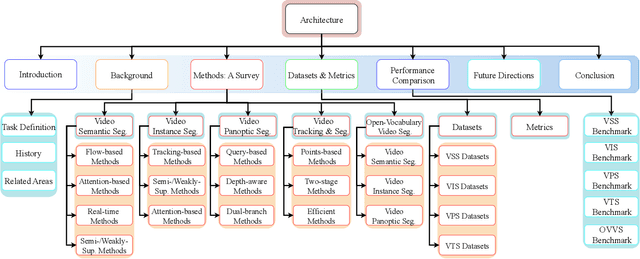
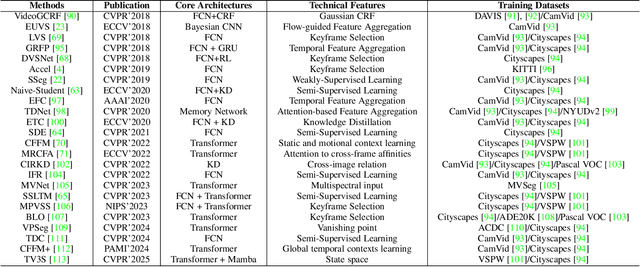
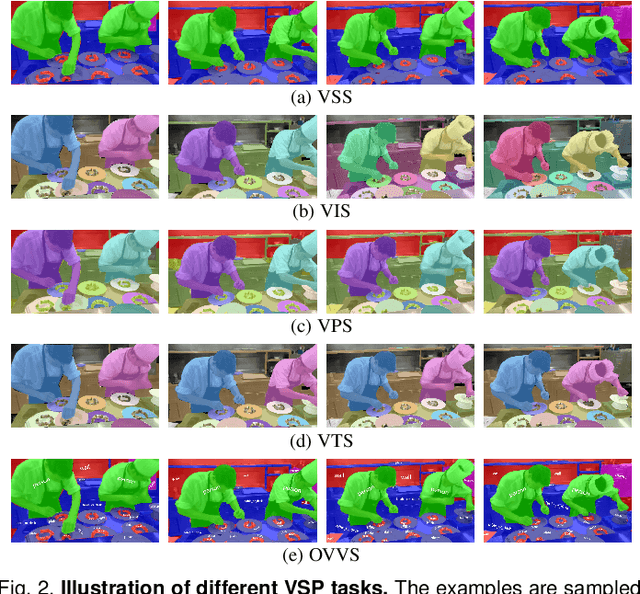
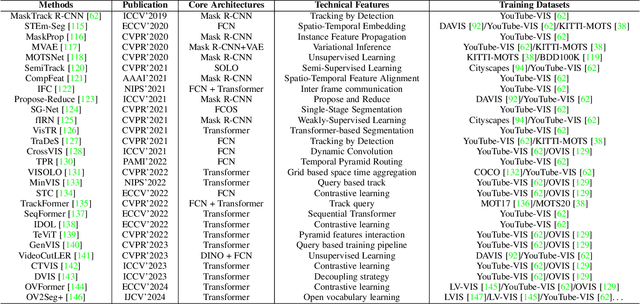
Video Scene Parsing (VSP) has emerged as a cornerstone in computer vision, facilitating the simultaneous segmentation, recognition, and tracking of diverse visual entities in dynamic scenes. In this survey, we present a holistic review of recent advances in VSP, covering a wide array of vision tasks, including Video Semantic Segmentation (VSS), Video Instance Segmentation (VIS), Video Panoptic Segmentation (VPS), as well as Video Tracking and Segmentation (VTS), and Open-Vocabulary Video Segmentation (OVVS). We systematically analyze the evolution from traditional hand-crafted features to modern deep learning paradigms -- spanning from fully convolutional networks to the latest transformer-based architectures -- and assess their effectiveness in capturing both local and global temporal contexts. Furthermore, our review critically discusses the technical challenges, ranging from maintaining temporal consistency to handling complex scene dynamics, and offers a comprehensive comparative study of datasets and evaluation metrics that have shaped current benchmarking standards. By distilling the key contributions and shortcomings of state-of-the-art methodologies, this survey highlights emerging trends and prospective research directions that promise to further elevate the robustness and adaptability of VSP in real-world applications.