 Add to Chrome
 Add to Firefox
 Add to Edge
The Imperfect Learner: Incorporating Developmental Trajectories in Memory-based Student Simulation
Nov 08, 2025
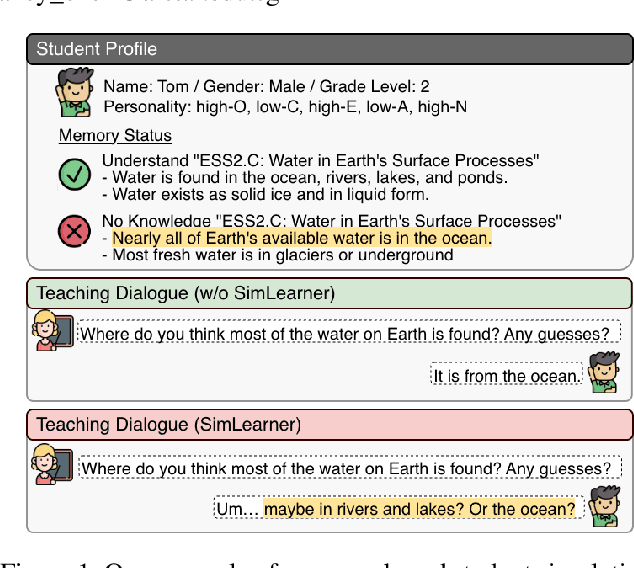
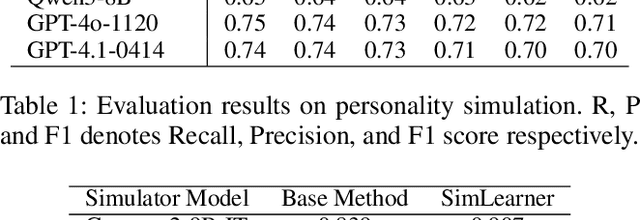
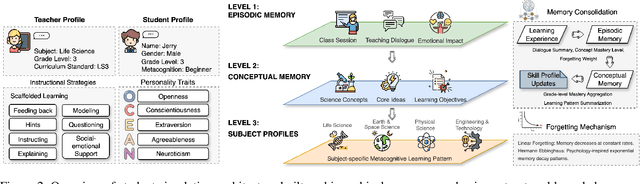
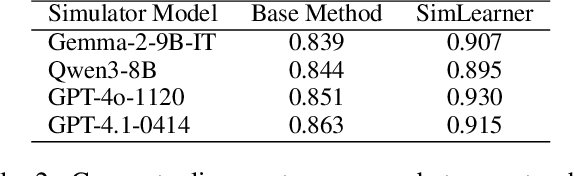
User simulation is important for developing and evaluating human-centered AI, yet current student simulation in educational applications has significant limitations. Existing approaches focus on single learning experiences and do not account for students' gradual knowledge construction and evolving skill sets. Moreover, large language models are optimized to produce direct and accurate responses, making it challenging to represent the incomplete understanding and developmental constraints that characterize real learners. In this paper, we introduce a novel framework for memory-based student simulation that incorporates developmental trajectories through a hierarchical memory mechanism with structured knowledge representation. The framework also integrates metacognitive processes and personality traits to enrich the individual learner profiling, through dynamical consolidation of both cognitive development and personal learning characteristics. In practice, we implement a curriculum-aligned simulator grounded on the Next Generation Science Standards. Experimental results show that our approach can effectively reflect the gradual nature of knowledge development and the characteristic difficulties students face, providing a more accurate representation of learning processes.

CoinMath: Harnessing the Power of Coding Instruction for Math LLMs
Dec 16, 2024
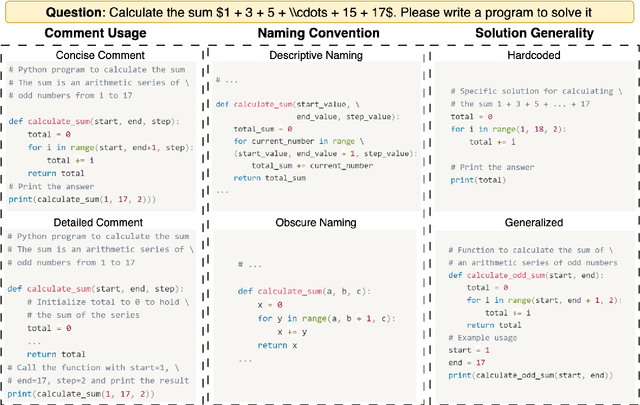
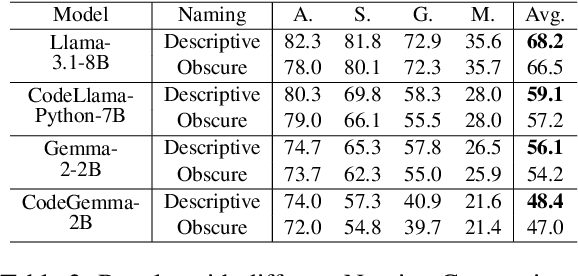
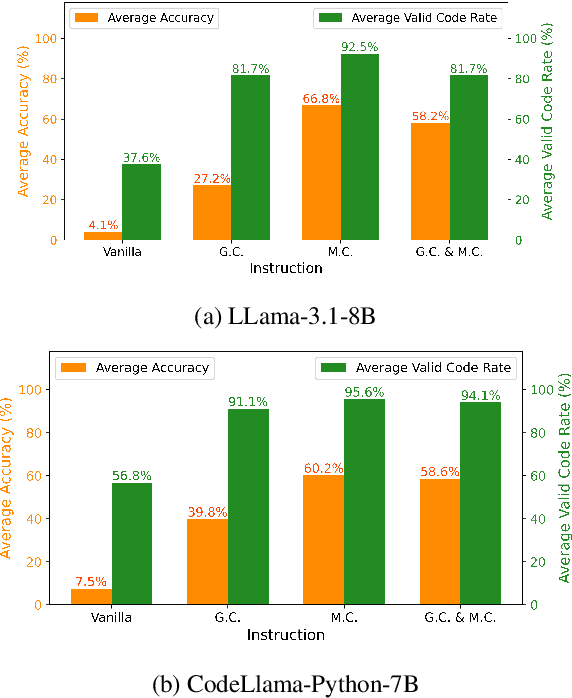
Large Language Models (LLMs) have shown strong performance in solving mathematical problems, with code-based solutions proving particularly effective. However, the best practice to leverage coding instruction data to enhance mathematical reasoning remains underexplored. This study investigates three key questions: (1) How do different coding styles of mathematical code-based rationales impact LLMs' learning performance? (2) Can general-domain coding instructions improve performance? (3) How does integrating textual rationales with code-based ones during training enhance mathematical reasoning abilities? Our findings reveal that code-based rationales with concise comments, descriptive naming, and hardcoded solutions are beneficial, while improvements from general-domain coding instructions and textual rationales are relatively minor. Based on these insights, we propose CoinMath, a learning strategy designed to enhance mathematical reasoning by diversifying the coding styles of code-based rationales. CoinMath generates a variety of code-based rationales incorporating concise comments, descriptive naming conventions, and hardcoded solutions. Experimental results demonstrate that CoinMath significantly outperforms its baseline model, MAmmoTH, one of the SOTA math LLMs.