 Add to Chrome
 Add to Firefox
 Add to Edge
LegalWorld: A Life-Cycle Interactive Environment for Legal Agents
Jun 17, 2026
Civil litigation is inherently a life-cycle process: what a lawyer drafts on day one constrains what unfolds at trial months later. Yet existing legal benchmarks evaluate isolated subtasks, and prior legal-agent simulators reinitialize each scenario from shared ground truth, leaving cross-stage causal dependencies unmodeled. We present LegalWorld, a life-cycle interactive environment that models Chinese civil litigation as a causally connected state chain of five stages (seven sub-scenarios), grounded in 75,309 paired Chinese civil judgments. We pair it with reusable infrastructure (local memory, global case memory, a Skill/Tool library) that keeps each dispute consistent across its full life cycle. Building on this environment, we construct LongJud-Bench to evaluate agent capability across all five connected stages. 18,992 ratings from 217 legal-background evaluators confirm that LegalWorld trajectories are procedurally faithful and role-consistent; and a capability-level cross-model evaluation reveals sharp divergences that aggregate scores cannot expose, with no single backbone leading across consultation, drafting, and courtroom advocacy. Detailed resources will be released publicly.

SocioVerse: A World Model for Social Simulation Powered by LLM Agents and A Pool of 10 Million Real-World Users
Apr 14, 2025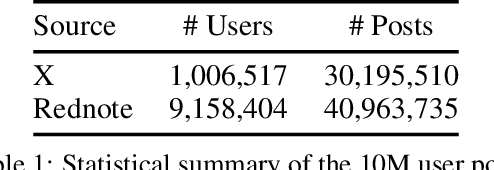
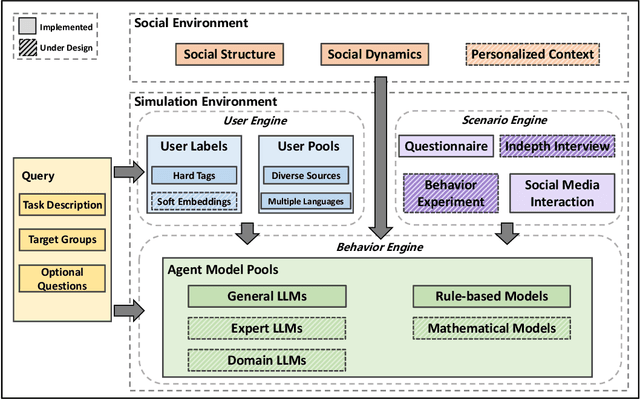

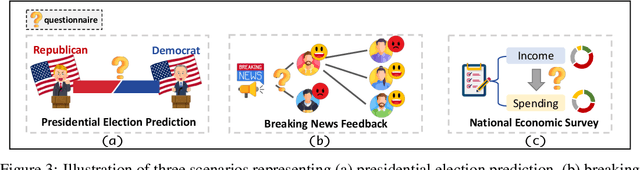
Social simulation is transforming traditional social science research by modeling human behavior through interactions between virtual individuals and their environments. With recent advances in large language models (LLMs), this approach has shown growing potential in capturing individual differences and predicting group behaviors. However, existing methods face alignment challenges related to the environment, target users, interaction mechanisms, and behavioral patterns. To this end, we introduce SocioVerse, an LLM-agent-driven world model for social simulation. Our framework features four powerful alignment components and a user pool of 10 million real individuals. To validate its effectiveness, we conducted large-scale simulation experiments across three distinct domains: politics, news, and economics. Results demonstrate that SocioVerse can reflect large-scale population dynamics while ensuring diversity, credibility, and representativeness through standardized procedures and minimal manual adjustments.