 Add to Chrome
 Add to Firefox
 Add to Edge
Decoupled Residual Quantization for Robust Semantic IDs in Recommendation
Jun 01, 2026
Semantic IDs represent items as shared discrete token sequences and have become a practical tool for recommendation and retrieval. Yet it remains difficult to tell why a tokenizer fails: poor quality may come from codebook underutilization, unstable decision boundaries, or geometric distortion of the embedding space. This paper develops a quantitative framework for diagnosing these failures through expected codeword overlap and effective codebook capacity. The former measures expected codeword confusion under retrieval-time perturbation, while the latter converts that confusion into an effective number of usable, well-separated codes. The framework links semantic boundary confusion to both code usage imbalance and Euclidean geometric constraints. As a proof of concept, we present Decoupled Residual Quantization (DRQ), which separates continuous geometry reconstruction from discrete distribution matching. Experiments on a large-scale industrial dataset show that Semantic ID quality is multi-objective: symbolic robustness, reconstruction fidelity, and behavior-aware soft matching each stress different aspects of a tokenizer. These downstream observations are based on one proprietary industrial dataset, so they should be read as a case study rather than a universal benchmark claim.

DTN: Deep Multiple Task-specific Feature Interactions Network for Multi-Task Recommendation
Aug 21, 2024
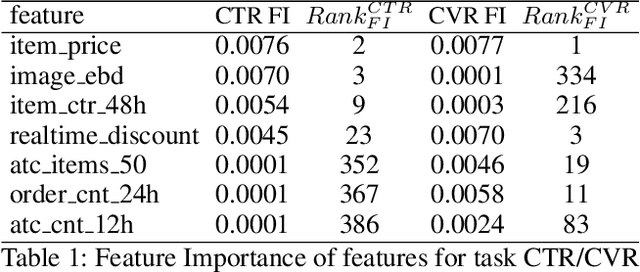

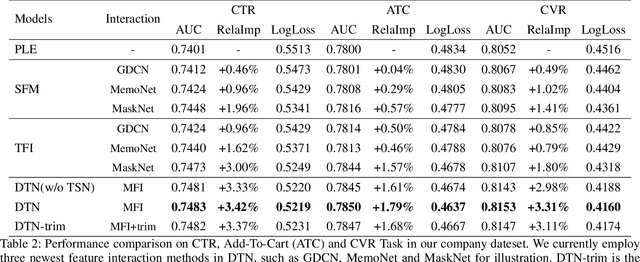
Neural-based multi-task learning (MTL) has been successfully applied to many recommendation applications. However, these MTL models (e.g., MMoE, PLE) did not consider feature interaction during the optimization, which is crucial for capturing complex high-order features and has been widely used in ranking models for real-world recommender systems. Moreover, through feature importance analysis across various tasks in MTL, we have observed an interesting divergence phenomenon that the same feature can have significantly different importance across different tasks in MTL. To address these issues, we propose Deep Multiple Task-specific Feature Interactions Network (DTN) with a novel model structure design. DTN introduces multiple diversified task-specific feature interaction methods and task-sensitive network in MTL networks, enabling the model to learn task-specific diversified feature interaction representations, which improves the efficiency of joint representation learning in a general setup. We applied DTN to our company's real-world E-commerce recommendation dataset, which consisted of over 6.3 billion samples, the results demonstrated that DTN significantly outperformed state-of-the-art MTL models. Moreover, during online evaluation of DTN in a large-scale E-commerce recommender system, we observed a 3.28% in clicks, a 3.10% increase in orders and a 2.70% increase in GMV (Gross Merchandise Value) compared to the state-of-the-art MTL models. Finally, extensive offline experiments conducted on public benchmark datasets demonstrate that DTN can be applied to various scenarios beyond recommendations, enhancing the performance of ranking models.