 Add to Chrome
 Add to Firefox
 Add to Edge
CompressKV: Semantic-Retrieval-Guided KV-Cache Compression for Resource-Efficient Long-Context LLM Inference
Jun 23, 2026
Long-context large language model (LLM) inference is increasingly constrained by the memory footprint and decoding cost of key-value (KV) caches, limiting sustainable deployment on resource-constrained hardware. Existing KV cache eviction methods typically apply heuristic token scoring over all heads in GQA-based LLMs. These methods ignore the different functionalities of attention heads, leading to the eviction of critical tokens and thus degrading the performance of LLMs. To address this issue, we propose CompressKV, a resource-efficient KV-cache compression framework for GQA-based LLMs. Instead of aggregating attention scores from all heads, CompressKV identifies Semantic Retrieval Heads (SRHs) that capture both the initial and final tokens of a prompt and semantically important mid-context evidence, and uses them to select tokens whose KV pairs should be retained. Furthermore, CompressKV allocates cache budgets across layers according to offline estimates of layer-wise eviction error. Experiments on LongBench and Needle-in-a-Haystack show that CompressKV consistently outperforms existing KV-cache eviction methods across memory budgets. Notably, it preserves over 97\% of full-cache performance using only 3\% of the KV cache on LongBench question-answering tasks and achieves 90\% accuracy with just 0.7\% KV storage on Needle-in-a-Haystack. These results demonstrate an improved resource--performance trade-off for long-context LLM inference. Our code is publicly available at: https://github.com/TUDa-HWAI/CompressKV

Dustin: Draft-Augmented Sparse Verification for Efficient Long-Context Generation with Speculative Decoding
Jun 23, 2026While speculative decoding improves inference throughput for multi-batch long-context Large Language Models (LLMs), its efficiency is often limited by a verification bottleneck where Key-Value (KV) cache loading dominates latency. Existing compression methods fail in this regime: static eviction incurs accuracy loss due to saliency shift, while dynamic selection introduces prohibitive computational overhead during the verification path. We propose Dustin, a sparse verification framework designed for long-context speculative decoding. Dustin integrates lookahead signals from the draft model with historical attention from the target model to identify critical tokens with high fidelity across multi-step verification windows. To reduce recomputation latency, this approach further employs a sparse estimation scheme that restricts importance scoring to a minimal subset of attention heads. Evaluations on PG-19 and LongBench with Qwen2.5-72B demonstrate that Dustin achieves a 27.85x speedup in self-attention and a 9.17x end-to-end decoding speedup at a 32k sequence length, all with negligible accuracy degradation.
AnchorFlow: Editable SVG Reconstruction via Sparse Anchor Point Fields
May 19, 2026Image-to-SVG reconstruction aims to produce vector graphics that are faithful to raster inputs and easy to edit. Existing methods face a structural trade-off in how vector structure is parameterized, including how many paths represent an image and how many anchor points define each path. High-fidelity methods often rely on many paths or densely parameterized curves, whereas overly compact SVG generation may deviate from the input geometry. This issue becomes more pronounced when local raster evidence is imperfect, where boundary-following reconstruction can introduce redundant anchors and fragmented structures. We argue that this trade-off should be addressed at the level of anchor placement, since anchors on Bezier curves define local path structure and strongly affect both accuracy and editability. We propose AnchorFlow, an editable SVG reconstruction framework that models path-level anchor placement with sparse anchor point fields. Given path-like foreground components extracted from a raster image, AnchorFlow predicts an image-conditioned sparse anchor field for each component and resolves it into an ordered Bezier path. Rendering-guided feedback then corrects local structural errors before re-resolution. The recovered paths are then assembled and optimized into the final SVG. Experiments on isolated paths and full images show that AnchorFlow achieves a favorable fidelity-editability trade-off, substantially reducing editable complexity while preserving competitive raster fidelity.
KV Packet: Recomputation-Free Context-Independent KV Caching for LLMs
Apr 14, 2026Large Language Models (LLMs) rely heavily on Key-Value (KV) caching to minimize inference latency. However, standard KV caches are context-dependent: reusing a cached document in a new context requires recomputing KV states to account for shifts in attention distribution. Existing solutions such as CacheBlend, EPIC, and SAM-KV mitigate this issue by selectively recomputing a subset of tokens; however, they still incur non-negligible computational overhead (FLOPs) and increased Time-to-First-Token (TTFT) latency. In this paper, we propose KV Packet, a recomputation-free cache reuse framework that treats cached documents as immutable ``packets'' wrapped in light-weight trainable soft-token adapters, which are trained via self-supervised distillation to bridge context discontinuities. Experiments on Llama-3.1 and Qwen2.5 demonstrate that the proposed KV Packet method achieves near-zero FLOPs and lower TTFT than recomputation-based baselines, while retaining F1 scores comparable to those of the full recomputation baseline.
OptINC: Optical In-Network-Computing for Scalable Distributed Learning
Mar 30, 2026Distributed learning is widely used for training large models on large datasets by distributing parts of the model or dataset across multiple devices and aggregating the computed results for subsequent computations or parameter updates. Existing communication algorithms for distributed learning such as ring all-reduce result in heavy communication overhead between servers. Since communication in large-scale systems uses optical fibers, we propose an Optical In-Network-Computing (OptINC) architecture to offload the computation in servers onto the optical interconnects. To execute gradient averaging and quantization in the optical domain, we incorporate optical devices such as Mach-Zehnder-Interferometers (MZIs) into the interconnects. Such a de facto optical neural network (ONN) can effectively reduce the communication overhead in existing distributed training solutions. To reduce dataset complexity for training this neural network, a preprocessing algorithm implemented in the optical domain is also proposed. Hardware cost is lowered by approximating the weight matrices of the optical neural network with unitary and diagonal matrices, while the accuracy is maintained by a proposed hardware-aware training algorithm. The proposed solution was evaluated on real distributed learning tasks, including ResNet50 on CIFAR-100, and a LLaMA-based network on Wikipedia-1B. In both cases, the proposed framework can achieve comparable training accuracy to the ring all-reduce baseline, while eliminating communication overhead.
Late Breaking Results: Conversion of Neural Networks into Logic Flows for Edge Computing
Jan 29, 2026Neural networks have been successfully applied in various resource-constrained edge devices, where usually central processing units (CPUs) instead of graphics processing units exist due to limited power availability. State-of-the-art research still focuses on efficiently executing enormous numbers of multiply-accumulate (MAC) operations. However, CPUs themselves are not good at executing such mathematical operations on a large scale, since they are more suited to execute control flow logic, i.e., computer algorithms. To enhance the computation efficiency of neural networks on CPUs, in this paper, we propose to convert them into logic flows for execution. Specifically, neural networks are first converted into equivalent decision trees, from which decision paths with constant leaves are then selected and compressed into logic flows. Such logic flows consist of if and else structures and a reduced number of MAC operations. Experimental results demonstrate that the latency can be reduced by up to 14.9 % on a simulated RISC-V CPU without any accuracy degradation. The code is open source at https://github.com/TUDa-HWAI/NN2Logic
PEL-NAS: Search Space Partitioned Architecture Prompt Co-Evolutionary LLM-driven Hardware-Aware Neural Architecture Search
Oct 01, 2025Hardware-Aware Neural Architecture Search (HW-NAS) requires joint optimization of accuracy and latency under device constraints. Traditional supernet-based methods require multiple GPU days per dataset. Large Language Model (LLM)-driven approaches avoid training a large supernet and can provide quick feedback, but we observe an exploration bias: the LLM repeatedly proposes neural network designs within limited search space and fails to discover architectures across different latency ranges in the entire search space. To address this issue, we propose PEL-NAS: a search space Partitioned, architecture prompt co-Evolutionary and LLM-driven Neural Architecture Search that can generate neural networks with high accuracy and low latency with reduced search cost. Our proposed PEL-NAS has three key components: 1) a complexity-driven partitioning engine that divides the search space by complexity to enforce diversity and mitigate exploration bias; 2) an LLM-powered architecture prompt co-evolution operator, in which the LLM first updates a knowledge base of design heuristics based on results from the previous round, then performs a guided evolution algorithm on architectures with prompts that incorporate this knowledge base. Prompts and designs improve together across rounds which avoids random guesswork and improve efficiency; 3) a zero-cost predictor to avoid training a large number of candidates from scratch. Experimental results show that on HW-NAS-Bench, PEL-NAS can achieve overall higher HV, lower IGD, and up to 54% lower latency than baselines at similar accuracy. Meanwhile, the search cost drops from days to minutes compared with traditional supernet baselines.
Revolution or Hype? Seeking the Limits of Large Models in Hardware Design
Sep 05, 2025Recent breakthroughs in Large Language Models (LLMs) and Large Circuit Models (LCMs) have sparked excitement across the electronic design automation (EDA) community, promising a revolution in circuit design and optimization. Yet, this excitement is met with significant skepticism: Are these AI models a genuine revolution in circuit design, or a temporary wave of inflated expectations? This paper serves as a foundational text for the corresponding ICCAD 2025 panel, bringing together perspectives from leading experts in academia and industry. It critically examines the practical capabilities, fundamental limitations, and future prospects of large AI models in hardware design. The paper synthesizes the core arguments surrounding reliability, scalability, and interpretability, framing the debate on whether these models can meaningfully outperform or complement traditional EDA methods. The result is an authoritative overview offering fresh insights into one of today's most contentious and impactful technology trends.
Basis Sharing: Cross-Layer Parameter Sharing for Large Language Model Compression
Oct 02, 2024
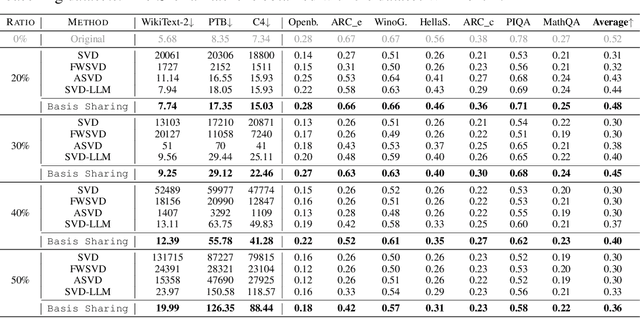


Large Language Models (LLMs) have achieved remarkable breakthroughs. However, the huge number of parameters in LLMs require significant amount of memory storage in inference, which prevents their practical deployment in many applications. To reduce memory storage of LLMs, singular value decomposition (SVD) provides a promising solution to approximate weight matrices for compressing LLMs. In this paper, we take a step further to explore parameter sharing across different layers with SVD to achieve more effective compression for LLMs. Specifically, weight matrices in different layers are decomposed and represented as a linear combination of a set of shared basis vectors and unique coefficients. The types of weight matrices and the layer selection for basis sharing are examined when compressing LLMs to maintain the performance. Comprehensive experiments demonstrate that Basis Sharing outperforms state-of-the-art SVD-based compression approaches and parameter sharing techniques, especially under large compression ratios. Code is available at: https://github.com/TUDa-HWAI/Basis_Sharing
BasisN: Reprogramming-Free RRAM-Based In-Memory-Computing by Basis Combination for Deep Neural Networks
Jul 04, 2024Deep neural networks (DNNs) have made breakthroughs in various fields including image recognition and language processing. DNNs execute hundreds of millions of multiply-and-accumulate (MAC) operations. To efficiently accelerate such computations, analog in-memory-computing platforms have emerged leveraging emerging devices such as resistive RAM (RRAM). However, such accelerators face the hurdle of being required to have sufficient on-chip crossbars to hold all the weights of a DNN. Otherwise, RRAM cells in the crossbars need to be reprogramed to process further layers, which causes huge time/energy overhead due to the extremely slow writing and verification of the RRAM cells. As a result, it is still not possible to deploy such accelerators to process large-scale DNNs in industry. To address this problem, we propose the BasisN framework to accelerate DNNs on any number of available crossbars without reprogramming. BasisN introduces a novel representation of the kernels in DNN layers as combinations of global basis vectors shared between all layers with quantized coefficients. These basis vectors are written to crossbars only once and used for the computations of all layers with marginal hardware modification. BasisN also provides a novel training approach to enhance computation parallelization with the global basis vectors and optimize the coefficients to construct the kernels. Experimental results demonstrate that cycles per inference and energy-delay product were reduced to below 1% compared with applying reprogramming on crossbars in processing large-scale DNNs such as DenseNet and ResNet on ImageNet and CIFAR100 datasets, while the training and hardware costs are negligible.