 Add to Chrome
 Add to Firefox
 Add to Edge
AnchorFlow: Editable SVG Reconstruction via Sparse Anchor Point Fields
May 19, 2026
Image-to-SVG reconstruction aims to produce vector graphics that are faithful to raster inputs and easy to edit. Existing methods face a structural trade-off in how vector structure is parameterized, including how many paths represent an image and how many anchor points define each path. High-fidelity methods often rely on many paths or densely parameterized curves, whereas overly compact SVG generation may deviate from the input geometry. This issue becomes more pronounced when local raster evidence is imperfect, where boundary-following reconstruction can introduce redundant anchors and fragmented structures. We argue that this trade-off should be addressed at the level of anchor placement, since anchors on Bezier curves define local path structure and strongly affect both accuracy and editability. We propose AnchorFlow, an editable SVG reconstruction framework that models path-level anchor placement with sparse anchor point fields. Given path-like foreground components extracted from a raster image, AnchorFlow predicts an image-conditioned sparse anchor field for each component and resolves it into an ordered Bezier path. Rendering-guided feedback then corrects local structural errors before re-resolution. The recovered paths are then assembled and optimized into the final SVG. Experiments on isolated paths and full images show that AnchorFlow achieves a favorable fidelity-editability trade-off, substantially reducing editable complexity while preserving competitive raster fidelity.

Class-Aware Pruning for Efficient Neural Networks
Dec 10, 2023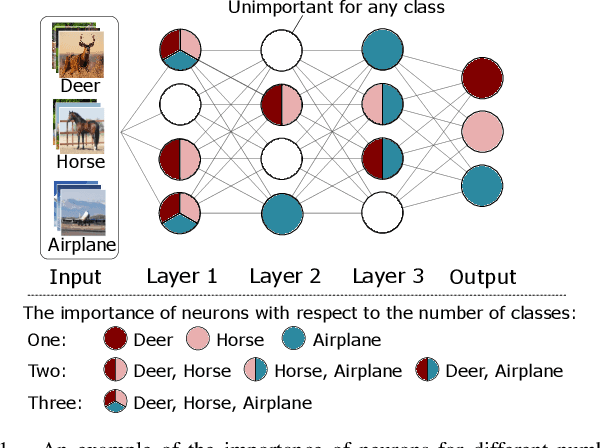
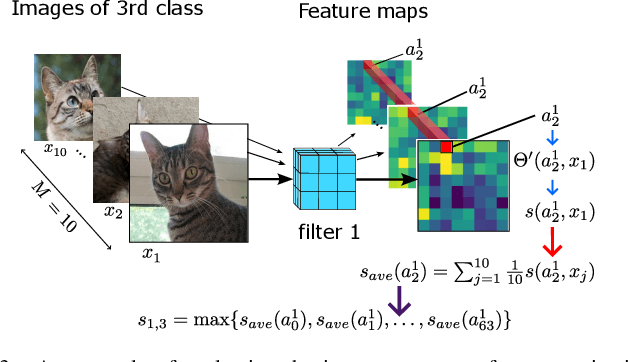
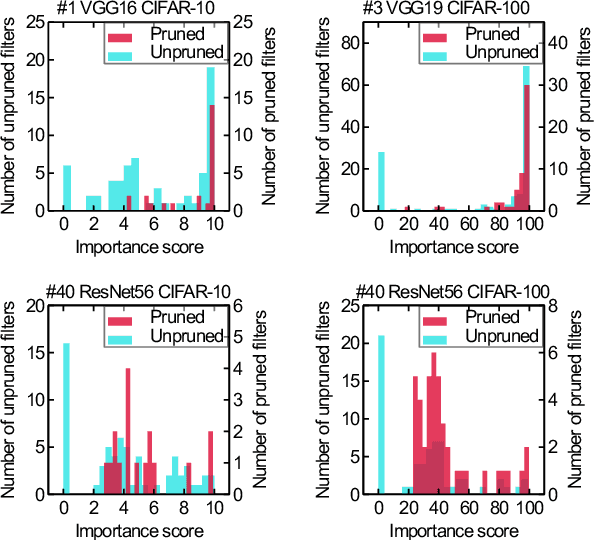
Deep neural networks (DNNs) have demonstrated remarkable success in various fields. However, the large number of floating-point operations (FLOPs) in DNNs poses challenges for their deployment in resource-constrained applications, e.g., edge devices. To address the problem, pruning has been introduced to reduce the computational cost in executing DNNs. Previous pruning strategies are based on weight values, gradient values and activation outputs. Different from previous pruning solutions, in this paper, we propose a class-aware pruning technique to compress DNNs, which provides a novel perspective to reduce the computational cost of DNNs. In each iteration, the neural network training is modified to facilitate the class-aware pruning. Afterwards, the importance of filters with respect to the number of classes is evaluated. The filters that are only important for a few number of classes are removed. The neural network is then retrained to compensate for the incurred accuracy loss. The pruning iterations end until no filter can be removed anymore, indicating that the remaining filters are very important for many classes. This pruning technique outperforms previous pruning solutions in terms of accuracy, pruning ratio and the reduction of FLOPs. Experimental results confirm that this class-aware pruning technique can significantly reduce the number of weights and FLOPs, while maintaining a high inference accuracy.