 Add to Chrome
 Add to Firefox
 Add to Edge
Can Cross-Layer Transcoders Replace Vision Transformer Activations? An Interpretable Perspective on Vision
Apr 14, 2026
Understanding the internal activations of Vision Transformers (ViTs) is critical for building interpretable and trustworthy models. While Sparse Autoencoders (SAEs) have been used to extract human-interpretable features, they operate on individual layers and fail to capture the cross-layer computational structure of Transformers, as well as the relative significance of each layer in forming the last-layer representation. Alternatively, we introduce the adoption of Cross-Layer Transcoders (CLTs) as reliable, sparse, and depth-aware proxy models for MLP blocks in ViTs. CLTs use an encoder-decoder scheme to reconstruct each post-MLP activation from learned sparse embeddings of preceding layers, yielding a linear decomposition that transforms the final representation of ViTs from an opaque embedding into an additive, layer-resolved construction that enables faithful attribution and process-level interpretability. We train CLTs on CLIP ViT-B/32 and ViT-B/16 across CIFAR-100, COCO, and ImageNet-100. We show that CLTs achieve high reconstruction fidelity with post-MLP activations while preserving and even improving, in some cases, CLIP zero-shot classification accuracy. In terms of interpretability, we show that the cross-layer contribution scores provide faithful attribution, revealing that the final representation is concentrated in a smaller set of dominant layer-wise terms whose removal degrades performance and whose retention largely preserves it. These results showcase the significance of adopting CLTs as an alternative interpretable proxy of ViTs in the vision domain.

LUCID-SAE: Learning Unified Vision-Language Sparse Codes for Interpretable Concept Discovery
Feb 07, 2026Sparse autoencoders (SAEs) offer a natural path toward comparable explanations across different representation spaces. However, current SAEs are trained per modality, producing dictionaries whose features are not directly understandable and whose explanations do not transfer across domains. In this study, we introduce LUCID (Learning Unified vision-language sparse Codes for Interpretable concept Discovery), a unified vision-language sparse autoencoder that learns a shared latent dictionary for image patch and text token representations, while reserving private capacity for modality-specific details. We achieve feature alignment by coupling the shared codes with a learned optimal transport matching objective without the need of labeling. LUCID yields interpretable shared features that support patch-level grounding, establish cross-modal neuron correspondence, and enhance robustness against the concept clustering problem in similarity-based evaluation. Leveraging the alignment properties, we develop an automated dictionary interpretation pipeline based on term clustering without manual observations. Our analysis reveals that LUCID's shared features capture diverse semantic categories beyond objects, including actions, attributes, and abstract concepts, demonstrating a comprehensive approach to interpretable multimodal representations.
Zero-Shot Cross-lingual Aphasia Detection using Automatic Speech Recognition
Apr 01, 2022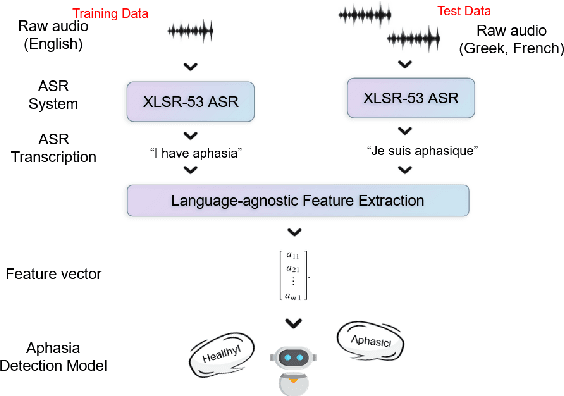
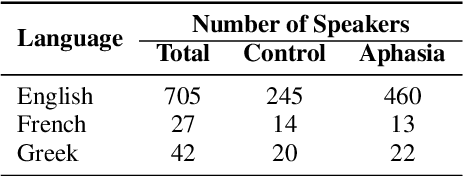
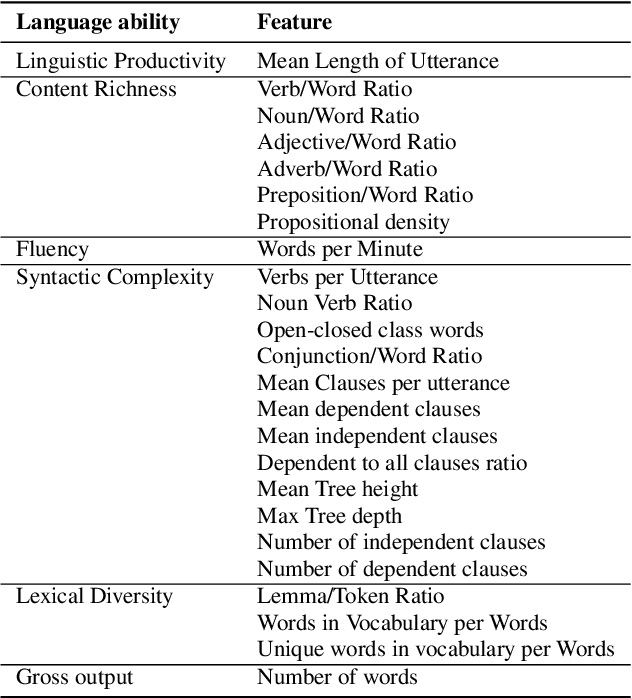
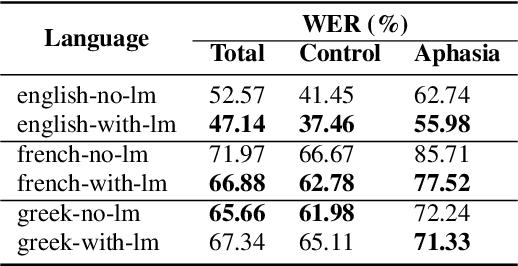
Aphasia is a common speech and language disorder, typically caused by a brain injury or a stroke, that affects millions of people worldwide. Detecting and assessing Aphasia in patients is a difficult, time-consuming process, and numerous attempts to automate it have been made, the most successful using machine learning models trained on aphasic speech data. Like in many medical applications, aphasic speech data is scarce and the problem is exacerbated in so-called "low resource" languages, which are, for this task, most languages excluding English. We attempt to leverage available data in English and achieve zero-shot aphasia detection in low-resource languages such as Greek and French, by using language-agnostic linguistic features. Current cross-lingual aphasia detection approaches rely on manually extracted transcripts. We propose an end-to-end pipeline using pre-trained Automatic Speech Recognition (ASR) models that share cross-lingual speech representations and are fine-tuned for our desired low-resource languages. To further boost our ASR model's performance, we also combine it with a language model. We show that our ASR-based end-to-end pipeline offers comparable results to previous setups using human-annotated transcripts.