 Add to Chrome
 Add to Firefox
 Add to Edge
Code Translation with Compiler Representations
Jul 13, 2022
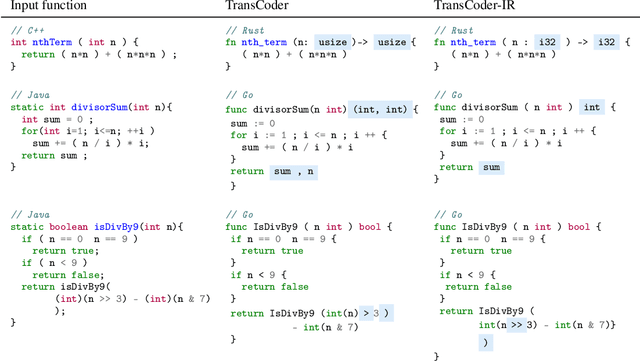
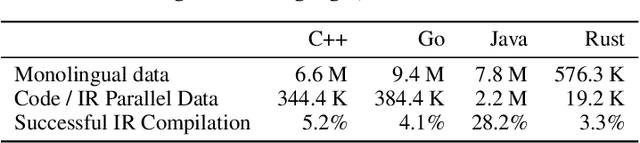
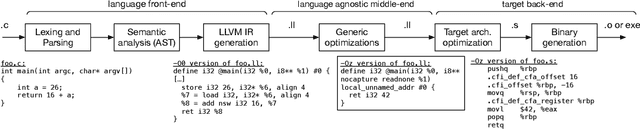
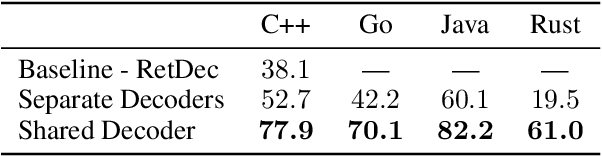
In this paper, we leverage low-level compiler intermediate representations (IR) to improve code translation. Traditional transpilers rely on syntactic information and handcrafted rules, which limits their applicability and produces unnatural-looking code. Applying neural machine translation (NMT) approaches to code has successfully broadened the set of programs on which one can get a natural-looking translation. However, they treat the code as sequences of text tokens, and still do not differentiate well enough between similar pieces of code which have different semantics in different languages. The consequence is low quality translation, reducing the practicality of NMT, and stressing the need for an approach significantly increasing its accuracy. Here we propose to augment code translation with IRs, specifically LLVM IR, with results on the C++, Java, Rust, and Go languages. Our method improves upon the state of the art for unsupervised code translation, increasing the number of correct translations by 11% on average, and up to 79% for the Java - Rust pair. We extend previous test sets for code translation, by adding hundreds of Go and Rust functions. Additionally, we train models with high performance on the problem of IR decompilation, generating programming source code from IR, and study using IRs as intermediary pivot for translation.

Flashlight: Enabling Innovation in Tools for Machine Learning
Jan 29, 2022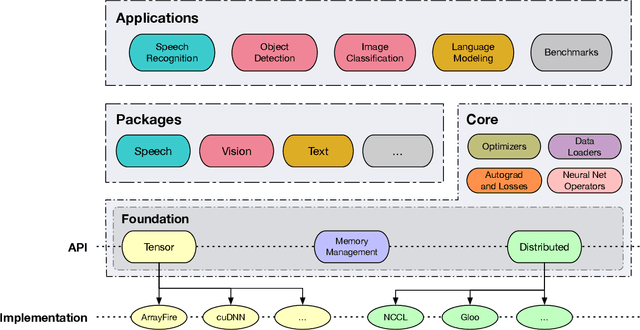
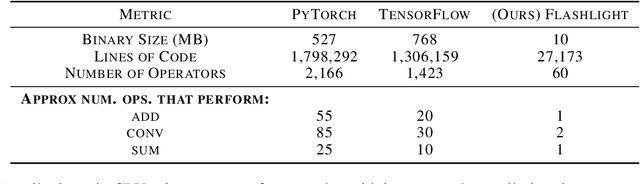
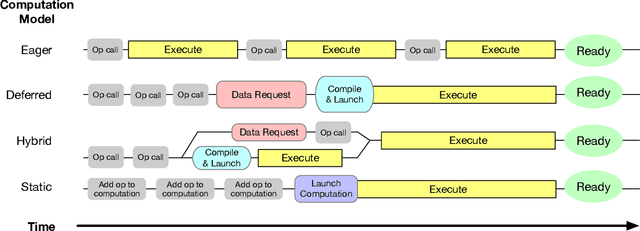
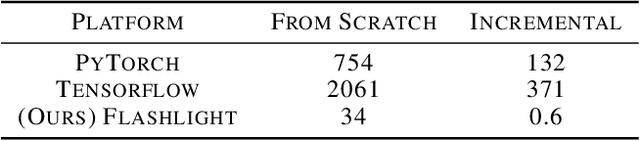
As the computational requirements for machine learning systems and the size and complexity of machine learning frameworks increases, essential framework innovation has become challenging. While computational needs have driven recent compiler, networking, and hardware advancements, utilization of those advancements by machine learning tools is occurring at a slower pace. This is in part due to the difficulties involved in prototyping new computational paradigms with existing frameworks. Large frameworks prioritize machine learning researchers and practitioners as end users and pay comparatively little attention to systems researchers who can push frameworks forward -- we argue that both are equally important stakeholders. We introduce Flashlight, an open-source library built to spur innovation in machine learning tools and systems by prioritizing open, modular, customizable internals and state-of-the-art, research-ready models and training setups across a variety of domains. Flashlight allows systems researchers to rapidly prototype and experiment with novel ideas in machine learning computation and has low overhead, competing with and often outperforming other popular machine learning frameworks. We see Flashlight as a tool enabling research that can benefit widely used libraries downstream and bring machine learning and systems researchers closer together.
Star Temporal Classification: Sequence Classification with Partially Labeled Data
Jan 28, 2022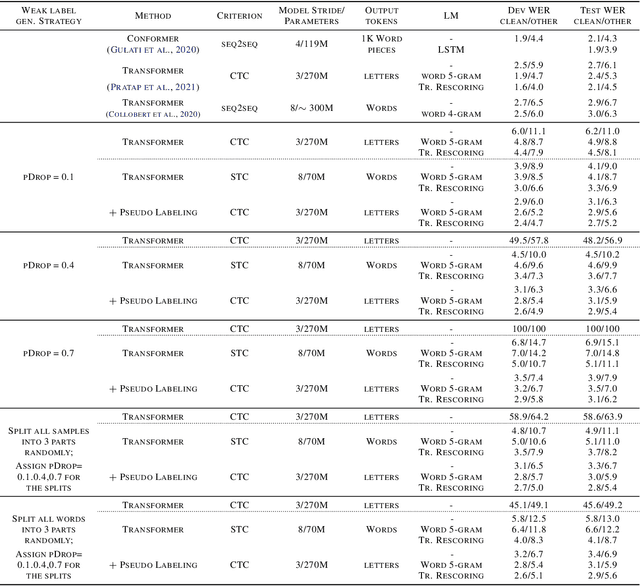
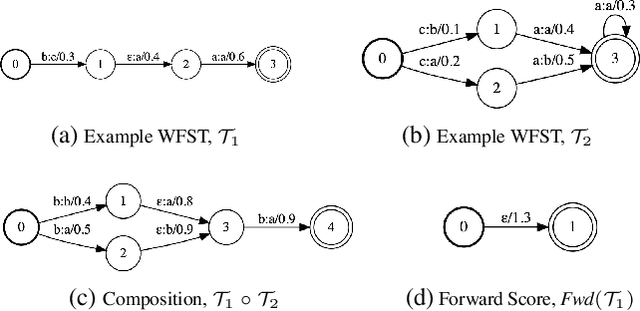
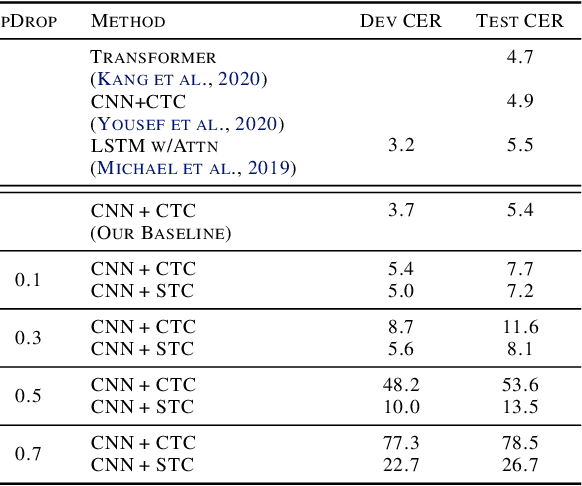
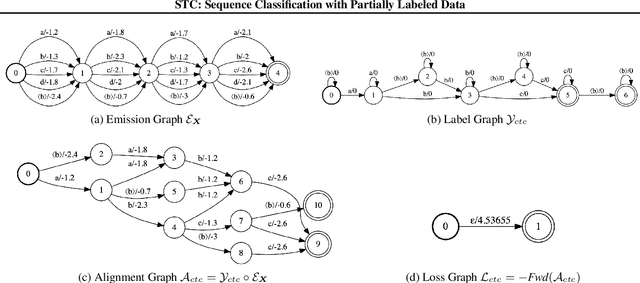
We develop an algorithm which can learn from partially labeled and unsegmented sequential data. Most sequential loss functions, such as Connectionist Temporal Classification (CTC), break down when many labels are missing. We address this problem with Star Temporal Classification (STC) which uses a special star token to allow alignments which include all possible tokens whenever a token could be missing. We express STC as the composition of weighted finite-state transducers (WFSTs) and use GTN (a framework for automatic differentiation with WFSTs) to compute gradients. We perform extensive experiments on automatic speech recognition. These experiments show that STC can recover most of the performance of supervised baseline when up to 70% of the labels are missing. We also perform experiments in handwriting recognition to show that our method easily applies to other sequence classification tasks.
Augmenting Convolutional networks with attention-based aggregation
Dec 27, 2021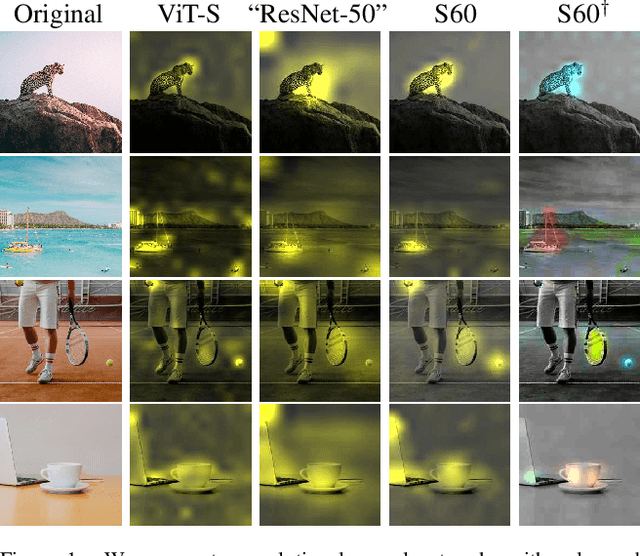
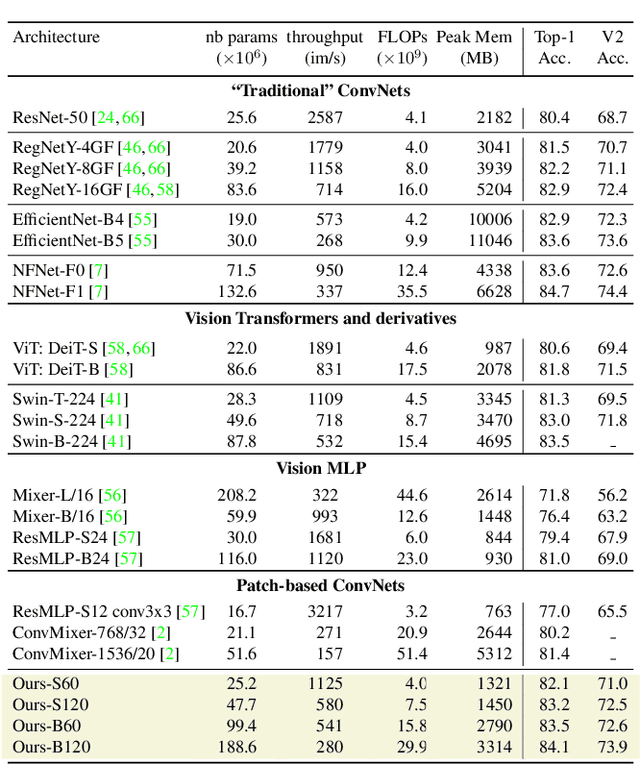
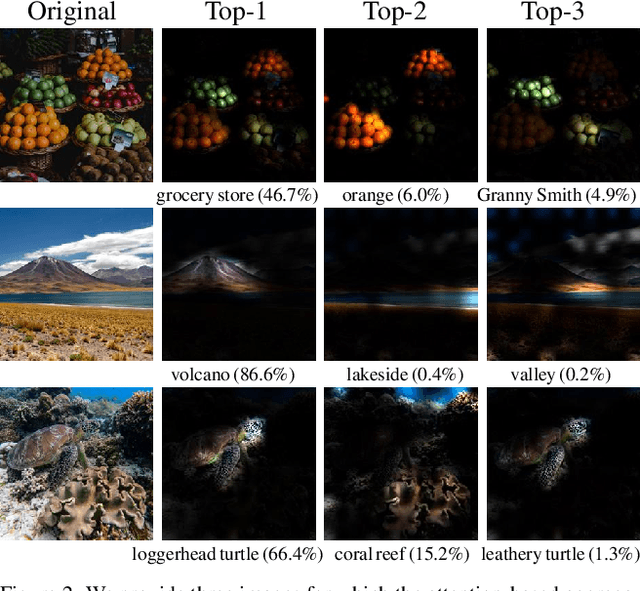
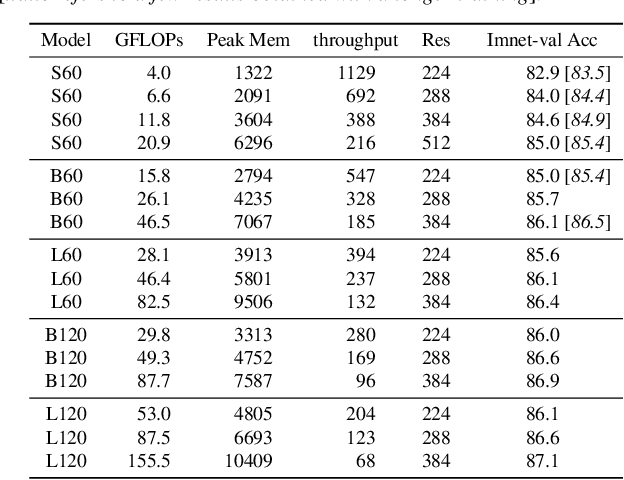
We show how to augment any convolutional network with an attention-based global map to achieve non-local reasoning. We replace the final average pooling by an attention-based aggregation layer akin to a single transformer block, that weights how the patches are involved in the classification decision. We plug this learned aggregation layer with a simplistic patch-based convolutional network parametrized by 2 parameters (width and depth). In contrast with a pyramidal design, this architecture family maintains the input patch resolution across all the layers. It yields surprisingly competitive trade-offs between accuracy and complexity, in particular in terms of memory consumption, as shown by our experiments on various computer vision tasks: object classification, image segmentation and detection.
Pseudo-Labeling for Massively Multilingual Speech Recognition
Oct 30, 2021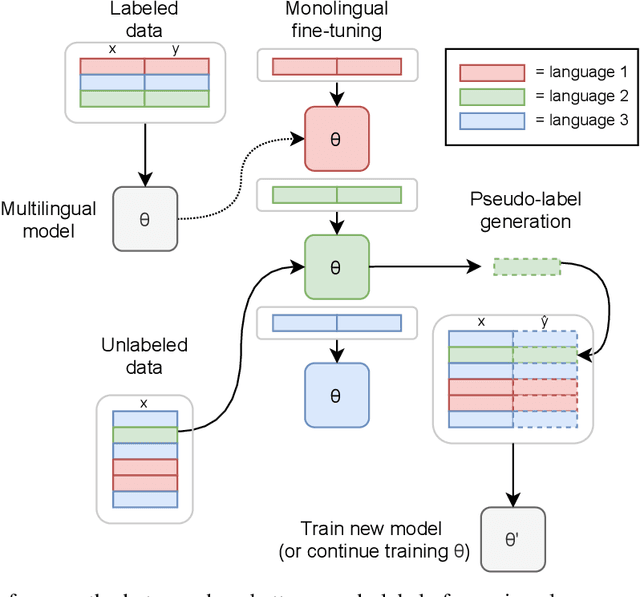
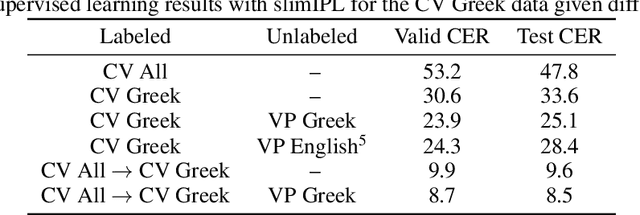
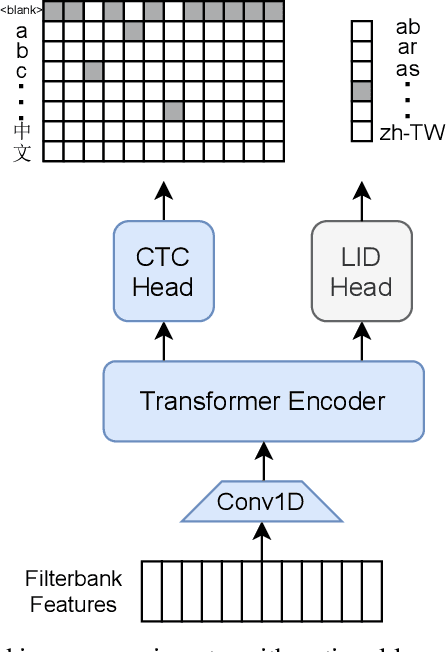
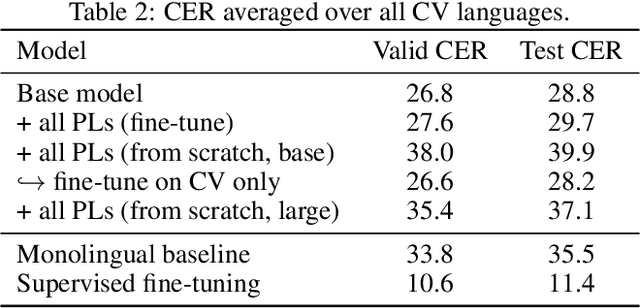
Semi-supervised learning through pseudo-labeling has become a staple of state-of-the-art monolingual speech recognition systems. In this work, we extend pseudo-labeling to massively multilingual speech recognition with 60 languages. We propose a simple pseudo-labeling recipe that works well even with low-resource languages: train a supervised multilingual model, fine-tune it with semi-supervised learning on a target language, generate pseudo-labels for that language, and train a final model using pseudo-labels for all languages, either from scratch or by fine-tuning. Experiments on the labeled Common Voice and unlabeled VoxPopuli datasets show that our recipe can yield a model with better performance for many languages that also transfers well to LibriSpeech.
Hierarchical Skills for Efficient Exploration
Oct 20, 2021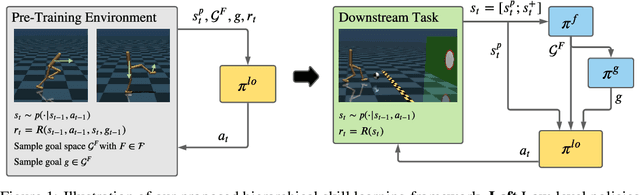
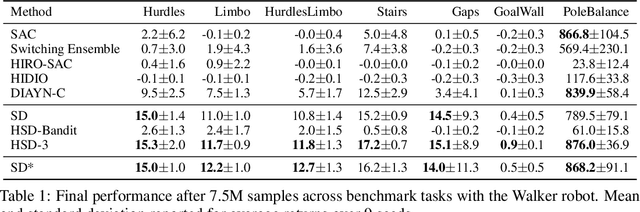
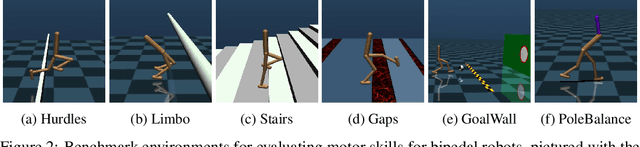
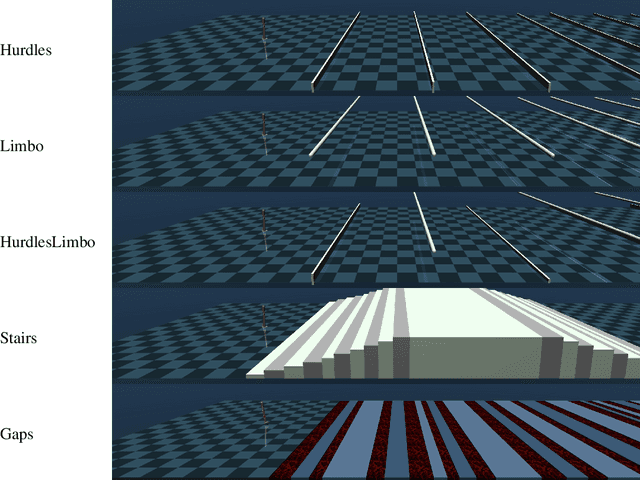
In reinforcement learning, pre-trained low-level skills have the potential to greatly facilitate exploration. However, prior knowledge of the downstream task is required to strike the right balance between generality (fine-grained control) and specificity (faster learning) in skill design. In previous work on continuous control, the sensitivity of methods to this trade-off has not been addressed explicitly, as locomotion provides a suitable prior for navigation tasks, which have been of foremost interest. In this work, we analyze this trade-off for low-level policy pre-training with a new benchmark suite of diverse, sparse-reward tasks for bipedal robots. We alleviate the need for prior knowledge by proposing a hierarchical skill learning framework that acquires skills of varying complexity in an unsupervised manner. For utilization on downstream tasks, we present a three-layered hierarchical learning algorithm to automatically trade off between general and specific skills as required by the respective task. In our experiments, we show that our approach performs this trade-off effectively and achieves better results than current state-of-the-art methods for end- to-end hierarchical reinforcement learning and unsupervised skill discovery. Code and videos are available at https://facebookresearch.github.io/hsd3 .
Word Order Does Not Matter For Speech Recognition
Oct 18, 2021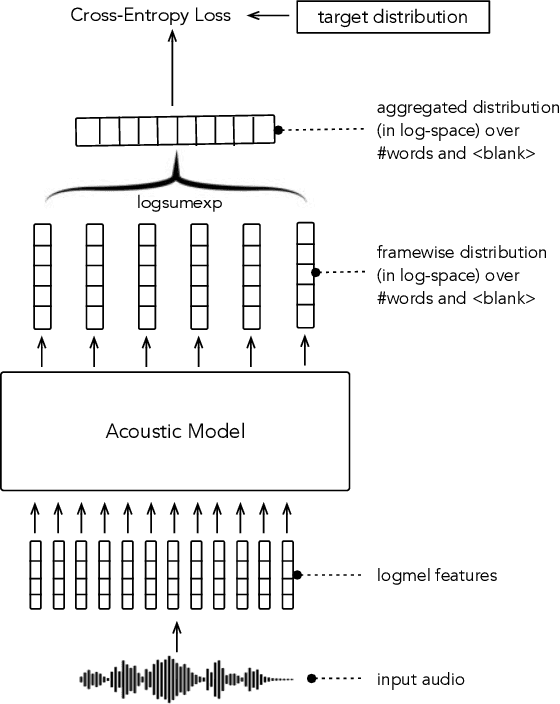
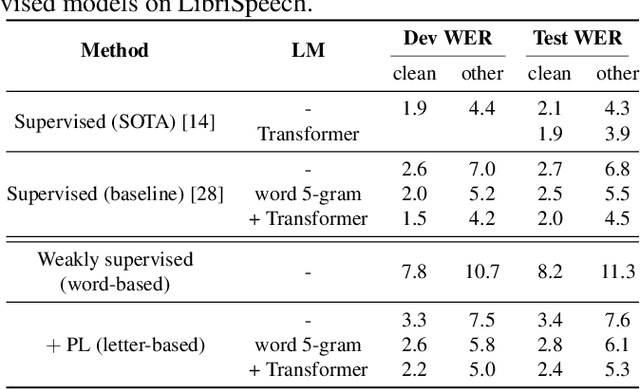
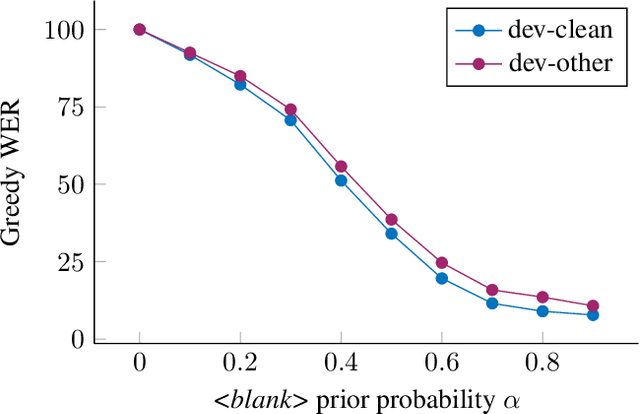
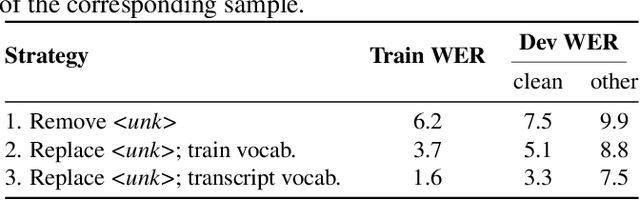
In this paper, we study training of automatic speech recognition system in a weakly supervised setting where the order of words in transcript labels of the audio training data is not known. We train a word-level acoustic model which aggregates the distribution of all output frames using LogSumExp operation and uses a cross-entropy loss to match with the ground-truth words distribution. Using the pseudo-labels generated from this model on the training set, we then train a letter-based acoustic model using Connectionist Temporal Classification loss. Our system achieves 2.3%/4.6% on test-clean/test-other subsets of LibriSpeech, which closely matches with the supervised baseline's performance.
ASR4REAL: An extended benchmark for speech models
Oct 16, 2021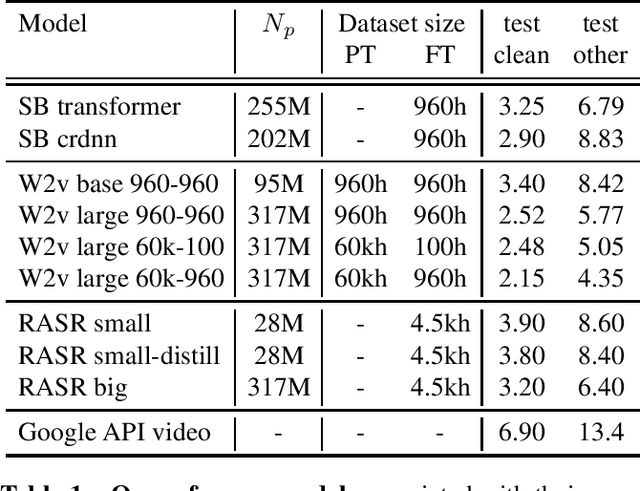
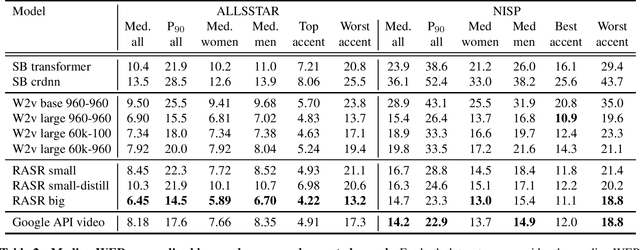
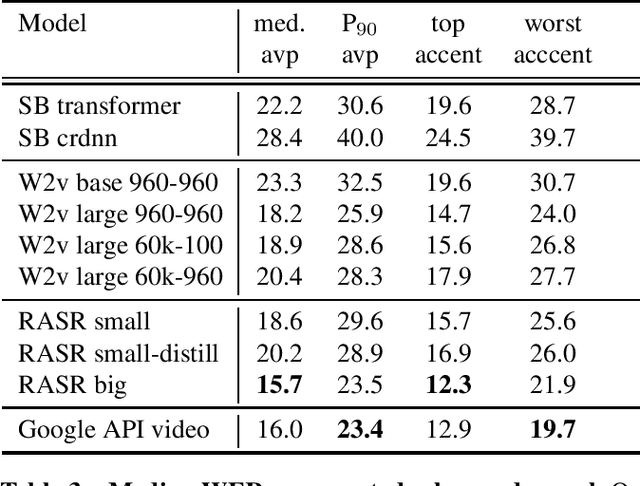
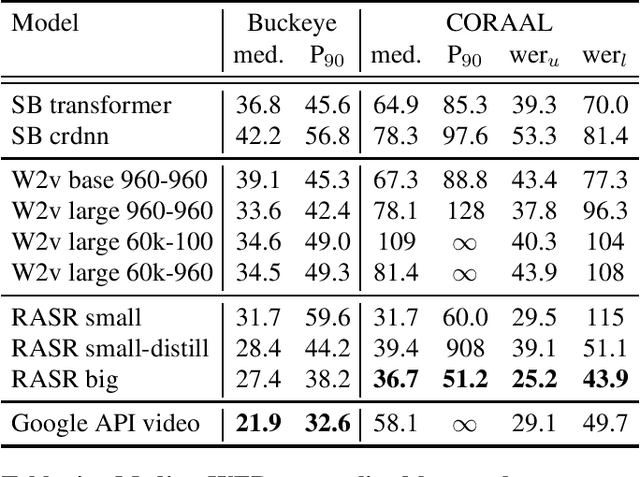
Popular ASR benchmarks such as Librispeech and Switchboard are limited in the diversity of settings and speakers they represent. We introduce a set of benchmarks matching real-life conditions, aimed at spotting possible biases and weaknesses in models. We have found out that even though recent models do not seem to exhibit a gender bias, they usually show important performance discrepancies by accent, and even more important ones depending on the socio-economic status of the speakers. Finally, all tested models show a strong performance drop when tested on conversational speech, and in this precise context even a language model trained on a dataset as big as Common Crawl does not seem to have significant positive effect which reiterates the importance of developing conversational language models
Leveraging Automated Unit Tests for Unsupervised Code Translation
Oct 13, 2021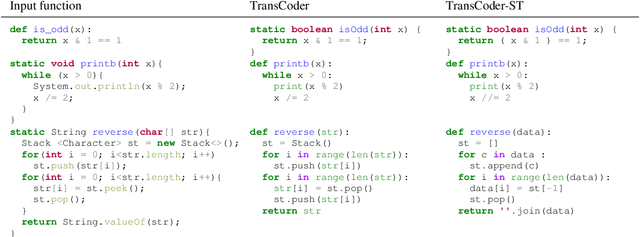
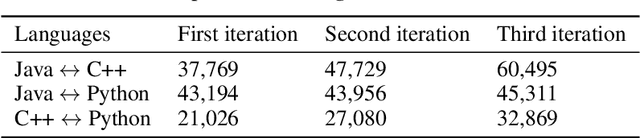
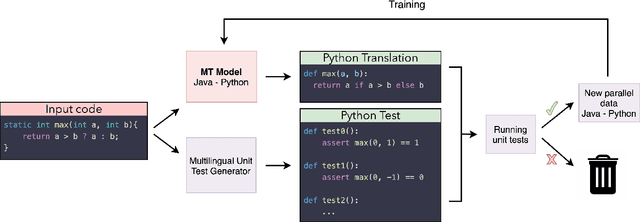
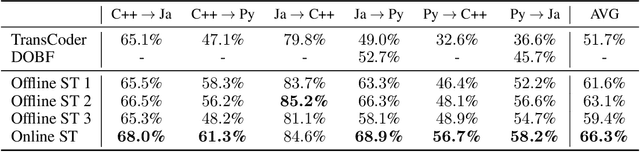
With little to no parallel data available for programming languages, unsupervised methods are well-suited to source code translation. However, the majority of unsupervised machine translation approaches rely on back-translation, a method developed in the context of natural language translation and one that inherently involves training on noisy inputs. Unfortunately, source code is highly sensitive to small changes; a single token can result in compilation failures or erroneous programs, unlike natural languages where small inaccuracies may not change the meaning of a sentence. To address this issue, we propose to leverage an automated unit-testing system to filter out invalid translations, thereby creating a fully tested parallel corpus. We found that fine-tuning an unsupervised model with this filtered data set significantly reduces the noise in the translations so-generated, comfortably outperforming the state-of-the-art for all language pairs studied. In particular, for Java $\to$ Python and Python $\to$ C++ we outperform the best previous methods by more than 16% and 24% respectively, reducing the error rate by more than 35%.
XCiT: Cross-Covariance Image Transformers
Jun 18, 2021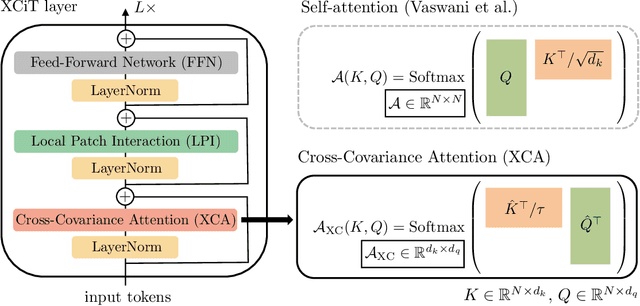
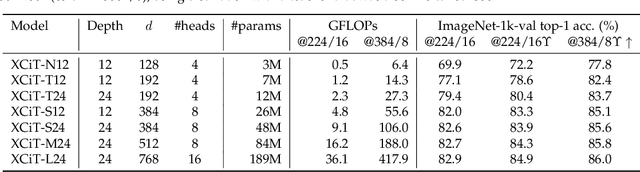
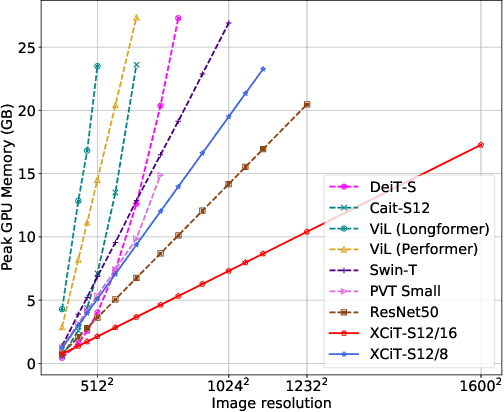
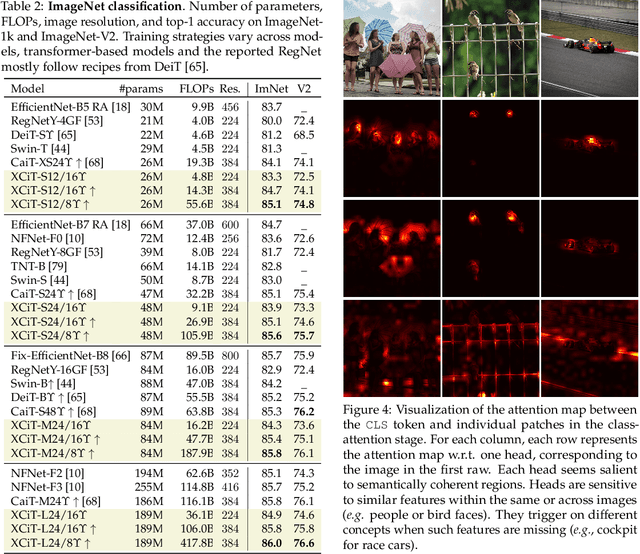
Following their success in natural language processing, transformers have recently shown much promise for computer vision. The self-attention operation underlying transformers yields global interactions between all tokens ,i.e. words or image patches, and enables flexible modelling of image data beyond the local interactions of convolutions. This flexibility, however, comes with a quadratic complexity in time and memory, hindering application to long sequences and high-resolution images. We propose a "transposed" version of self-attention that operates across feature channels rather than tokens, where the interactions are based on the cross-covariance matrix between keys and queries. The resulting cross-covariance attention (XCA) has linear complexity in the number of tokens, and allows efficient processing of high-resolution images. Our cross-covariance image transformer (XCiT) is built upon XCA. It combines the accuracy of conventional transformers with the scalability of convolutional architectures. We validate the effectiveness and generality of XCiT by reporting excellent results on multiple vision benchmarks, including image classification and self-supervised feature learning on ImageNet-1k, object detection and instance segmentation on COCO, and semantic segmentation on ADE20k.