 Add to Chrome
 Add to Firefox
 Add to Edge
Superficial Beliefs in LLM Decision-Making
Jun 09, 2026
We ask whether large language models (LLMs) merely imitate rationales when choosing between two options, or whether their choices reflect a systematic underlying decision structure. Using synthetic binary decision settings in which models choose between profiles defined by graded attributes, we compare the attribute a model says mattered most with the attribute that best explains its choice under a behavioural model fit to prior decisions. The behavioural model predicts held-out choices well, showing that model behaviour is systematically related to the visible attributes rather than being random. However, direct self-reports and a separate score-based judge recover the behaviourally inferred driver only partially. The resulting picture is neither one of arbitrary behaviour nor one of fully articulated belief - outputs are structured enough to support prediction, but explicit reasons track the recovered driver only imperfectly. This qualitative pattern persists across prompt-order and sampling perturbations, alternative behavioural models, targeted occlusion analyses, and structurally varied decision settings. We interpret this as evidence for ``superficial belief'' in LLM decision-making: models behave as if guided by probabilistic local priorities over attributes, while having only limited verbal access to the attributes that drive their decisions.

Neurosymbolic Learning for Inference-Time Argumentation
May 19, 2026Claim verification is an important problem in high-stakes settings, including health and finance. When information underpinning claims is incomplete or conflicting, uncertain answers may be more appropriate than binary true or false classifications. In all cases, faithful explanations of the considerations determining the final verdict are crucial. We introduce inference-time argumentation (ITA), a trainable neurosymbolic framework for ternary claim verification in which a formal argumentation semantics giving the strength of claims is used both (i) to guide LLM training as models learn to generate arguments and assign them base scores (representing intrinsic strengths) and (ii) to compute ternary (true/false/uncertain) predictions from generated, scored arguments. As a result, at training time, argument generation and scoring can be optimised according to the quality of the induced argumentative predictions. Moreover, at inference time, the final prediction is faithful, by construction, to the arguments and scores determining the verdict, rather than being justified by a potentially unfaithful post-hoc reasoning trace as in conventional reasoning models. We finally show that, on two datasets for ternary claim verification, ITA improves upon argumentative baselines and can perform competitively against non-argumentative direct-prediction baselines, while providing verdicts that are computed deterministically from explicit, inspectable argumentative structures.
Exploring the Potential for Large Language Models to Demonstrate Rational Probabilistic Beliefs
Apr 18, 2025Advances in the general capabilities of large language models (LLMs) have led to their use for information retrieval, and as components in automated decision systems. A faithful representation of probabilistic reasoning in these models may be essential to ensure trustworthy, explainable and effective performance in these tasks. Despite previous work suggesting that LLMs can perform complex reasoning and well-calibrated uncertainty quantification, we find that current versions of this class of model lack the ability to provide rational and coherent representations of probabilistic beliefs. To demonstrate this, we introduce a novel dataset of claims with indeterminate truth values and apply a number of well-established techniques for uncertainty quantification to measure the ability of LLM's to adhere to fundamental properties of probabilistic reasoning.
Pub-Guard-LLM: Detecting Fraudulent Biomedical Articles with Reliable Explanations
Feb 21, 2025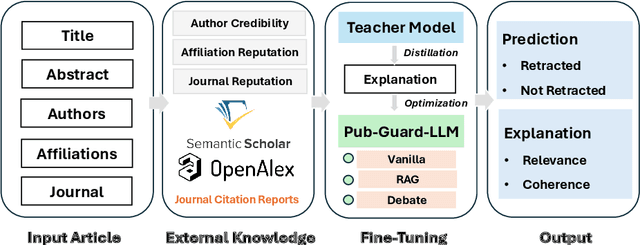



A significant and growing number of published scientific articles is found to involve fraudulent practices, posing a serious threat to the credibility and safety of research in fields such as medicine. We propose Pub-Guard-LLM, the first large language model-based system tailored to fraud detection of biomedical scientific articles. We provide three application modes for deploying Pub-Guard-LLM: vanilla reasoning, retrieval-augmented generation, and multi-agent debate. Each mode allows for textual explanations of predictions. To assess the performance of our system, we introduce an open-source benchmark, PubMed Retraction, comprising over 11K real-world biomedical articles, including metadata and retraction labels. We show that, across all modes, Pub-Guard-LLM consistently surpasses the performance of various baselines and provides more reliable explanations, namely explanations which are deemed more relevant and coherent than those generated by the baselines when evaluated by multiple assessment methods. By enhancing both detection performance and explainability in scientific fraud detection, Pub-Guard-LLM contributes to safeguarding research integrity with a novel, effective, open-source tool.
Contestable AI needs Computational Argumentation
May 17, 2024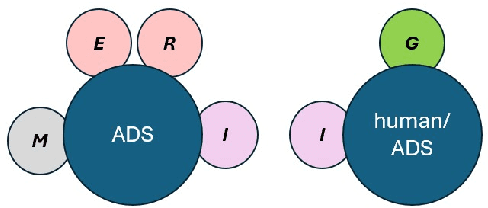
AI has become pervasive in recent years, but state-of-the-art approaches predominantly neglect the need for AI systems to be contestable. Instead, contestability is advocated by AI guidelines (e.g. by the OECD) and regulation of automated decision-making (e.g. GDPR). In this position paper we explore how contestability can be achieved computationally in and for AI. We argue that contestable AI requires dynamic (human-machine and/or machine-machine) explainability and decision-making processes, whereby machines can (i) interact with humans and/or other machines to progressively explain their outputs and/or their reasoning as well as assess grounds for contestation provided by these humans and/or other machines, and (ii) revise their decision-making processes to redress any issues successfully raised during contestation. Given that much of the current AI landscape is tailored to static AIs, the need to accommodate contestability will require a radical rethinking, that, we argue, computational argumentation is ideally suited to support.
Argumentative Large Language Models for Explainable and Contestable Decision-Making
May 03, 2024The diversity of knowledge encoded in large language models (LLMs) and their ability to apply this knowledge zero-shot in a range of settings makes them a promising candidate for use in decision-making. However, they are currently limited by their inability to reliably provide outputs which are explainable and contestable. In this paper, we attempt to reconcile these strengths and weaknesses by introducing a method for supplementing LLMs with argumentative reasoning. Concretely, we introduce argumentative LLMs, a method utilising LLMs to construct argumentation frameworks, which then serve as the basis for formal reasoning in decision-making. The interpretable nature of these argumentation frameworks and formal reasoning means that any decision made by the supplemented LLM may be naturally explained to, and contested by, humans. We demonstrate the effectiveness of argumentative LLMs experimentally in the decision-making task of claim verification. We obtain results that are competitive with, and in some cases surpass, comparable state-of-the-art techniques.