 Add to Chrome
 Add to Firefox
 Add to Edge
Efficient bias mitigation in T2I diffusion models using Concept Graphs
Jul 03, 2026
Text-to-Image diffusion models often propagate harmful bias inherited from the training data. Existing bias mitigation techniques typically intervene only at the text encoder or provide inference-time guidance, often leading to generations that collapse into semantically incoherent outputs. To address these limitations, we introduce CO-ALIGN (Concept Ontology Alignment), a novel bias mitigation approach based on concept-graph alignment that operates on the model's internal concept ontology. By aligning concepts within the text encoder and denoiser, CO-ALIGN achieves substantial bias reduction while preserving generative integrity. We demonstrate the effectiveness of concept-graph alignment across three paradigms: text-encoders, denoisers and joint text-denoiser ontology alignment. CO-ALIGN outperforms the state of the art, improving fairness by $30\%$, $ΔFID=11.4$ in image quality, $2.8\%$ in image fidelity, all while reducing semantically incoherent outputs by $88\%$. Beyond bias mitigation, we show that CO-ALIGN benefits other downstream tasks as well. In particular, our experiments demonstrate that better-aligned internal ontologies enhance concept unlearning robustness across multiple unlearning techniques.

Neurosymbolic Learning for Inference-Time Argumentation
May 19, 2026Claim verification is an important problem in high-stakes settings, including health and finance. When information underpinning claims is incomplete or conflicting, uncertain answers may be more appropriate than binary true or false classifications. In all cases, faithful explanations of the considerations determining the final verdict are crucial. We introduce inference-time argumentation (ITA), a trainable neurosymbolic framework for ternary claim verification in which a formal argumentation semantics giving the strength of claims is used both (i) to guide LLM training as models learn to generate arguments and assign them base scores (representing intrinsic strengths) and (ii) to compute ternary (true/false/uncertain) predictions from generated, scored arguments. As a result, at training time, argument generation and scoring can be optimised according to the quality of the induced argumentative predictions. Moreover, at inference time, the final prediction is faithful, by construction, to the arguments and scores determining the verdict, rather than being justified by a potentially unfaithful post-hoc reasoning trace as in conventional reasoning models. We finally show that, on two datasets for ternary claim verification, ITA improves upon argumentative baselines and can perform competitively against non-argumentative direct-prediction baselines, while providing verdicts that are computed deterministically from explicit, inspectable argumentative structures.
Selective Fine-Tuning for Targeted and Robust Concept Unlearning
Feb 08, 2026Text guided diffusion models are used by millions of users, but can be easily exploited to produce harmful content. Concept unlearning methods aim at reducing the models' likelihood of generating harmful content. Traditionally, this has been tackled at an individual concept level, with only a handful of recent works considering more realistic concept combinations. However, state of the art methods depend on full finetuning, which is computationally expensive. Concept localisation methods can facilitate selective finetuning, but existing techniques are static, resulting in suboptimal utility. In order to tackle these challenges, we propose TRUST (Targeted Robust Selective fine Tuning), a novel approach for dynamically estimating target concept neurons and unlearning them through selective finetuning, empowered by a Hessian based regularization. We show experimentally, against a number of SOTA baselines, that TRUST is robust against adversarial prompts, preserves generation quality to a significant degree, and is also significantly faster than the SOTA. Our method achieves unlearning of not only individual concepts but also combinations of concepts and conditional concepts, without any specific regularization.
AmalREC: A Dataset for Relation Extraction and Classification Leveraging Amalgamation of Large Language Models
Dec 29, 2024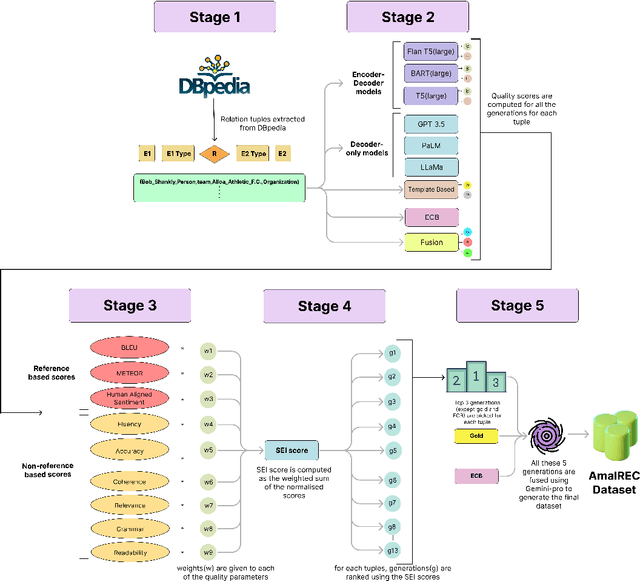


Existing datasets for relation classification and extraction often exhibit limitations such as restricted relation types and domain-specific biases. This work presents a generic framework to generate well-structured sentences from given tuples with the help of Large Language Models (LLMs). This study has focused on the following major questions: (i) how to generate sentences from relation tuples, (ii) how to compare and rank them, (iii) can we combine strengths of individual methods and amalgamate them to generate an even bette quality of sentences, and (iv) how to evaluate the final dataset? For the first question, we employ a multifaceted 5-stage pipeline approach, leveraging LLMs in conjunction with template-guided generation. We introduce Sentence Evaluation Index(SEI) that prioritizes factors like grammatical correctness, fluency, human-aligned sentiment, accuracy, and complexity to answer the first part of the second question. To answer the second part of the second question, this work introduces a SEI-Ranker module that leverages SEI to select top candidate generations. The top sentences are then strategically amalgamated to produce the final, high-quality sentence. Finally, we evaluate our dataset on LLM-based and SOTA baselines for relation classification. The proposed dataset features 255 relation types, with 15K sentences in the test set and around 150k in the train set organized in, significantly enhancing relational diversity and complexity. This work not only presents a new comprehensive benchmark dataset for RE/RC task, but also compare different LLMs for generation of quality sentences from relational tuples.