 Add to Chrome
 Add to Firefox
 Add to Edge
Distortion-Resilient Robotic Imitation Learning for Autonomous Cable Routing
Jun 10, 2026
The rapid development of intelligent control methodologies has endowed robots with powerful autonomous intelligence. Cable routing, a ubiquitous foundational task in industry, provides a rigorous benchmark for robotic dexterity and sequential decision-making. In these practical scenarios, image observation distortion frequently occurs. Samples characterized by low-quality image observations often hinder accurate model training, posing challenges to the reliability and accuracy of intelligent control systems. Nevertheless, no dedicated intelligent control solution has been proposed for scenarios of image signal distortion. Meanwhile, image quality information has not been sufficiently exploited to further enhance the performance of intelligent control methodologies. To this end, we propose a novel robotic imitation learning framework that comprises an image quality assessment module, a confidence-based learning mechanism, and a decision-making module, which is designed to maintain high performance even under distorted image observations. In the proposed framework, the image quality assessment module synergizes with the confidence-based learning mechanism to enhance the efficacy of the decision-making module. Specifically, the image quality assessment module is incorporated to extract image quality information from image observations, while the confidence-based learning mechanism adaptively prioritizes challenging samples to improve learning effectiveness. The decision-making module determines appropriate discrete skills or continuous actions. Experimental results demonstrate that our formulated framework enhances the overall performance of the decision-making module.

SDD-FIQA: Unsupervised Face Image Quality Assessment with Similarity Distribution Distance
Mar 10, 2021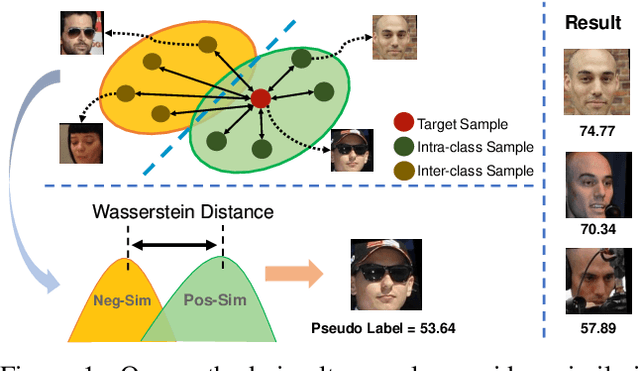
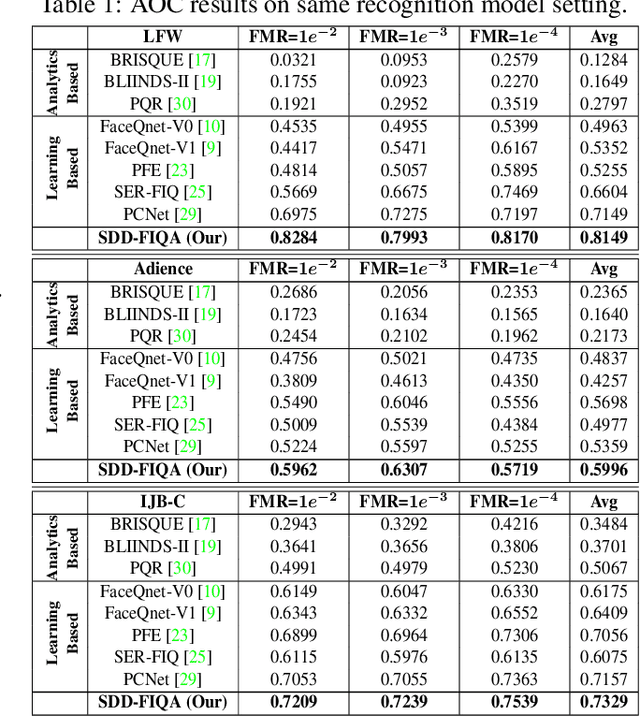
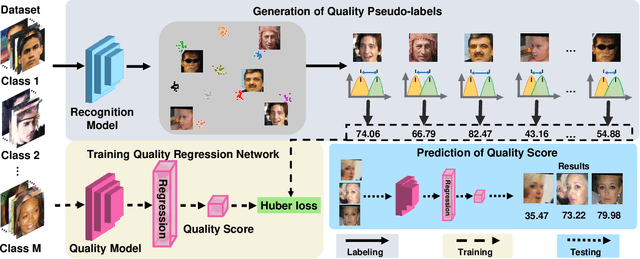
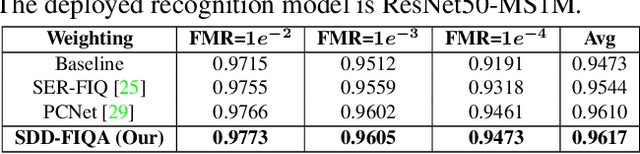
In recent years, Face Image Quality Assessment (FIQA) has become an indispensable part of the face recognition system to guarantee the stability and reliability of recognition performance in an unconstrained scenario. For this purpose, the FIQA method should consider both the intrinsic property and the recognizability of the face image. Most previous works aim to estimate the sample-wise embedding uncertainty or pair-wise similarity as the quality score, which only considers the information from partial intra-class. However, these methods ignore the valuable information from the inter-class, which is for estimating to the recognizability of face image. In this work, we argue that a high-quality face image should be similar to its intra-class samples and dissimilar to its inter-class samples. Thus, we propose a novel unsupervised FIQA method that incorporates Similarity Distribution Distance for Face Image Quality Assessment (SDD-FIQA). Our method generates quality pseudo-labels by calculating the Wasserstein Distance (WD) between the intra-class similarity distributions and inter-class similarity distributions. With these quality pseudo-labels, we are capable of training a regression network for quality prediction. Extensive experiments on benchmark datasets demonstrate that the proposed SDD-FIQA surpasses the state-of-the-arts by an impressive margin. Meanwhile, our method shows good generalization across different recognition systems.
Controllable List-wise Ranking for Universal No-reference Image Quality Assessment
Jan 06, 2020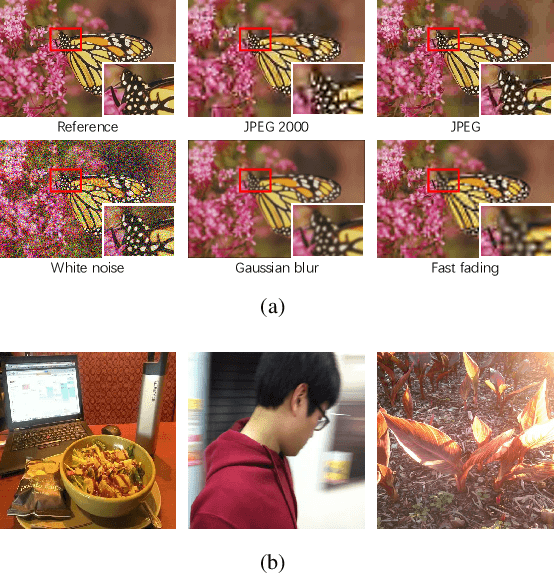
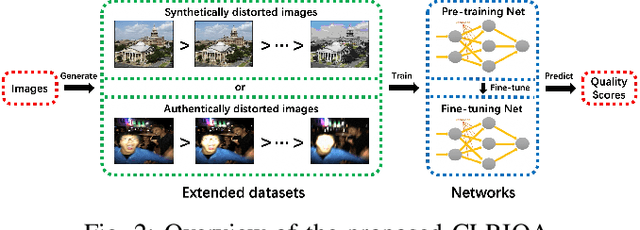
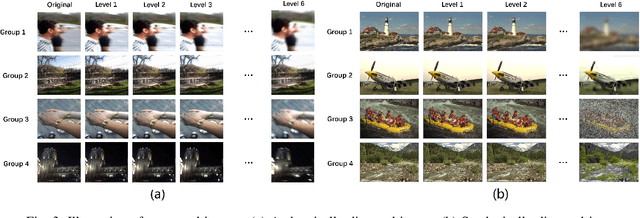
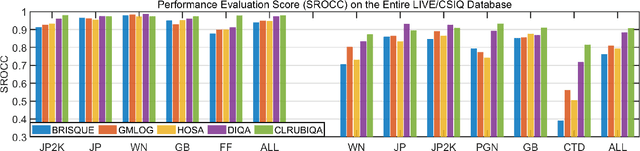
No-reference image quality assessment (NR-IQA) has received increasing attention in the IQA community since reference image is not always available. Real-world images generally suffer from various types of distortion. Unfortunately, existing NR-IQA methods do not work with all types of distortion. It is a challenging task to develop universal NR-IQA that has the ability of evaluating all types of distorted images. In this paper, we propose a universal NR-IQA method based on controllable list-wise ranking (CLRIQA). First, to extend the authentically distorted image dataset, we present an imaging-heuristic approach, in which the over-underexposure is formulated as an inverse of Weber-Fechner law, and fusion strategy and probabilistic compression are adopted, to generate the degraded real-world images. These degraded images are label-free yet associated with quality ranking information. We then design a controllable list-wise ranking function by limiting rank range and introducing an adaptive margin to tune rank interval. Finally, the extended dataset and controllable list-wise ranking function are used to pre-train a CNN. Moreover, in order to obtain an accurate prediction model, we take advantage of the original dataset to further fine-tune the pre-trained network. Experiments evaluated on four benchmark datasets (i.e. LIVE, CSIQ, TID2013, and LIVE-C) show that the proposed CLRIQA improves the state of the art by over 9% in terms of overall performance. The code and model are publicly available at https://github.com/GZHU-Image-Lab/CLRIQA.