 Add to Chrome
 Add to Firefox
 Add to Edge
From Plausible to Actionable: A Position on LLM Self-Explanations
Jul 17, 2026
Large Language Models (LLMs) can generate natural language explanations that rationalize their own decisions, a phenomenon commonly referred to as self-explanations.Such explanations have emerged as a promising direction for explainable artificial intelligence (XAI), particularly for interpreting LLM behavior.However, while self-explanations often appear plausible, whether they faithfully reflect a model's underlying reasoning process remains an open question. In this opinion paper, we argue that self-explanations can be highly plausible, questionably faithful, and yet highly actionable. From a traditional XAI perspective, we identify the limitations of standard evaluation protocols for LLM-generated self-explanations and propose practical guidelines for assessing their plausibility and faithfulness. Moreover, we argue that evaluation should extend beyond these criteria to actionability, highlighting applications of LLM rationalization capabilities that support informed decision-making and appropriate action across diverse stakeholders.

Explainable AI for Cancer Drug Response Prediction: Beyond Univariate Feature Attributions
Jul 01, 2026Predicting cancer drug response from transcriptomic profiles is a cornerstone of precision oncology, yet the scientific value of machine learning models hinges not solely on predictive accuracy, but also on their capacity to generate reliable biological insights. Current explainability approaches in this setting are computationally costly, lack robustness, and reduce complex drug response to univariate gene importance scores, overlooking the coordinated gene activity that drives sensitivity and resistance. In this work, we present ILLUME+, a scalable post-hoc explainability framework that moves beyond single-gene assessments to capture multiple, complementary forms of explanation. Integrated into our end-to-end pipeline, ILLUME+ produces more stable gene importance scores than existing baselines, recovers established drug-gene associations and mechanisms of action, and enables AI-assisted hypothesis generation to uncover novel interaction-driven molecular signals in cancer biology.
Disagreeing Rationales: Rethinking Classification and Explainability Evaluation in Hate Speech Detection
May 29, 2026Human disagreement is ubiquitous and well-known in labeling. However, variation in explanations, captured through token-level human rationales, remains far less explored. At the same time, it is unclear how to best evaluate human labels and rationales -- or even how to best aggregate rationales beyond majority vote -- in light of this variation. Yet, rationales may provide additional insights into the richness of human reasoning, that may differ in style, values and interpretations -- especially in subjective NLP tasks like hate speech detection. In this work, we unify diverse models, training strategies, loss functions, and existing evaluation metrics under a single protocol by systematically re-implementing them across different label and rationale representation spaces. Classification metrics are organized around two key properties -- predictive and distributional -- while explainability metrics through three complementary dimensions: plausibility, faithfulness, and complexity. In this unified supervision framework, we evaluate model behavior across classification and explainability metrics, as well as metric sensitivity to the choice of label (hard and soft) and rationale representation space (hard, intermediate and soft). Results show that both hard and soft metrics favor softer representations, highlighting their effectiveness in capturing variation and the need to rethink evaluation in subjective NLP.
The Diversity Paradox revisited: Systemic Effects of Feedback Loops in Recommender Systems
Feb 18, 2026Recommender systems shape individual choices through feedback loops in which user behavior and algorithmic recommendations coevolve over time. The systemic effects of these loops remain poorly understood, in part due to unrealistic assumptions in existing simulation studies. We propose a feedback-loop model that captures implicit feedback, periodic retraining, probabilistic adoption of recommendations, and heterogeneous recommender systems. We apply the framework on online retail and music streaming data and analyze systemic effects of the feedback loop. We find that increasing recommender adoption may lead to a progressive diversification of individual consumption, while collective demand is redistributed in model- and domain-dependent ways, often amplifying popularity concentration. Temporal analyses further reveal that apparent increases in individual diversity observed in static evaluations are illusory: when adoption is fixed and time unfolds, individual diversity consistently decreases across all models. Our results highlight the need to move beyond static evaluations and explicitly account for feedback-loop dynamics when designing recommender systems.
Position: Explaining Behavioral Shifts in Large Language Models Requires a Comparative Approach
Feb 02, 2026Large-scale foundation models exhibit behavioral shifts: intervention-induced behavioral changes that appear after scaling, fine-tuning, reinforcement learning or in-context learning. While investigating these phenomena have recently received attention, explaining their appearance is still overlooked. Classic explainable AI (XAI) methods can surface failures at a single checkpoint of a model, but they are structurally ill-suited to justify what changed internally across different checkpoints and which explanatory claims are warranted about that change. We take the position that behavioral shifts should be explained comparatively: the core target should be the intervention-induced shift between a reference model and an intervened model, rather than any single model in isolation. To this aim we formulate a Comparative XAI ($Δ$-XAI) framework with a set of desiderata to be taken into account when designing proper explaining methods. To highlight how $Δ$-XAI methods work, we introduce a set of possible pipelines, relate them to the desiderata, and provide a concrete $Δ$-XAI experiment.
Bridging the Gap: In-Context Learning for Modeling Human Disagreement
Jun 06, 2025Large Language Models (LLMs) have shown strong performance on NLP classification tasks. However, they typically rely on aggregated labels-often via majority voting-which can obscure the human disagreement inherent in subjective annotations. This study examines whether LLMs can capture multiple perspectives and reflect annotator disagreement in subjective tasks such as hate speech and offensive language detection. We use in-context learning (ICL) in zero-shot and few-shot settings, evaluating four open-source LLMs across three label modeling strategies: aggregated hard labels, and disaggregated hard and soft labels. In few-shot prompting, we assess demonstration selection methods based on textual similarity (BM25, PLM-based), annotation disagreement (entropy), a combined ranking, and example ordering strategies (random vs. curriculum-based). Results show that multi-perspective generation is viable in zero-shot settings, while few-shot setups often fail to capture the full spectrum of human judgments. Prompt design and demonstration selection notably affect performance, though example ordering has limited impact. These findings highlight the challenges of modeling subjectivity with LLMs and the importance of building more perspective-aware, socially intelligent models.
Explanations Go Linear: Interpretable and Individual Latent Encoding for Post-hoc Explainability
Apr 29, 2025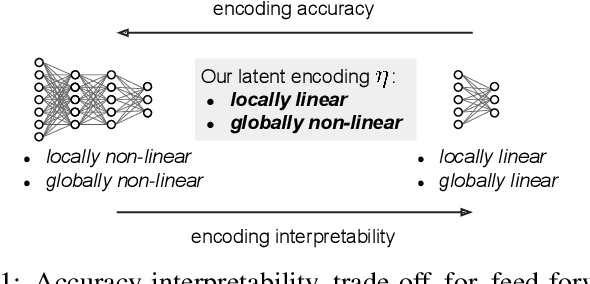

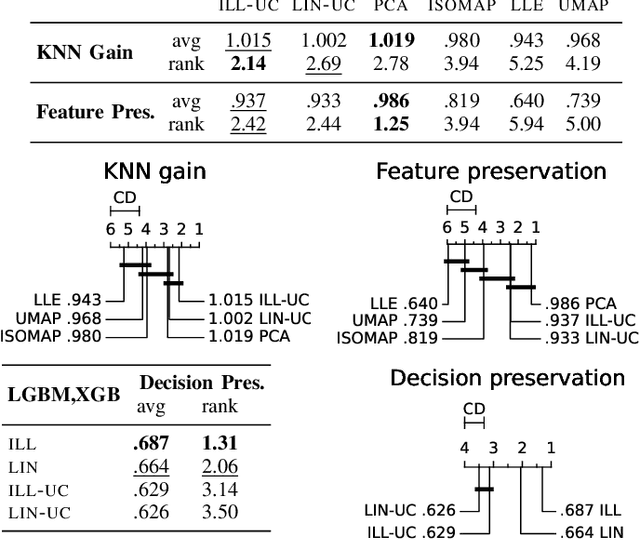
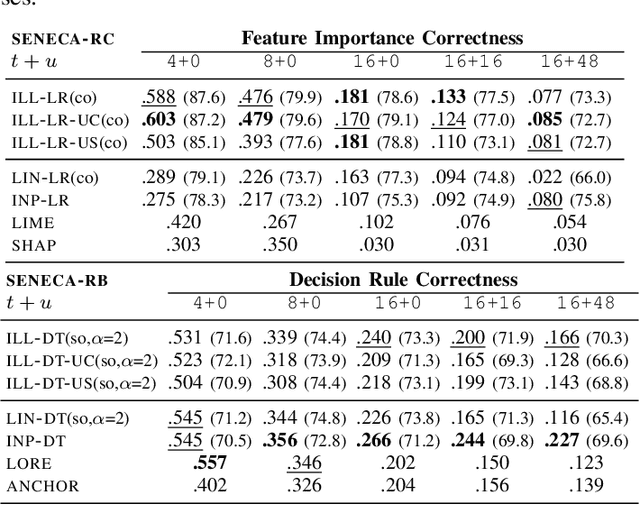
Post-hoc explainability is essential for understanding black-box machine learning models. Surrogate-based techniques are widely used for local and global model-agnostic explanations but have significant limitations. Local surrogates capture non-linearities but are computationally expensive and sensitive to parameters, while global surrogates are more efficient but struggle with complex local behaviors. In this paper, we present ILLUME, a flexible and interpretable framework grounded in representation learning, that can be integrated with various surrogate models to provide explanations for any black-box classifier. Specifically, our approach combines a globally trained surrogate with instance-specific linear transformations learned with a meta-encoder to generate both local and global explanations. Through extensive empirical evaluations, we demonstrate the effectiveness of ILLUME in producing feature attributions and decision rules that are not only accurate but also robust and faithful to the black-box, thus providing a unified explanation framework that effectively addresses the limitations of traditional surrogate methods.
Interpretable and Fair Mechanisms for Abstaining Classifiers
Mar 24, 2025Abstaining classifiers have the option to refrain from providing a prediction for instances that are difficult to classify. The abstention mechanism is designed to trade off the classifier's performance on the accepted data while ensuring a minimum number of predictions. In this setting, often fairness concerns arise when the abstention mechanism solely reduces errors for the majority groups of the data, resulting in increased performance differences across demographic groups. While there exist a bunch of methods that aim to reduce discrimination when abstaining, there is no mechanism that can do so in an explainable way. In this paper, we fill this gap by introducing Interpretable and Fair Abstaining Classifier IFAC, an algorithm that can reject predictions both based on their uncertainty and their unfairness. By rejecting possibly unfair predictions, our method reduces error and positive decision rate differences across demographic groups of the non-rejected data. Since the unfairness-based rejections are based on an interpretable-by-design method, i.e., rule-based fairness checks and situation testing, we create a transparent process that can empower human decision-makers to review the unfair predictions and make more just decisions for them. This explainable aspect is especially important in light of recent AI regulations, mandating that any high-risk decision task should be overseen by human experts to reduce discrimination risks.
Deferring Concept Bottleneck Models: Learning to Defer Interventions to Inaccurate Experts
Mar 20, 2025Concept Bottleneck Models (CBMs) are machine learning models that improve interpretability by grounding their predictions on human-understandable concepts, allowing for targeted interventions in their decision-making process. However, when intervened on, CBMs assume the availability of humans that can identify the need to intervene and always provide correct interventions. Both assumptions are unrealistic and impractical, considering labor costs and human error-proneness. In contrast, Learning to Defer (L2D) extends supervised learning by allowing machine learning models to identify cases where a human is more likely to be correct than the model, thus leading to deferring systems with improved performance. In this work, we gain inspiration from L2D and propose Deferring CBMs (DCBMs), a novel framework that allows CBMs to learn when an intervention is needed. To this end, we model DCBMs as a composition of deferring systems and derive a consistent L2D loss to train them. Moreover, by relying on a CBM architecture, DCBMs can explain why defer occurs on the final task. Our results show that DCBMs achieve high predictive performance and interpretability at the cost of deferring more to humans.
Mathematical Foundation of Interpretable Equivariant Surrogate Models
Mar 03, 2025This paper introduces a rigorous mathematical framework for neural network explainability, and more broadly for the explainability of equivariant operators called Group Equivariant Operators (GEOs) based on Group Equivariant Non-Expansive Operators (GENEOs) transformations. The central concept involves quantifying the distance between GEOs by measuring the non-commutativity of specific diagrams. Additionally, the paper proposes a definition of interpretability of GEOs according to a complexity measure that can be defined according to each user preferences. Moreover, we explore the formal properties of this framework and show how it can be applied in classical machine learning scenarios, like image classification with convolutional neural networks.