 Add to Chrome
 Add to Firefox
 Add to Edge
Explainable AI for Cancer Drug Response Prediction: Beyond Univariate Feature Attributions
Jul 01, 2026
Predicting cancer drug response from transcriptomic profiles is a cornerstone of precision oncology, yet the scientific value of machine learning models hinges not solely on predictive accuracy, but also on their capacity to generate reliable biological insights. Current explainability approaches in this setting are computationally costly, lack robustness, and reduce complex drug response to univariate gene importance scores, overlooking the coordinated gene activity that drives sensitivity and resistance. In this work, we present ILLUME+, a scalable post-hoc explainability framework that moves beyond single-gene assessments to capture multiple, complementary forms of explanation. Integrated into our end-to-end pipeline, ILLUME+ produces more stable gene importance scores than existing baselines, recovers established drug-gene associations and mechanisms of action, and enables AI-assisted hypothesis generation to uncover novel interaction-driven molecular signals in cancer biology.

Position: Explaining Behavioral Shifts in Large Language Models Requires a Comparative Approach
Feb 02, 2026Large-scale foundation models exhibit behavioral shifts: intervention-induced behavioral changes that appear after scaling, fine-tuning, reinforcement learning or in-context learning. While investigating these phenomena have recently received attention, explaining their appearance is still overlooked. Classic explainable AI (XAI) methods can surface failures at a single checkpoint of a model, but they are structurally ill-suited to justify what changed internally across different checkpoints and which explanatory claims are warranted about that change. We take the position that behavioral shifts should be explained comparatively: the core target should be the intervention-induced shift between a reference model and an intervened model, rather than any single model in isolation. To this aim we formulate a Comparative XAI ($Δ$-XAI) framework with a set of desiderata to be taken into account when designing proper explaining methods. To highlight how $Δ$-XAI methods work, we introduce a set of possible pipelines, relate them to the desiderata, and provide a concrete $Δ$-XAI experiment.
Consistent Multigroup Low-Rank Approximation
Mar 27, 2025We consider the problem of consistent low-rank approximation for multigroup data: we ask for a sequence of $k$ basis vectors such that projecting the data onto their spanned subspace treats all groups as equally as possible, by minimizing the maximum error among the groups. Additionally, we require that the sequence of basis vectors satisfies the natural consistency property: when looking for the best $k$ vectors, the first $d<k$ vectors are the best possible solution to the problem of finding $d$ basis vectors. Thus, this multigroup low-rank approximation method naturally generalizes \svd and reduces to \svd for data with a single group. We give an iterative algorithm for this task that sequentially adds to the basis the vector that gives the best rank$-1$ projection according to the min-max criterion, and then projects the data onto the orthogonal complement of that vector. For finding the best rank$-1$ projection, we use primal-dual approaches or semidefinite programming. We analyze the theoretical properties of the algorithms and demonstrate empirically that the proposed methods compare favorably to existing methods for multigroup (or fair) PCA.
Efficient Exploration of the Rashomon Set of Rule Set Models
Jun 05, 2024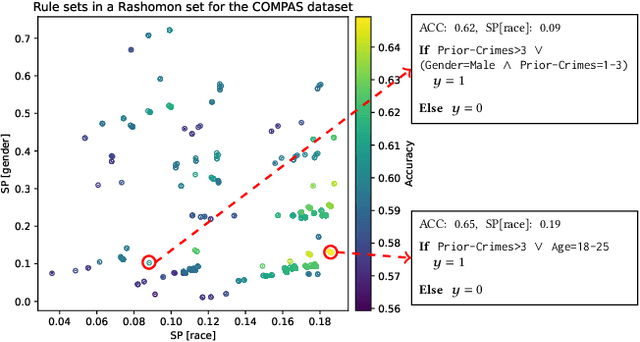
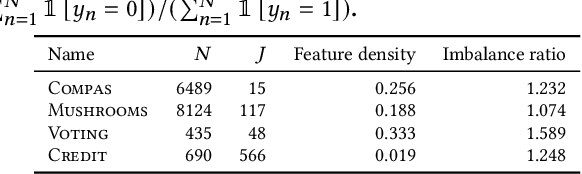
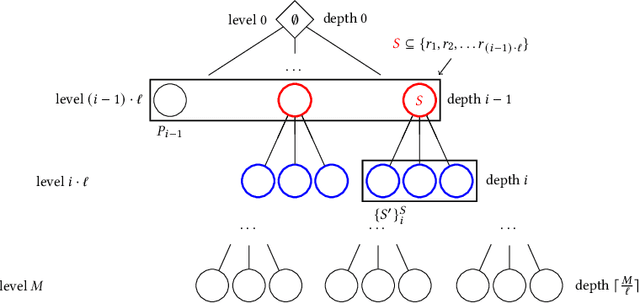
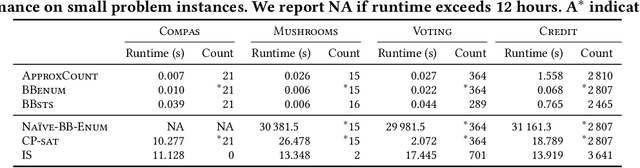
Today, as increasingly complex predictive models are developed, simple rule sets remain a crucial tool to obtain interpretable predictions and drive high-stakes decision making. However, a single rule set provides a partial representation of a learning task. An emerging paradigm in interpretable machine learning aims at exploring the Rashomon set of all models exhibiting near-optimal performance. Existing work on Rashomon-set exploration focuses on exhaustive search of the Rashomon set for particular classes of models, which can be a computationally challenging task. On the other hand, exhaustive enumeration leads to redundancy that often is not necessary, and a representative sample or an estimate of the size of the Rashomon set is sufficient for many applications. In this work, we propose, for the first time, efficient methods to explore the Rashomon set of rule set models with or without exhaustive search. Extensive experiments demonstrate the effectiveness of the proposed methods in a variety of scenarios.
Concise and interpretable multi-label rule sets
Oct 04, 2022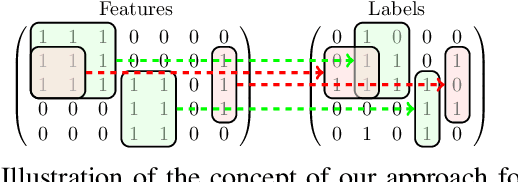
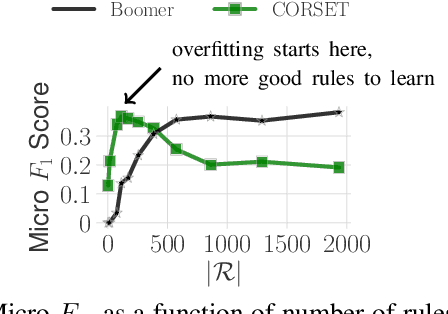
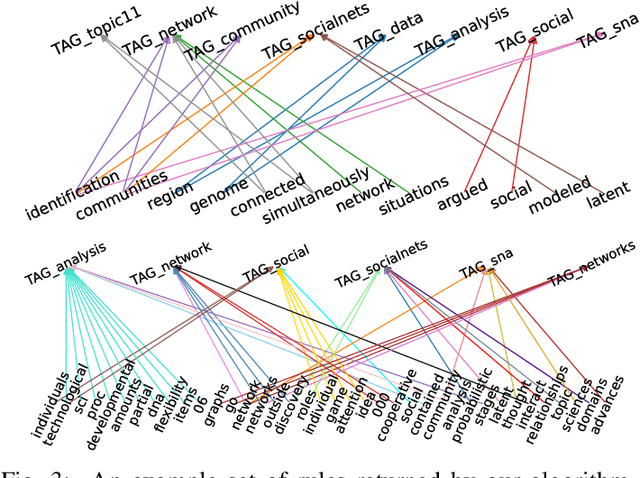
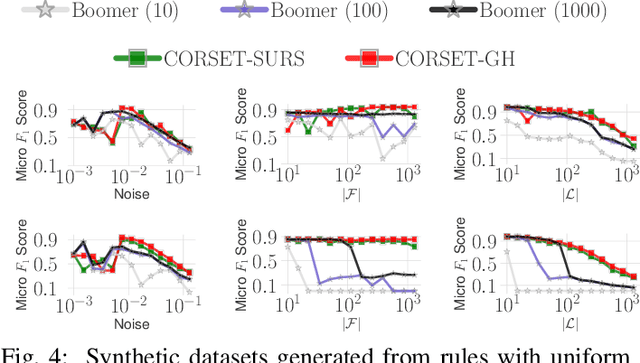
Multi-label classification is becoming increasingly ubiquitous, but not much attention has been paid to interpretability. In this paper, we develop a multi-label classifier that can be represented as a concise set of simple "if-then" rules, and thus, it offers better interpretability compared to black-box models. Notably, our method is able to find a small set of relevant patterns that lead to accurate multi-label classification, while existing rule-based classifiers are myopic and wasteful in searching rules,requiring a large number of rules to achieve high accuracy. In particular, we formulate the problem of choosing multi-label rules to maximize a target function, which considers not only discrimination ability with respect to labels, but also diversity. Accounting for diversity helps to avoid redundancy, and thus, to control the number of rules in the solution set. To tackle the said maximization problem we propose a 2-approximation algorithm, which relies on a novel technique to sample high-quality rules. In addition to our theoretical analysis, we provide a thorough experimental evaluation, which indicates that our approach offers a trade-off between predictive performance and interpretability that is unmatched in previous work.