 Add to Chrome
 Add to Firefox
 Add to Edge
Strategy-Aware Optimization Modeling with Reasoning LLMs
May 04, 2026
Large language models (LLMs) can generate syntactically valid optimization programs, yet often struggle to reliably choose an effective modeling strategy, leading to incorrect formulations and inefficient solver behavior. We propose SAGE, a strategy-aware framework that makes Modeling Strategy explicit in both data construction and post-training. SAGE builds a solver-verified multi-strategy dataset and trains a student model with supervised fine-tuning followed by Segment-Weighted GRPO using a composite reward over format compliance, correctness, and solver efficiency. Across eight benchmarks spanning synthetic and real-world settings, SAGE improves average pass@1 from 72.7 to 80.3 over the strongest open-source baseline. With multiple generations, SAGE discovers more distinct correct formulations and improves component-level diversity at pass@16 by 19-29%. At the largest scale, SAGE produces more compact constraint systems with 14.2% fewer constraints than the baseline, consistent with solver-efficient modeling. Overall, these results show that making Modeling Strategy explicit improves automated optimization modeling. Code is available at https://github.com/rachhhhing/SAGE.

Beyond One-Size-Fits-All: Adaptive Subgraph Denoising for Zero-Shot Graph Learning with Large Language Models
Mar 03, 2026Graph-based tasks in the zero-shot setting remain a significant challenge due to data scarcity and the inability of traditional Graph Neural Networks (GNNs) to generalize to unseen domains or label spaces. While recent advancements have transitioned toward leveraging Large Language Models (LLMs) as predictors to enhance GNNs, these methods often suffer from cross-modal alignment issues. A recent paradigm (i.e., Graph-R1) overcomes the aforementioned architectural dependencies by adopting a purely text-based format and utilizing LLM-based graph reasoning, showing improved zero-shot generalization. However, it employs a task-agnostic, one-size-fits-all subgraph extraction strategy, which inevitably introduces significant structural noise--irrelevant neighbors and edges--that distorts the LLMs' receptive field and leads to suboptimal predictions. To address this limitation, we introduce GraphSSR, a novel framework designed for adaptive subgraph extraction and denoising in zero-shot LLM-based graph reasoning. Specifically, we propose the SSR pipeline, which dynamically tailors subgraph extraction to specific contexts through a "Sample-Select-Reason" process, enabling the model to autonomously filter out task-irrelevant neighbors and overcome the one-size-fits-all issue. To internalize this capability, we develop SSR-SFT, a data synthesis strategy that generates high-quality SSR-style graph reasoning traces for supervised fine-tuning of LLMs. Furthermore, we propose SSR-RL, a two-stage reinforcement learning framework that explicitly regulates sampling and selection operations within the proposed SSR pipeline designed for adaptive subgraph denoising. By incorporating Authenticity-Reinforced and Denoising-Reinforced RL, we guide the model to achieve accurate predictions using parsimonious, denoised subgraphs for reasoning.
LLMs as Zero-shot Graph Learners: Alignment of GNN Representations with LLM Token Embeddings
Aug 25, 2024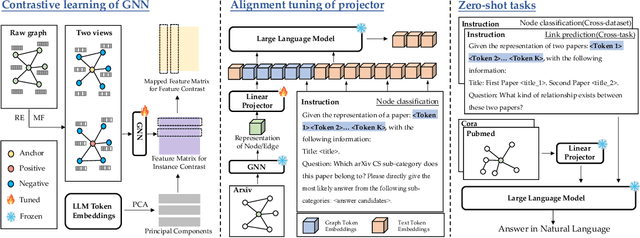
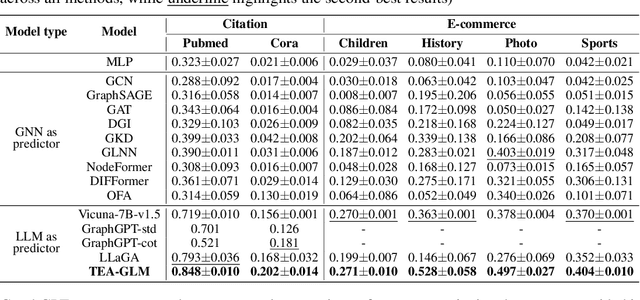
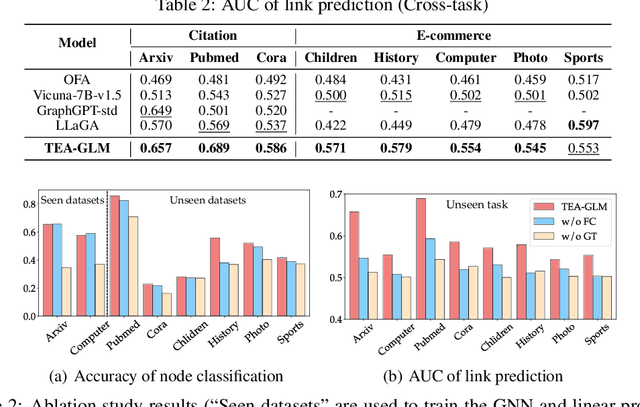

Zero-shot graph machine learning, especially with graph neural networks (GNNs), has garnered significant interest due to the challenge of scarce labeled data. While methods like self-supervised learning and graph prompt learning have been extensively explored, they often rely on fine-tuning with task-specific labels, limiting their effectiveness in zero-shot scenarios. Inspired by the zero-shot capabilities of instruction-fine-tuned large language models (LLMs), we introduce a novel framework named Token Embedding-Aligned Graph Language Model (TEA-GLM) that leverages LLMs as cross-dataset and cross-task zero-shot learners for graph machine learning. Concretely, we pretrain a GNN, aligning its representations with token embeddings of an LLM. We then train a linear projector that transforms the GNN's representations into a fixed number of graph token embeddings without tuning the LLM. A unified instruction is designed for various graph tasks at different levels, such as node classification (node-level) and link prediction (edge-level). These design choices collectively enhance our method's effectiveness in zero-shot learning, setting it apart from existing methods. Experiments show that our graph token embeddings help the LLM predictor achieve state-of-the-art performance on unseen datasets and tasks compared to other methods using LLMs as predictors.