 Add to Chrome
 Add to Firefox
 Add to Edge
UniScale: Synergistic Entire Space Data and Model Scaling for Search Ranking
Mar 25, 2026
Recent advances in Large Language Models (LLMs) have inspired a surge of scaling law research in industrial search, advertising, and recommendation systems. However, existing approaches focus mainly on architectural improvements, overlooking the critical synergy between data and architecture design. We observe that scaling model parameters alone exhibits diminishing returns, i.e., the marginal gain in performance steadily declines as model size increases, and that the performance degradation caused by complex heterogeneous data distributions is often irrecoverable through model design alone. In this paper, we propose UniScale to address these limitation, a novel co-design framework that jointly optimizes data and architecture to unlock the full potential of model scaling, which includes two core parts: (1) ES$^3$ (Entire-Space Sample System), a high-quality data scaling system that expands the training signal beyond conventional sampling strategies from both intra-domain request contexts with global supervised signal constructed by hierarchical label attribution and cross-domain samples aligning with the essence of user decision under similar content exposure environment in search domain; and (2) HHSFT (Heterogeneous Hierarchical Sample Fusion Transformer), a novel architecture designed to effectively model the complex heterogeneous distribution of scaled data and to harness the entire space user behavior data with Heterogeneous Hierarchical Feature Interaction and Entire Space User Interest Fusion, thereby surpassing the performance ceiling of structure-only model tuning. Extensive experiments on large-scale real world E-commerce search platform demonstrate that UniScale achieves significant improvements through the synergistic co-design of data and architecture and exhibits clear scaling trends, delivering substantial gains in key business metrics.

Advancing Continual Learning for Robust Deepfake Audio Classification
Jul 14, 2024
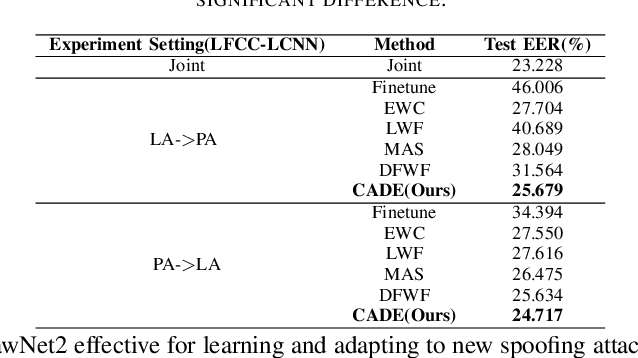


The emergence of new spoofing attacks poses an increasing challenge to audio security. Current detection methods often falter when faced with unseen spoofing attacks. Traditional strategies, such as retraining with new data, are not always feasible due to extensive storage. This paper introduces a novel continual learning method Continual Audio Defense Enhancer (CADE). First, by utilizing a fixed memory size to store randomly selected samples from previous datasets, our approach conserves resources and adheres to privacy constraints. Additionally, we also apply two distillation losses in CADE. By distillation in classifiers, CADE ensures that the student model closely resembles that of the teacher model. This resemblance helps the model retain old information while facing unseen data. We further refine our model's performance with a novel embedding similarity loss that extends across multiple depth layers, facilitating superior positive sample alignment. Experiments conducted on the ASVspoof2019 dataset show that our proposed method outperforms the baseline methods.