 Add to Chrome
 Add to Firefox
 Add to Edge
ExtraVAR: Stage-Aware RoPE Remapping for Resolution Extrapolation in Visual Autoregressive Models
May 11, 2026
Visual Autoregressive (VAR) models have emerged as a strong alternative to diffusion for image synthesis, yet their fixed training resolution prevents direct generation at higher resolutions. Naively transferring training-free extrapolation methods from LLMs or diffusion models to VAR yields three characteristic failure modes: global repetition, local repetition, and detail degradation. We trace them to a unified band-stage mismatch: VAR generates images in a coarse-to-fine, scale-wise process where each stage is driven by a distinct dominant RoPE frequency band, and each failure mode emerges when the dominant band of a particular stage is disrupted. Building on this insight, we propose Stage-Aware RoPE Remapping, a training-free strategy that assigns each frequency band a stage-specific remapping rule, jointly suppressing all three failure modes. We further observe that attention becomes systematically dispersed as the image resolution increases. Existing methods typically depend on predefined attention scaling factors, which are neither adaptive to the target resolution nor capable of faithfully capturing the actual extent of attention dispersion. We therefore propose Entropy-Driven Adaptive Attention Calibration, which quantifies dispersion via a resolution-invariant normalized entropy and yields a closed-form per-head scaling factor that realigns the extrapolated-resolution attention entropy with its training-resolution counterpart. Extensive experiments show that our method consistently outperforms prior resolution-extrapolation methods in both structural coherence and fine-detail fidelity. Our code is available at https://github.com/feihongyan1/ExtraVAR.

LazyMAR: Accelerating Masked Autoregressive Models via Feature Caching
Mar 16, 2025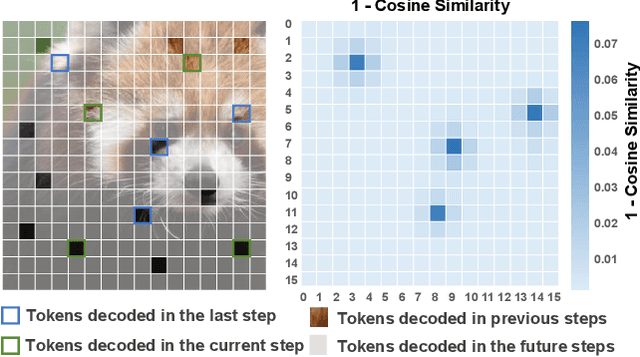
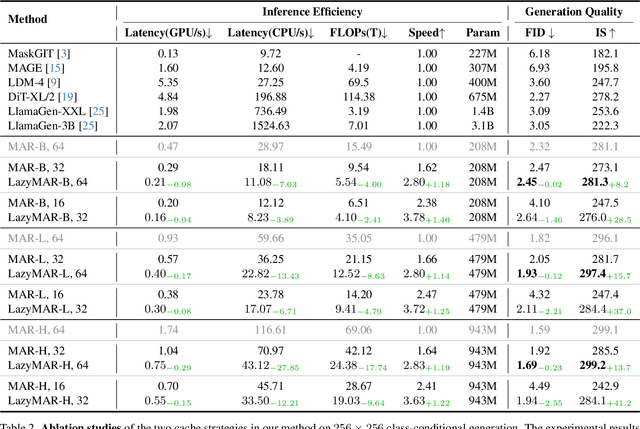
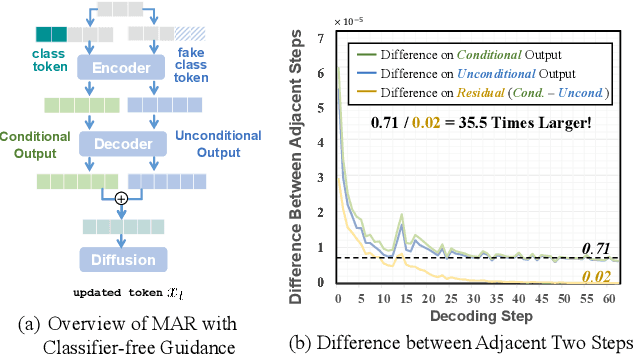

Masked Autoregressive (MAR) models have emerged as a promising approach in image generation, expected to surpass traditional autoregressive models in computational efficiency by leveraging the capability of parallel decoding. However, their dependence on bidirectional self-attention inherently conflicts with conventional KV caching mechanisms, creating unexpected computational bottlenecks that undermine their expected efficiency. To address this problem, this paper studies the caching mechanism for MAR by leveraging two types of redundancy: Token Redundancy indicates that a large portion of tokens have very similar representations in the adjacent decoding steps, which allows us to first cache them in previous steps and then reuse them in the later steps. Condition Redundancy indicates that the difference between conditional and unconditional output in classifier-free guidance exhibits very similar values in adjacent steps. Based on these two redundancies, we propose LazyMAR, which introduces two caching mechanisms to handle them one by one. LazyMAR is training-free and plug-and-play for all MAR models. Experimental results demonstrate that our method achieves 2.83 times acceleration with almost no drop in generation quality. Our codes will be released in https://github.com/feihongyan1/LazyMAR.