 Add to Chrome
 Add to Firefox
 Add to Edge
ExtraVAR: Stage-Aware RoPE Remapping for Resolution Extrapolation in Visual Autoregressive Models
May 11, 2026
Visual Autoregressive (VAR) models have emerged as a strong alternative to diffusion for image synthesis, yet their fixed training resolution prevents direct generation at higher resolutions. Naively transferring training-free extrapolation methods from LLMs or diffusion models to VAR yields three characteristic failure modes: global repetition, local repetition, and detail degradation. We trace them to a unified band-stage mismatch: VAR generates images in a coarse-to-fine, scale-wise process where each stage is driven by a distinct dominant RoPE frequency band, and each failure mode emerges when the dominant band of a particular stage is disrupted. Building on this insight, we propose Stage-Aware RoPE Remapping, a training-free strategy that assigns each frequency band a stage-specific remapping rule, jointly suppressing all three failure modes. We further observe that attention becomes systematically dispersed as the image resolution increases. Existing methods typically depend on predefined attention scaling factors, which are neither adaptive to the target resolution nor capable of faithfully capturing the actual extent of attention dispersion. We therefore propose Entropy-Driven Adaptive Attention Calibration, which quantifies dispersion via a resolution-invariant normalized entropy and yields a closed-form per-head scaling factor that realigns the extrapolated-resolution attention entropy with its training-resolution counterpart. Extensive experiments show that our method consistently outperforms prior resolution-extrapolation methods in both structural coherence and fine-detail fidelity. Our code is available at https://github.com/feihongyan1/ExtraVAR.

SciceVPR: Stable Cross-Image Correlation Enhanced Model for Visual Place Recognition
Feb 28, 2025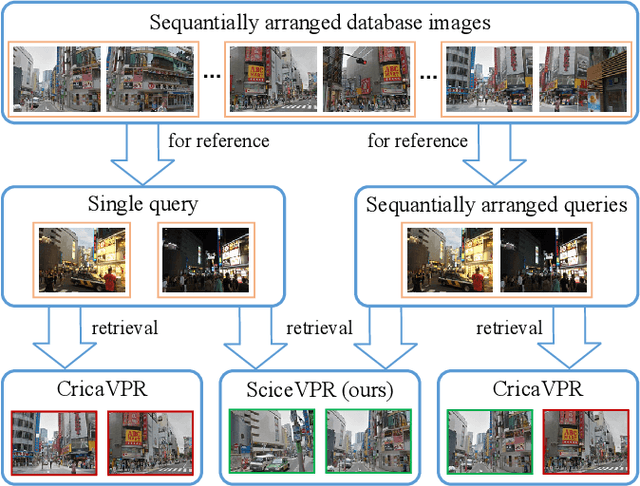
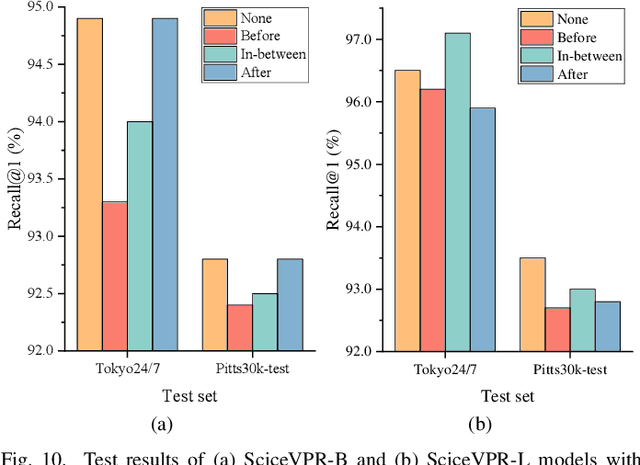
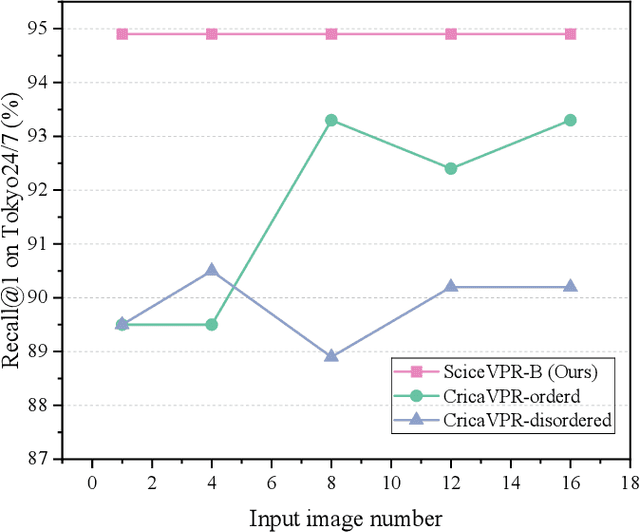

Visual Place Recognition (VPR) is a major challenge for robotics and autonomous systems, with the goal of predicting the location of an image based solely on its visual features. State-of-the-art (SOTA) models extract global descriptors using the powerful foundation model DINOv2 as backbone. These models either explore the cross-image correlation or propose a time-consuming two-stage re-ranking strategy to achieve better performance. However, existing works only utilize the final output of DINOv2, and the current cross-image correlation causes unstable retrieval results. To produce both discriminative and constant global descriptors, this paper proposes stable cross-image correlation enhanced model for VPR called SciceVPR. This model explores the full potential of DINOv2 in providing useful feature representations that implicitly encode valuable contextual knowledge. Specifically, SciceVPR first uses a multi-layer feature fusion module to capture increasingly detailed task-relevant channel and spatial information from the multi-layer output of DINOv2. Secondly, SciceVPR considers the invariant correlation between images within a batch as valuable knowledge to be distilled into the proposed self-enhanced encoder. In this way, SciceVPR can acquire fairly robust global features regardless of domain shifts (e.g., changes in illumination, weather and viewpoint between pictures taken in the same place). Experimental results demonstrate that the base variant, SciceVPR-B, outperforms SOTA one-stage methods with single input on multiple datasets with varying domain conditions. The large variant, SciceVPR-L, performs on par with SOTA two-stage models, scoring over 3% higher in Recall@1 compared to existing models on the challenging Tokyo24/7 dataset. Our code will be released at https://github.com/shuimushan/SciceVPR.