 Add to Chrome
 Add to Firefox
 Add to Edge
Ling and Ring 2.6 Technical Report: Efficient and Instant Agentic Intelligence at Trillion-Parameter Scale
Jun 13, 2026
Efficient and scalable agentic intelligence requires models that can deliver both low-latency responses and strong reasoning capabilities while remaining practical to train, serve, and deploy. In this report, we present Ling-2.6 and Ring-2.6, a family of models designed to address this challenge at scale. Ling-2.6 is optimized for instant response generation and high capability per output token, whereas Ring-2.6 is tailored for deeper reasoning and more advanced agentic workflows. Instead of training from scratch, we upgrade the Ling-2.0 base model through architectural migration pre-training and large-scale post-training. This upgrade is guided by a unified co-design of model architecture, optimization objectives, serving systems, and agent training environments, enabling improvements in both model capability and deployment efficiency. At the architectural level, we introduce a hybrid linear attention design that integrates Lightning Attention with MLA, improving the efficiency of long-context training and decoding. To further enhance token efficiency, we optimize capability per output token through Evolutionary Chain-of-Thought, Linguistic Unit Policy Optimization, bidirectional preference alignment, and shortest-correct-response distillation. For agentic capabilities, we propose KPop, a reinforcement learning framework designed to support stable training of Ring-2.6-1T on large-scale environment-grounded data. KPop improves training efficiency through asynchronous scheduling across coding, search, tool use, and workflow execution, enabling scalable learning from complex agent-environment interactions. Together, Ling-2.6 and Ring-2.6 provide a practical pathway toward efficient, scalable, and open agentic systems. We open-source all checkpoints in the 2.6 family to support further research and development in practical agentic intelligence.

Generative Visual Commonsense Answering and Explaining with Generative Scene Graph Constructing
Jan 15, 2025
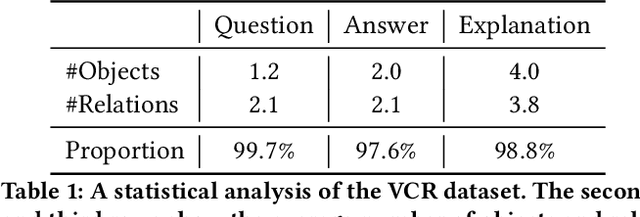
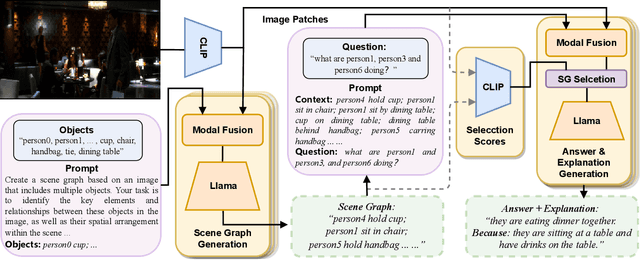
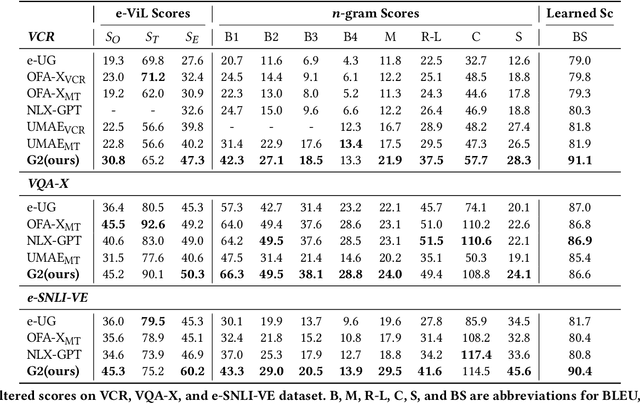
Visual Commonsense Reasoning, which is regarded as one challenging task to pursue advanced visual scene comprehension, has been used to diagnose the reasoning ability of AI systems. However, reliable reasoning requires a good grasp of the scene's details. Existing work fails to effectively exploit the real-world object relationship information present within the scene, and instead overly relies on knowledge from training memory. Based on these observations, we propose a novel scene-graph-enhanced visual commonsense reasoning generation method named \textit{\textbf{G2}}, which first utilizes the image patches and LLMs to construct a location-free scene graph, and then answer and explain based on the scene graph's information. We also propose automatic scene graph filtering and selection strategies to absorb valuable scene graph information during training. Extensive experiments are conducted on the tasks and datasets of scene graph constructing and visual commonsense answering and explaining, respectively. Experimental results and ablation analysis demonstrate the effectiveness of our proposed framework.
HELPD: Mitigating Hallucination of LVLMs by Hierarchical Feedback Learning with Vision-enhanced Penalty Decoding
Sep 30, 2024
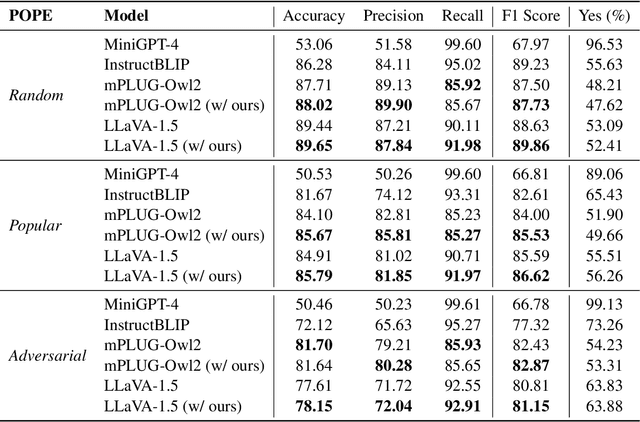
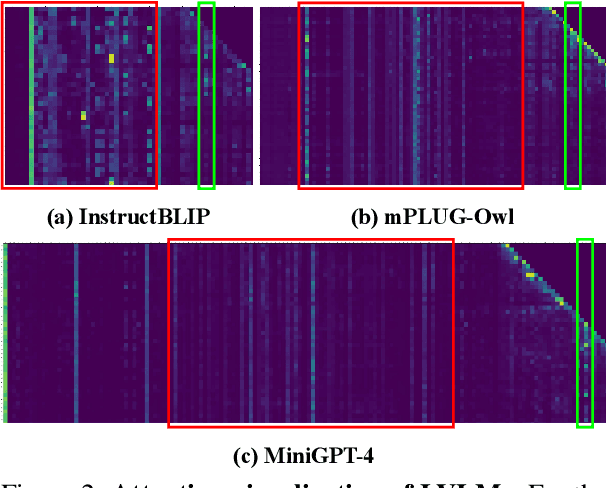
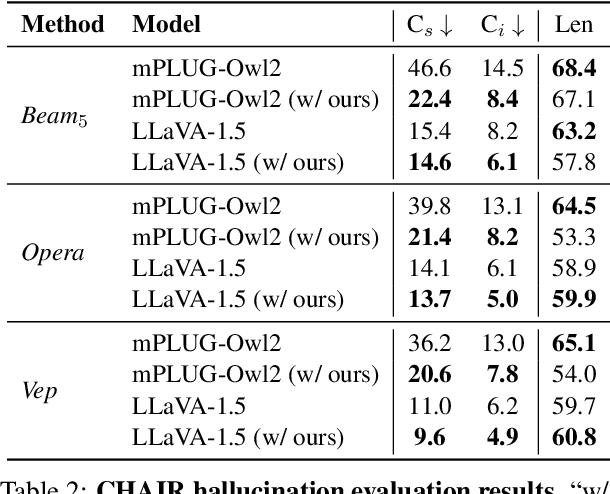
Large Vision-Language Models (LVLMs) have shown remarkable performance on many visual-language tasks. However, these models still suffer from multimodal hallucination, which means the generation of objects or content that violates the images. Many existing work detects hallucination by directly judging whether an object exists in an image, overlooking the association between the object and semantics. To address this issue, we propose Hierarchical Feedback Learning with Vision-enhanced Penalty Decoding (HELPD). This framework incorporates hallucination feedback at both object and sentence semantic levels. Remarkably, even with a marginal degree of training, this approach can alleviate over 15% of hallucination. Simultaneously, HELPD penalizes the output logits according to the image attention window to avoid being overly affected by generated text. HELPD can be seamlessly integrated with any LVLMs. Our experiments demonstrate that the proposed framework yields favorable results across multiple hallucination benchmarks. It effectively mitigates hallucination for different LVLMs and concurrently improves their text generation quality.