 Add to Chrome
 Add to Firefox
 Add to Edge
TrustCLIP: Learning Private Visual Features via Adversarial Reconstruction
Jul 05, 2026
Vision and vision-language models rely on high-level visual representations that are increasingly used across recognition, retrieval, and multimodal reasoning pipelines. However, recent advances in generative modeling have shown that such features can often be inverted, enabling realistic reconstructions of the underlying image and raising significant privacy risks. We revisit this problem through the lens of reconstruction and propose TrustCLIP, a reconstruction-driven framework that treats a feature-conditioned generator as an explicit privacy adversary. TrustCLIP learns a projection between encoder features and downstream modules that is explicitly optimized to degrade the reconstructions produced by generative attackers while retaining the necessary signals for downstream tasks. Unlike prior defenses that rely on discriminative privacy metrics, TrustCLIP directly optimizes against a generative reconstruction attacker, targeting a threat not captured by standard evaluation protocols. We demonstrate its effectiveness in both conventional classification and multimodal large language model pipelines. Across these settings, TrustCLIP consistently reduces the fidelity of generative inversions while maintaining downstream task performance. Project page: https://atnikos.github.io/trustclip/

Decouple and Cache: KV Cache Construction for Streaming Video Understanding
May 03, 2026Streaming video understanding requires processing unbounded video streams with limited memory and computation, posing two key challenges. First, continuously constructing new and evicting old key-value(KV) caches is required for unbounded streams. Secondly, due to the high cost of collecting and training on unbounded streams, models must learn from short sequences while generalizing to long streams. Existing streaming VideoVLLMs fail to scale to unbounded video streams or focus on cache reuse strategies, leaving the impact of cache construction underexplored. In this paper, we propose Decoupled Streaming Cache(DSCache), a training-free cache construction mechanism that adapts pretrained offline models to streaming settings. DSCache maintains a cumulative past KV cache while constructing a separate instant cache on-demand, decoupled from past caches to preserve the informativeness of recent inputs. To enable position extrapolation beyond the training length, DSCache further incorporates a position-agnostic encoding strategy, ensuring KV caches to support unseen positions and preventing position overflow. Experiments on Streaming Video QA benchmarks demonstrate DSCache's state-of-the-art performance, with an average 2.5% accuracy gains over prior methods.
Don't Pause! Every prediction matters in a streaming video
Apr 27, 2026Streaming video models should respond the moment an event unfolds, not after the moment has passed. Yet existing online VideoQA benchmarks remain largely retrospective. They pause the video at fixed timestamps, pose questions about current or past events, and score models only at those moments. This protocol leaves streaming predictions untested. To close this gap, we introduce SPOT-Bench, featuring multi-turn proactive queries that evaluate general streaming perception and assistive capabilities required by an always-on, real-time assistant. SPOT-Bench comes with Timeliness-F1, a consolidated metric that measures streaming predictions by their temporal precision and balanced coverage across the entire video. Our benchmark reveals: (i) offline models detect events reliably but spam predictions unprompted; (ii) post-training for silence reduces spamming but induces unresponsiveness; (iii) half of the streaming video expects no response, which we term dead-time - compute spent here does not affect response latency. These findings motivate AsynKV, a training-free streaming adaptation of offline models, that retains their event perception while improving their streaming behavior. AsynKV features a long-short term memory, utilized efficiently by scaling compute during dead-time. It serves as a strong baseline on SPOT-Bench, outperforming existing streaming models, and achieves state-of-the-art on retrospective benchmarks.
On Discriminative vs. Generative classifiers: Rethinking MLLMs for Action Understanding
Mar 03, 2026Multimodal Large Language Models (MLLMs) have advanced open-world action understanding and can be adapted as generative classifiers for closed-set settings by autoregressively generating action labels as text. However, this approach is inefficient, and shared subwords across action labels introduce semantic overlap, leading to ambiguity in generation. In contrast, discriminative classifiers learn task-specific representations with clear decision boundaries, enabling efficient one-step classification without autoregressive decoding. We first compare generative and discriminative classifiers with MLLMs for closed-set action understanding, revealing the superior accuracy and efficiency of the latter. To bridge the performance gap, we design strategies that elevate generative classifiers toward performance comparable with discriminative ones. Furthermore, we show that generative modeling can complement discriminative classifiers, leading to better performance while preserving efficiency. To this end, we propose Generation-Assisted Discriminative~(GAD) classifier for closed-set action understanding. GAD operates only during fine-tuning, preserving full compatibility with MLLM pretraining. Extensive experiments on temporal action understanding benchmarks demonstrate that GAD improves both accuracy and efficiency over generative methods, achieving state-of-the-art results on four tasks across five datasets, including an average 2.5% accuracy gain and 3x faster inference on our largest COIN benchmark.
SneakPeek: Future-Guided Instructional Streaming Video Generation
Dec 15, 2025Instructional video generation is an emerging task that aims to synthesize coherent demonstrations of procedural activities from textual descriptions. Such capability has broad implications for content creation, education, and human-AI interaction, yet existing video diffusion models struggle to maintain temporal consistency and controllability across long sequences of multiple action steps. We introduce a pipeline for future-driven streaming instructional video generation, dubbed SneakPeek, a diffusion-based autoregressive framework designed to generate precise, stepwise instructional videos conditioned on an initial image and structured textual prompts. Our approach introduces three key innovations to enhance consistency and controllability: (1) predictive causal adaptation, where a causal model learns to perform next-frame prediction and anticipate future keyframes; (2) future-guided self-forcing with a dual-region KV caching scheme to address the exposure bias issue at inference time; (3) multi-prompt conditioning, which provides fine-grained and procedural control over multi-step instructions. Together, these components mitigate temporal drift, preserve motion consistency, and enable interactive video generation where future prompt updates dynamically influence ongoing streaming video generation. Experimental results demonstrate that our method produces temporally coherent and semantically faithful instructional videos that accurately follow complex, multi-step task descriptions.
PALM: A Dataset and Baseline for Learning Multi-subject Hand Prior
Nov 07, 2025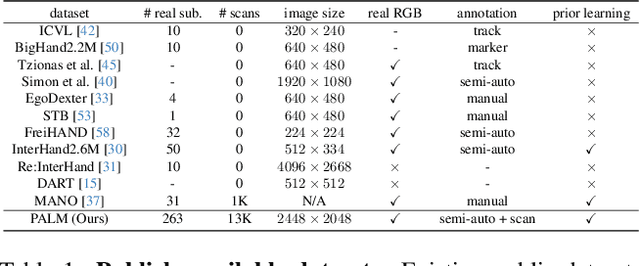
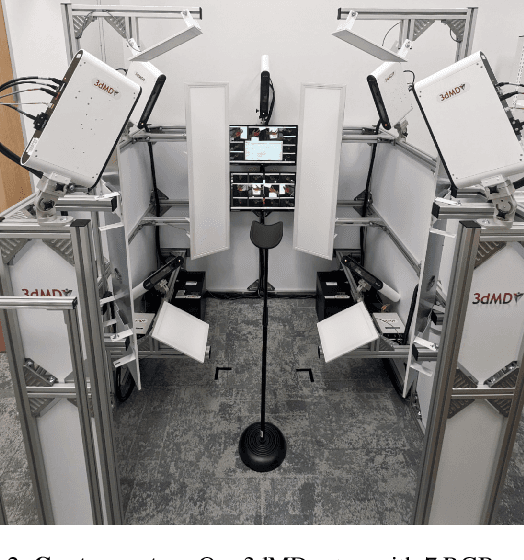
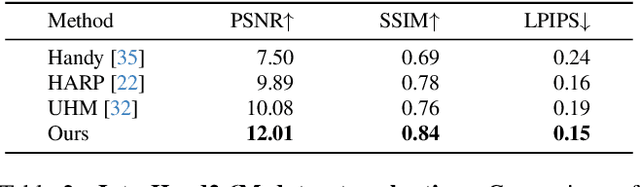
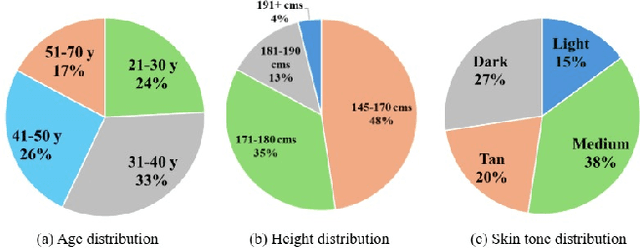
The ability to grasp objects, signal with gestures, and share emotion through touch all stem from the unique capabilities of human hands. Yet creating high-quality personalized hand avatars from images remains challenging due to complex geometry, appearance, and articulation, particularly under unconstrained lighting and limited views. Progress has also been limited by the lack of datasets that jointly provide accurate 3D geometry, high-resolution multiview imagery, and a diverse population of subjects. To address this, we present PALM, a large-scale dataset comprising 13k high-quality hand scans from 263 subjects and 90k multi-view images, capturing rich variation in skin tone, age, and geometry. To show its utility, we present a baseline PALM-Net, a multi-subject prior over hand geometry and material properties learned via physically based inverse rendering, enabling realistic, relightable single-image hand avatar personalization. PALM's scale and diversity make it a valuable real-world resource for hand modeling and related research.
Long-Tail Temporal Action Segmentation with Group-wise Temporal Logit Adjustment
Aug 19, 2024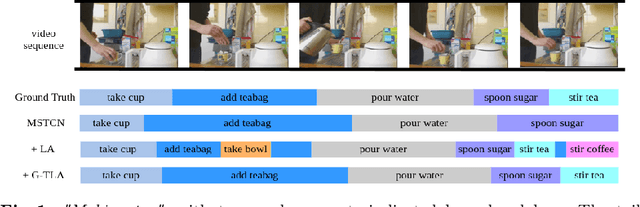
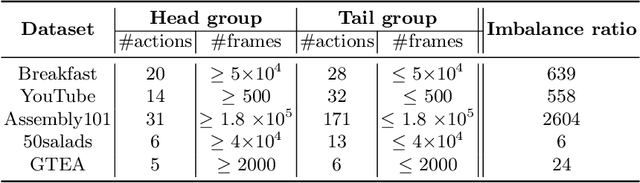
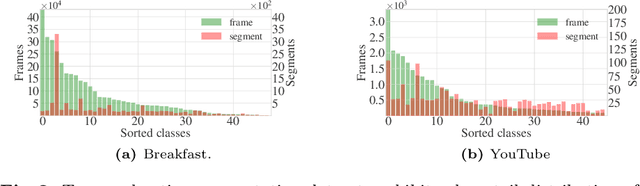
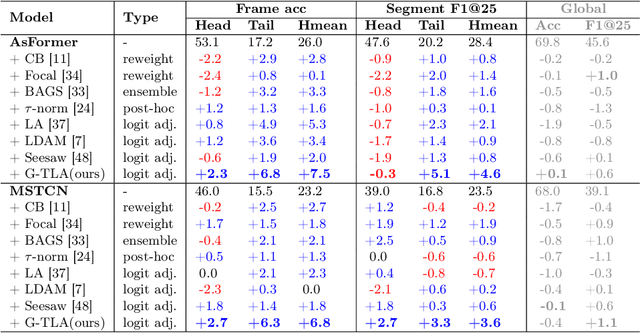
Procedural activity videos often exhibit a long-tailed action distribution due to varying action frequencies and durations. However, state-of-the-art temporal action segmentation methods overlook the long tail and fail to recognize tail actions. Existing long-tail methods make class-independent assumptions and struggle to identify tail classes when applied to temporal segmentation frameworks. This work proposes a novel group-wise temporal logit adjustment~(G-TLA) framework that combines a group-wise softmax formulation while leveraging activity information and action ordering for logit adjustment. The proposed framework significantly improves in segmenting tail actions without any performance loss on head actions.
X-MIC: Cross-Modal Instance Conditioning for Egocentric Action Generalization
Mar 28, 2024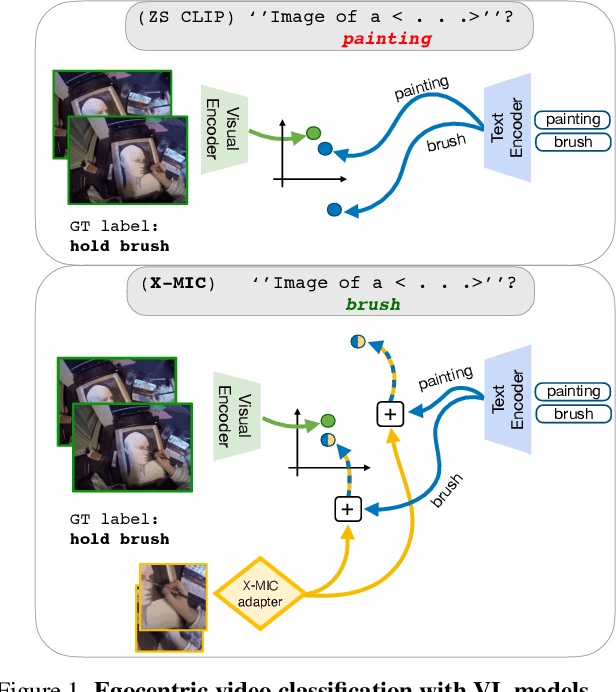

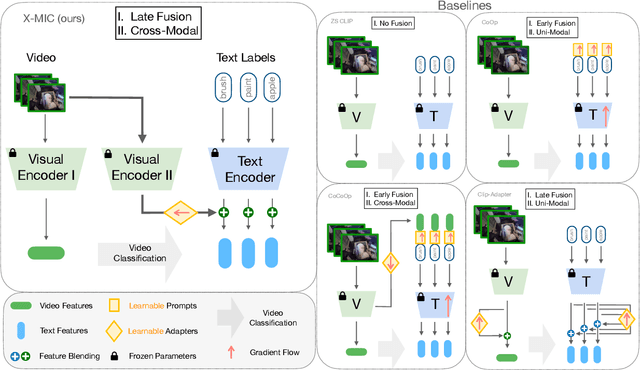
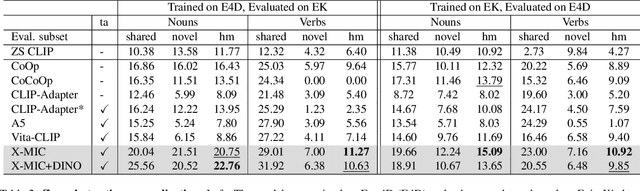
Lately, there has been growing interest in adapting vision-language models (VLMs) to image and third-person video classification due to their success in zero-shot recognition. However, the adaptation of these models to egocentric videos has been largely unexplored. To address this gap, we propose a simple yet effective cross-modal adaptation framework, which we call X-MIC. Using a video adapter, our pipeline learns to align frozen text embeddings to each egocentric video directly in the shared embedding space. Our novel adapter architecture retains and improves generalization of the pre-trained VLMs by disentangling learnable temporal modeling and frozen visual encoder. This results in an enhanced alignment of text embeddings to each egocentric video, leading to a significant improvement in cross-dataset generalization. We evaluate our approach on the Epic-Kitchens, Ego4D, and EGTEA datasets for fine-grained cross-dataset action generalization, demonstrating the effectiveness of our method. Code is available at https://github.com/annusha/xmic
DiffH2O: Diffusion-Based Synthesis of Hand-Object Interactions from Textual Descriptions
Mar 26, 2024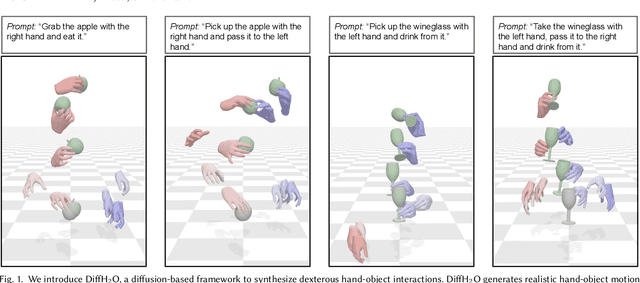
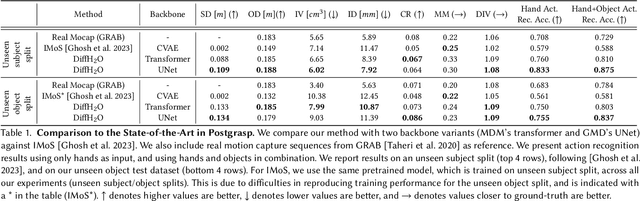
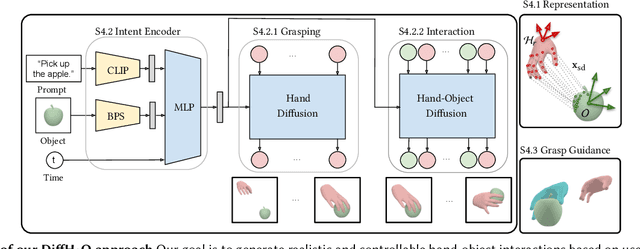
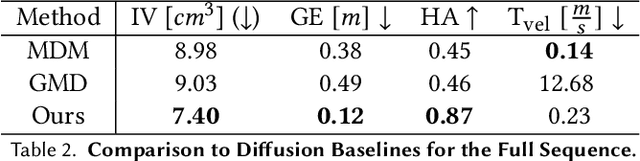
Generating natural hand-object interactions in 3D is challenging as the resulting hand and object motions are expected to be physically plausible and semantically meaningful. Furthermore, generalization to unseen objects is hindered by the limited scale of available hand-object interaction datasets. We propose DiffH2O, a novel method to synthesize realistic, one or two-handed object interactions from provided text prompts and geometry of the object. The method introduces three techniques that enable effective learning from limited data. First, we decompose the task into a grasping stage and a text-based interaction stage and use separate diffusion models for each. In the grasping stage, the model only generates hand motions, whereas in the interaction phase both hand and object poses are synthesized. Second, we propose a compact representation that tightly couples hand and object poses. Third, we propose two different guidance schemes to allow more control of the generated motions: grasp guidance and detailed textual guidance. Grasp guidance takes a single target grasping pose and guides the diffusion model to reach this grasp at the end of the grasping stage, which provides control over the grasping pose. Given a grasping motion from this stage, multiple different actions can be prompted in the interaction phase. For textual guidance, we contribute comprehensive text descriptions to the GRAB dataset and show that they enable our method to have more fine-grained control over hand-object interactions. Our quantitative and qualitative evaluation demonstrates that the proposed method outperforms baseline methods and leads to natural hand-object motions. Moreover, we demonstrate the practicality of our framework by utilizing a hand pose estimate from an off-the-shelf pose estimator for guidance, and then sampling multiple different actions in the interaction stage.
On the Utility of 3D Hand Poses for Action Recognition
Mar 14, 2024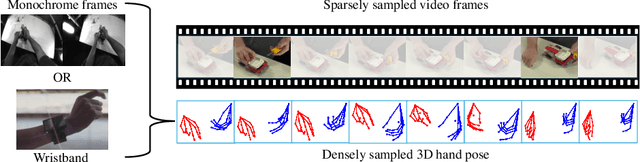
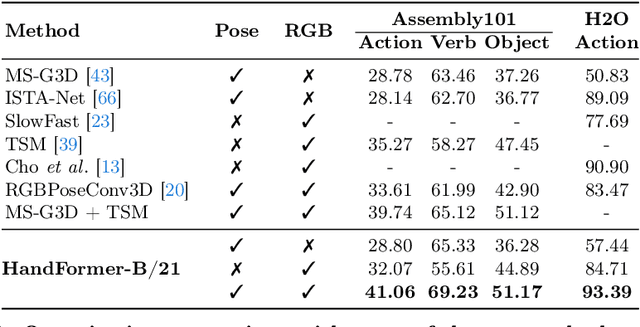
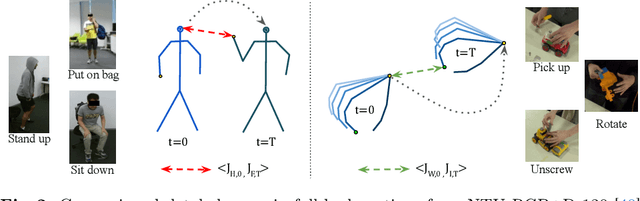
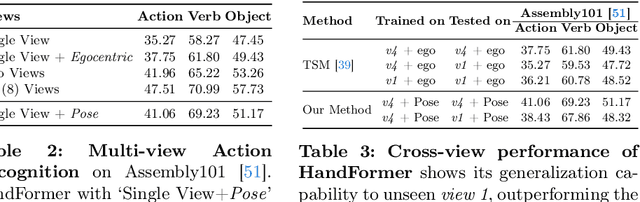
3D hand poses are an under-explored modality for action recognition. Poses are compact yet informative and can greatly benefit applications with limited compute budgets. However, poses alone offer an incomplete understanding of actions, as they cannot fully capture objects and environments with which humans interact. To efficiently model hand-object interactions, we propose HandFormer, a novel multimodal transformer. HandFormer combines 3D hand poses at a high temporal resolution for fine-grained motion modeling with sparsely sampled RGB frames for encoding scene semantics. Observing the unique characteristics of hand poses, we temporally factorize hand modeling and represent each joint by its short-term trajectories. This factorized pose representation combined with sparse RGB samples is remarkably efficient and achieves high accuracy. Unimodal HandFormer with only hand poses outperforms existing skeleton-based methods at 5x fewer FLOPs. With RGB, we achieve new state-of-the-art performance on Assembly101 and H2O with significant improvements in egocentric action recognition.