 Add to Chrome
 Add to Firefox
 Add to Edge
Integrated Real-Time Testbed for Wideband RFID and Wireless Power Transfer
Jun 04, 2026
This contribution presents an experimental integrated real-time 8 x 8 distributed MIMO (D-MIMO) testbed for wideband backscatter communication (BSC) and wireless power transfer (WPT). The testbed operates in the 2.45 GHz band with coherent sampling at 200 MS/s, employs a backscatter link frequency of 40 kHz, and uses wideband 5G NR reference signals for excitation. We evaluate the testbed by exploiting the estimated channel state information (CSI) in two target applications: wireless power transfer towards the backscatter device (BD) and real-time positioning of a BD in an indoor environment. In conjunction with the baseband processing chain introduced, the testbed requires less than 2 ms of total airtime to excite the system and acquire the signals for subsequent synchronization and CSI estimation on uplink BSC signals. With the CSI, we demonstrate effective energy harvesting gains of up to 12 dB.

Coherent Direct Multipath SLAM
Apr 21, 2026Challenging indoor and urban environments with severe multipath propagation and obstructed LoS (OLoS) degrade classical radio frequency (RF) positioning. Multipath-based simultaneous localization and mapping (MP-SLAM) is a promising remedy, building and exploiting a map of the propagation environment to enhance the robustness. Emerging distributed multiple-input multiple-output (D-MIMO)/extremely large-scale MIMO (XL-MIMO) infrastructures, with single XL antenna arrays or distributed subarrays, offer large spatial apertures and enable high-resolution sensing, in particular when phase coherence is maintained across base stations (BSs), subarrays, or distributed arrays. In this work, we propose a scalable Bayesian direct MP-SLAM method for coherent data fusion in D-MIMO/XL-MIMO systems that jointly infers the environment while performing robust, high-accuracy localization directly from raw RF signals. The key idea is a phase-preserving nonzero-mean Type-II likelihood function in which a complex mean is shared across BSs or subarrays and enables coherent fusion, while the variance captures noncoherent signal power. The likelihood function is combined with a surface feature vector (SFV)-based model that enables map feature fusion across the distributed infrastructure and supports near-field propagation and visibility effects. A GPU-parallel implementation enables highly scalable processing across a distributed infrastructure and particles, possibly allowing real-time calculations for large antenna arrays. Simulation results demonstrate performance gains over existing noncoherent methods and approach the corresponding posterior CRLB (PCRLB), highlighting the potential of coherent distributed arrays for high-resolution sensing and localization.
A Variational Message Passing Framework for Multi-Sensor Multi-Object Tracking using Raw Radar Signals
Apr 15, 2026The growing proliferation of unmanned aerial vehicles (UAVs) poses major challenges for reliable airspace surveillance, as drones are typically small, have low radar cross-sections, and often move slowly in cluttered environments. These characteristics make the joint tasks of detecting, localizing, and tracking multiple objects difficult for conventional detect-then-track (DTT) approaches, which rely on pre-processed measurements and may discard informative low-signal-to-noise ratio (SNR) signal components. To overcome these limitations, we propose a variational message passing (VMP)-based direct multiobject tracking (MOT) method that operates directly on raw radar signals and explicitly accounts for an unknown and time-varying number of objects. The proposed method is formulated for MIMO multi-radar systems and performs data fusion by jointly processing the signals of all radar sensors using a probabilistic model. A superimposed signal model is employed to capture correlations in the raw sensor data caused by closely spaced objects, and a hierarchical Bernoulli-Gamma model is introduced to jointly model object existence, reflectivities, and the reliability of individual radar-object links. Using a mean-field approximation, we derive message updates, yielding a computationally efficient VMP algorithm that simultaneously performs object detection, track formation, state estimation, and nuisance parameter learning directly from the radar signal. Simulation results in synthetic scenarios with weak and closely-spaced objects show that the proposed direct-MOT method outperforms a conventional pipeline based on super-resolution estimation followed by belief propagation (BP)-based tracking, particularly in low-SNR and clutter-rich conditions, demonstrating the advantages of direct signal-level inference and coherent multi-radar fusion.
Probabilistic Occupancy Grid for Radio-Based SLAM
Mar 03, 2026Sensing is an integral part of 6G and beyond systems, providing exceptional environmental perception along with communication. RF-based sensing often relies on simplified geometric assumptions (e.g., point scatterers or planar surfaces) to model specular multipath and keep inference tractable. However, such representations are not physically informative and fail to accurately capture extended objects with complex shapes and properties. This paper presents a probabilistic occupancy grid framework for radio-based simultaneous localization and mapping (SLAM), jointly reconstructing geometric structures and their radio-related properties. The proposed occupancy grid map representation is integrated into a multipath-based SLAM (MP-SLAM) formulation to enable simultaneous mobile-agent localization and environment mapping using multipath measurements. To connect RF measurements with the grid map, a surface model is employed to describe candidate reflection paths, while occupancy grid cell states capture measurement uncertainties and fine--grained geometric details. Object RF-related properties are modeled via reflection coefficients. The proposed framework offers a principled, proof-of-concept approach to physically interpretable radio-based mapping, and simulation results demonstrate accurate reconstruction of geometry and material properties, as well as high-accuracy localization. In addition, the results highlight the potential to use prior occupancy maps obtained from other radio devices or complementary sensors for subsequent map extension and refinement.
AI-enhanced Direct SLAM: A Principled Approach to Unsupervised Learning in Bayesian Inference
Mar 01, 2026In this paper, we propose an artificial intelligence (AI)-enhanced hybrid simultaneous localization and mapping (SLAM) method that performs Bayesian inference directly on raw radio-frequency (RF) signals while learning an environment model in an unsupervised manner. The approach combines a physically interpretable signal model for line-of-sight (LOS) components with an AI model that captures multipath component statistics. Building on this formulation, we develop a particle-based sumproduct algorithm (SPA) on a factor graph that jointly estimates the mobile terminal (MT) state, visibility, multipath parameters, and noise variances, and integrate it into a variational framework that maximizes the evidence lower bound (ELBO) to learn the neural network (NN) parametrization directly from measurements. We further present a highly efficient GPU-based implementation that enables parallel likelihood evaluation across particles and base stations (BSs). Simulation results in multipath environments demonstrate that the proposed method learns the generative, environment-dependent signal model in an unsupervised manner while accurately localizing the MT and effectively exploiting the learned map in obstructed-line-of-sight (OLOS) scenarios.
Simultaneous Source Separation, Synchronization, Localization and Mapping for 6G Systems
Dec 30, 2025Multipath-based simultaneous localization and mapping (MP-SLAM) is a promising approach for future 6G networks to jointly estimate the positions of transmitters and receivers together with the propagation environment. In cooperative MP-SLAM, information collected by multiple mobile terminals (MTs) is fused to enhance accuracy and robustness. Existing methods, however, typically assume perfectly synchronized base stations (BSs) and orthogonal transmission sequences, rendering inter-BS interference at the MTs negligible. In this work, we relax these assumptions and address simultaneous source separation, synchronization, and mapping. A relevant example arises in modern 5G systems, where BSs employ muting patterns to mitigate interference, yet localization performance still degrades. We propose a novel BS-dependent data association and synchronization bias model, integrated into a joint Bayesian framework and inferred via the sum-product algorithm on a factor graph. The impact of joint synchronization and source separation is analyzed under various system configurations. Compared with state-of-the-art cooperative MP-SLAM assuming orthogonal and synchronized BSs, our statistical analysis shows no significant performance degradation. The proposed BS-dependent data association model constitutes a principled approach for classifying features by arbitrary properties, such as reflection order or feature type (scatterers versus walls).
Optimizing Sparse Antenna Arrays for Localization and Sensing using Vector Spherical Wave Functions
Sep 19, 2025In increasing number of electronic devices implement wideband radio technologies for localization and sensing purposes, like ultra-wideband (UWB). Such radio technologies benefit from a large number of antennas, but space for antennas is often limited, especially in devices for mobile and IoT applications. A common challenge is therefore to optimize the placement and orientations of a small number of antenna elements inside a device, leading to the best localization performance. We propose a method for systematically approaching the optimization of such sparse arrays by means of Cram\'er-Rao lower bounds (CRLBs) and vector spherical wave functions (VSWFs). The VSWFs form the basis of a wideband signal model considering frequency, direction and polarization-dependent characteristics of the antenna array under test (AUT), together with mutual coupling and distortions from surrounding obstacles. We derive the CRLBs for localization parameters like delay and angle-of-arrival for this model under additive white Gaussian noise channel conditions, and formulate optimization problems for determining optimal antenna positions and orientations via minimization of the CRLBs. The proposed optimization procedure is demonstrated by means of an exemplary arrangement of three Crossed Exponentially Tapered Slot (XETS) antennas.
Multi-Sensor Fusion for Extended Object Tracking Exploiting Active and Passive Radio Signals
Sep 03, 2025Reliable and robust positioning of radio devices remains a challenging task due to multipath propagation, hardware impairments, and interference from other radio transmitters. A frequently overlooked but critical factor is the agent itself, e.g., the user carrying the device, which potentially obstructs line-of-sight (LOS) links to the base stations (anchors). This paper addresses the problem of accurate positioning in scenarios where LOS links are partially blocked by the agent. The agent is modeled as an extended object (EO) that scatters, attenuates, and blocks radio signals. We propose a Bayesian method that fuses ``active'' measurements (between device and anchors) with ``passive'' multistatic radar-type measurements (between anchors, reflected by the EO). To handle measurement origin uncertainty, we introduce an multi-sensor and multiple-measurement probabilistic data association (PDA) algorithm that jointly fuses all EO-related measurements. Furthermore, we develop an EO model tailored to agents such as human users, accounting for multiple reflections scattered off the body surface, and propose a simplified variant for low-complexity implementation. Evaluation on both synthetic and real radio measurements demonstrates that the proposed algorithm outperforms conventional PDA methods based on point target assumptions, particularly during and after obstructed line-of-sight (OLOS) conditions.
Multi-Sensor Fusion of Active and Passive Measurements for Extended Object Tracking
Apr 25, 2025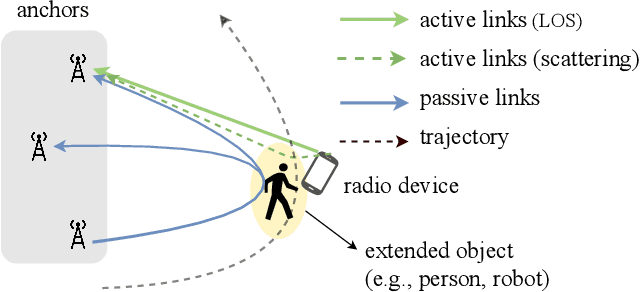
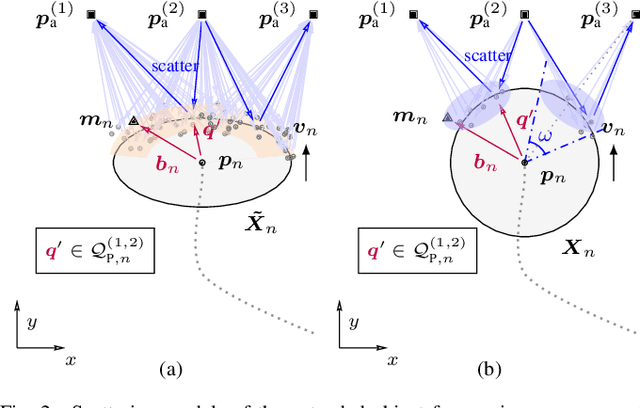
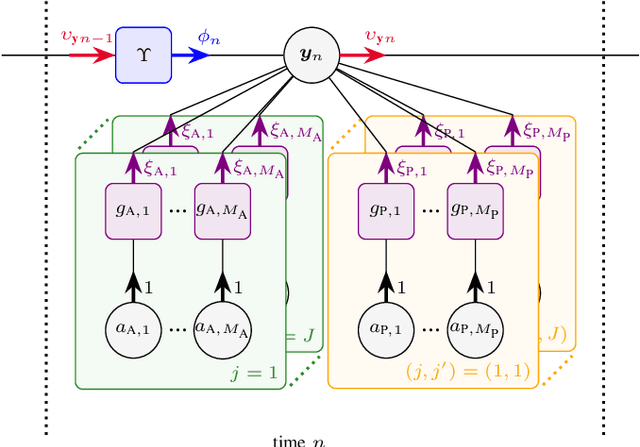
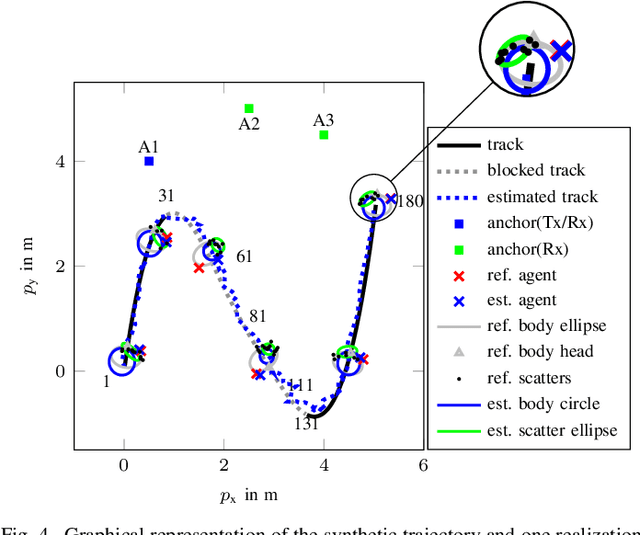
This paper addresses the challenge of achieving robust and reliable positioning of a radio device carried by an agent, in scenarios where direct line-of-sight (LOS) radio links are obstructed by the agent. We propose a Bayesian estimation algorithm that integrates active measurements between the radio device and anchors with passive measurements in-between anchors reflecting off the agent. A geometry-based scattering measurement model is introduced for multi-sensor structures, and multiple object-related measurements are incorporated to formulate an extended object probabilistic data association (PDA) algorithm, where the agent that blocks, scatters and attenuates radio signals is modeled as an extended object (EO). The proposed approach significantly improves the accuracy during and after obstructed LOS conditions, outperforming the conventional PDA (which is based on the point-target-assumption) and methods relying solely on active measurements.
Variational Message Passing-based Multiobject Tracking for MIMO-Radars using Raw Sensor Signals
Mar 19, 2025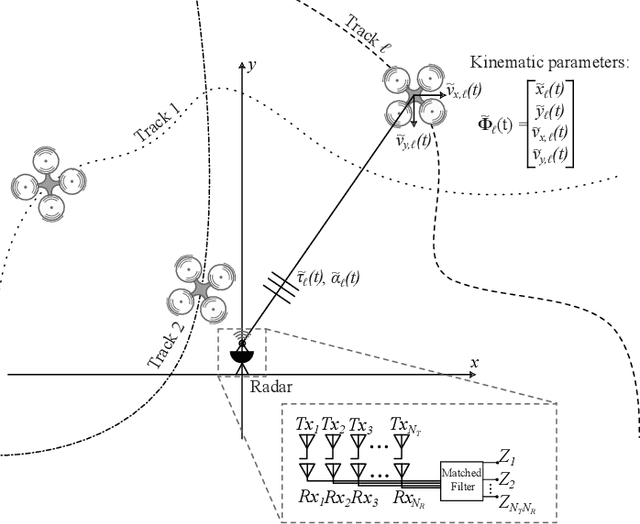
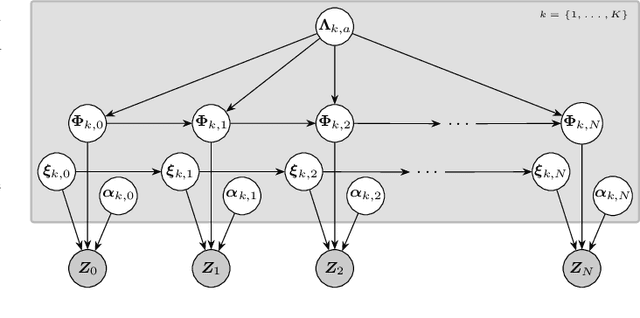
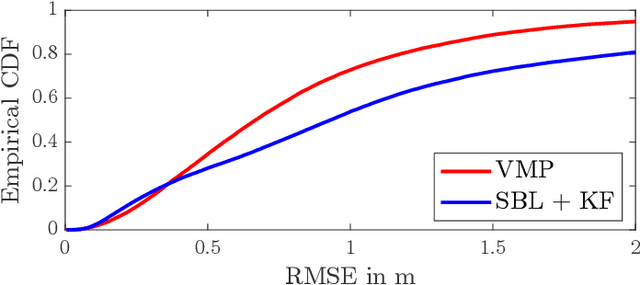
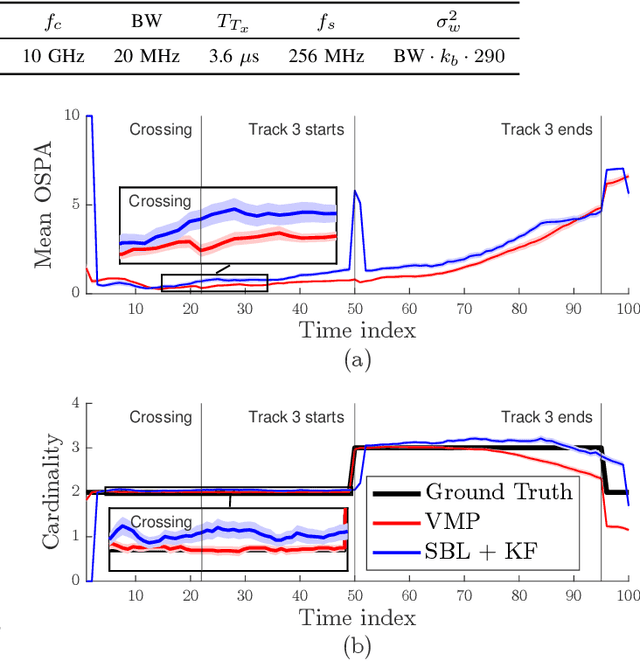
In this paper, we propose a direct multiobject tracking (MOT) approach for MIMO-radar signals that operates on raw sensor data via variational message passing (VMP). Unlike classical track-before-detect (TBD) methods, which often rely on simplified likelihood models and exclude nuisance parameters (e.g., object amplitudes, noise variance), our method adopts a superimposed signal model and employs a mean-field approximation to jointly estimate both object existence and object states. By considering correlations within in the radar signal due to closely spaced objects and jointly estimating nuisance parameters, the proposed method achieves robust performance for close-by objects and in low-signal-to-noise ratio (SNR) regimes. Our numerical evaluation based on MIMO-radar signals demonstrate that our VMP-based direct-MOT method outperforms a detect-then-track (DTT) pipeline comprising a super-resolution sparse Bayesian learning (SBL)-based estimation stage followed by classical MOT using global nearest neighbour data association and a Kalman filter.