 Add to Chrome
 Add to Firefox
 Add to Edge
Divergent-Convergent Reasoning: Scaling Test-Time Compute through Structured Solution Synthesis
Aug 15, 2026
Test-time compute can substantially improve Large Language Model (LLM) reasoning performance, yet how and when additional compute helps remains poorly understood. We study Divergent-Convergent Reasoning (DCR), a simple two-phase primitive consisting of an exploration phase that generates multiple candidate solutions followed by a convergent reconciliation phase. We present three core results. First, we show that even a single reconciliation step can reliably amplify correct minority reports: across datasets, DCR often recovers the correct answer when correct exploration outputs are in the minority, a regime where majority voting fails. Second, we introduce recursive DCR, an autoregressive reconciliation system that iteratively analyzes disagreements and allocates additional test-time compute. Recursive DCR achieves higher accuracy than fixed-compute baselines-reaching 93.3% on AIME 2024 and 92.0% on AIME 2025-while using roughly 27% less compute on average, demonstrating that attentive resource allocation is superior to uniform scaling. Third, we analyze disagreement among exploration outputs via a simple, training-free dispersion metric. Dispersion reveals a structured relationship between disagreement and test-time gains: in regimes where DCR is effective, higher disagreement among exploration outputs is associated with larger accuracy improvements from reconciliation. Together, these results show that disagreement, often viewed as noise, can be systematically exploited to improve test-time reasoning and reveal emerging scaling laws for agentic LLM systems.

Towards Automated and Marker-less Parkinson Disease Assessment: Predicting UPDRS Scores using Sit-stand videos
Apr 10, 2021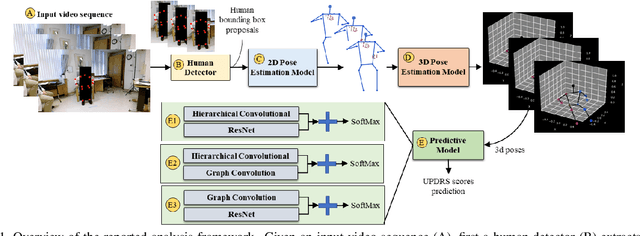
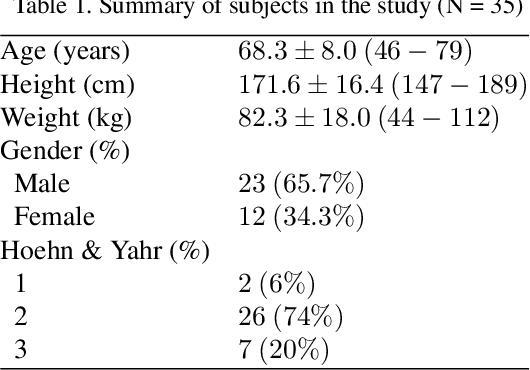
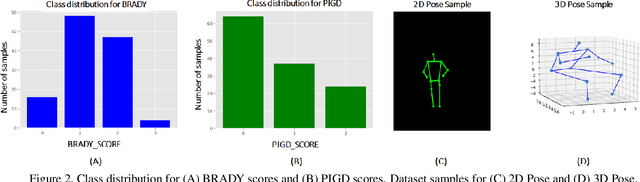
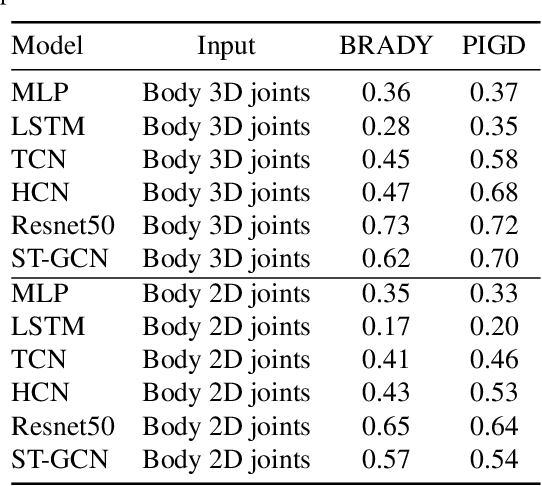
This paper presents a novel deep learning enabled, video based analysis framework for assessing the Unified Parkinsons Disease Rating Scale (UPDRS) that can be used in the clinic or at home. We report results from comparing the performance of the framework to that of trained clinicians on a population of 32 Parkinsons disease (PD) patients. In-person clinical assessments by trained neurologists are used as the ground truth for training our framework and for comparing the performance. We find that the standard sit-to-stand activity can be used to evaluate the UPDRS sub-scores of bradykinesia (BRADY) and posture instability and gait disorders (PIGD). For BRADY we find F1-scores of 0.75 using our framework compared to 0.50 for the video based rater clinicians, while for PIGD we find 0.78 for the framework and 0.45 for the video based rater clinicians. We believe our proposed framework has potential to provide clinically acceptable end points of PD in greater granularity without imposing burdens on patients and clinicians, which empowers a variety of use cases such as passive tracking of PD progression in spaces such as nursing homes, in-home self-assessment, and enhanced tele-medicine.
Deep Gradient Boosting
Jul 29, 2019


Stochastic gradient descent (SGD) has been the dominant optimization method for training deep neural networks due to its many desirable properties. One of the more remarkable and least understood quality of SGD is that it generalizes relatively well on unseen data even when the neural network has millions of parameters. In this work, we show that SGD is an extreme case of deep gradient boosting (DGB) and as such is intrinsically regularized. The key idea of DGB is that back-propagated gradients calculated using the chain rule can be viewed as pseudo-residual targets. Thus at each layer the weight update is calculated by solving the corresponding gradient boosting problem. We hypothesize that some learning tasks can benefit from a more lax regularization requirement and this approach provides a way to control that. We tested this hypothesis on a number of benchmark data sets and show that indeed in a subset of cases DGB outperforms SGD and under-performs on tasks that are more prone to over-fitting, such as image recognition.
Unsupervised Ensemble Regression
Mar 08, 2017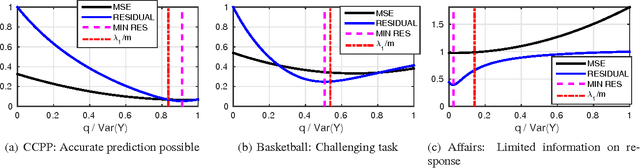
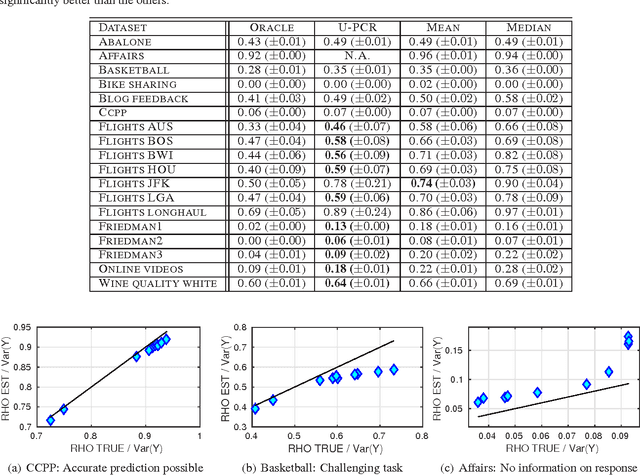
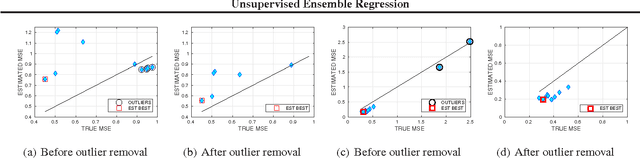
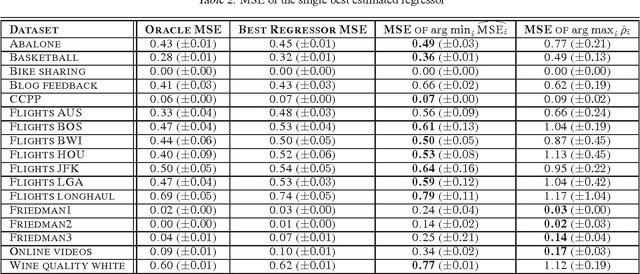
Consider a regression problem where there is no labeled data and the only observations are the predictions $f_i(x_j)$ of $m$ experts $f_{i}$ over many samples $x_j$. With no knowledge on the accuracy of the experts, is it still possible to accurately estimate the unknown responses $y_{j}$? Can one still detect the least or most accurate experts? In this work we propose a framework to study these questions, based on the assumption that the $m$ experts have uncorrelated deviations from the optimal predictor. Assuming the first two moments of the response are known, we develop methods to detect the best and worst regressors, and derive U-PCR, a novel principal components approach for unsupervised ensemble regression. We provide theoretical support for U-PCR and illustrate its improved accuracy over the ensemble mean and median on a variety of regression problems.