 Add to Chrome
 Add to Firefox
 Add to Edge
Evaluating and Mitigating the Misguidance Effect of Buggy Code in LLM-Generated Unit Tests
Jul 24, 2026
While Large Language Models (LLMs) show great promise for automating unit test generation, recent studies suggest that the quality of generated tests can be negatively impacted when models are prompted with buggy code. This paper presents a new metric to quantitatively measure the "misguidance effect," a phenomenon where buggy code steers LLMs toward generating tests that validate its erroneous behavior rather than expose it. Our analysis reveals that prompting LLMs with buggy code has a severe, twofold impact: it significantly increases "misguided tests" that assert incorrect behavior while simultaneously suppressing the generation of effective, bug-finding tests. We further corroborate this effect from a model-internal perspective, showing that buggy code skews LLMs' preference toward tests that assert the same erroneous behavior. To counter this, we introduce and validate a specification-based unit test generation paradigm that replaces the code under test in the prompt with an LLM-generated specification docstring. Our results show that this paradigm effectively reduces misguided tests while substantially increasing effective tests, improves multi-round, feedback-driven test generation pipelines, and remains applicable to both buggy and bug-free code. Overall, these results suggest that specification-based prompting is a promising strategy for mitigating misguidance from buggy code in LLM-generated unit tests.

Do Coverage and Mutation Scores of LLM-Generated Test Suites Correlate with Their Effectiveness? (Replicability Study)
Jul 24, 2026Recent advances in large language models (LLMs) have driven growing interest in using LLMs to automate test generation. Prior work commonly evaluates generated test suites using proxy metrics such as code coverage and mutation score. However, studies by Inozemtseva et al. and Papadakis et al. show that, for human-written tests, correlations among coverage, mutation, and real-bug detection can largely vanish once test suite size is controlled, raising concerns about the validity of evaluations based on proxy metrics. It also remains unclear whether these conclusions carry over to LLM-generated tests, given that prevailing LLM-based test-generation workflows differ substantially from traditional approaches. In this paper, we conduct a large-scale replication study of these two prior works using a wide range of test suites generated by a diverse set of LLMs, and re-examine the relationships among coverage, mutation, and real-bug detection effectiveness. Our findings diverge substantially from prior results. We show that the usefulness of coverage and mutation is highly context-dependent: in regression-style settings where the code provided to the LLM can be reasonably assumed bug-free, these metrics can provide meaningful signals when comparing across models; in another common scenario where the code-under-test may already be buggy and the goal is to expose the bug within the code-under-test, they no longer serve as reliable indicators. We also find little evidence that test suite size is a dominant confounder for correlations among coverage, mutation, and real-bug detection for LLM-generated tests. Based on these findings, we discuss how to interpret results from prior studies and provide actionable guidance for evaluating LLM-based test generation.
Formalize, Don't Optimize: The Heuristic Trap in LLM-Generated Combinatorial Solvers
May 12, 2026Large Language Models (LLMs) struggle to solve complex combinatorial problems through direct reasoning, so recent neuro-symbolic systems increasingly use them to synthesize executable solvers. A central design question is how the LLM should represent the solver, and whether it should also attempt to optimize search. We introduce CP-SynC-XL, a benchmark of 100 combinatorial problems (4,577 instances), and evaluate three solver-construction paradigms: native algorithmic search (Python), constraint modeling through a Python solver API (Python + OR-Tools), and declarative constraint modeling (MiniZinc + OR-Tools). We find a consistent representational divergence: Python + OR-Tools attains the highest correctness across LLMs, while MiniZinc + OR-Tools has lower absolute coverage despite using the same OR-Tools back-end. Native Python is the most likely to return a schema-valid solution that fails verification, whereas solver-backed paths preserve higher conditional fidelity. On the heuristic axis, prompting for search optimization yields only small median speed-ups (1.03-1.12x) and a strongly bimodal effect: many instances slow down, and correctness drops sharply on a long tail of problems. A paired code-level audit traces these regressions to a recurring heuristic trap. Under an efficiency-oriented prompt, the LLM may replace complete search with local approximations (Python), inject unverified bounds (Python + OR-Tools), or add redundant declarative machinery that overwhelms or over-constrains the model (MiniZinc + OR-Tools). These findings support a conservative design principle for LLM-generated combinatorial solvers: use the LLM primarily to formalize variables, constraints, and objectives for verified solvers, and separately check any LLM-authored search optimization before use.
Empowering Decision Trees via Shape Function Branching
Oct 21, 2025Decision trees are prized for their interpretability and strong performance on tabular data. Yet, their reliance on simple axis-aligned linear splits often forces deep, complex structures to capture non-linear feature effects, undermining human comprehension of the constructed tree. To address this limitation, we propose a novel generalization of a decision tree, the Shape Generalized Tree (SGT), in which each internal node applies a learnable axis-aligned shape function to a single feature, enabling rich, non-linear partitioning in one split. As users can easily visualize each node's shape function, SGTs are inherently interpretable and provide intuitive, visual explanations of the model's decision mechanisms. To learn SGTs from data, we propose ShapeCART, an efficient induction algorithm for SGTs. We further extend the SGT framework to bivariate shape functions (S$^2$GT) and multi-way trees (SGT$_K$), and present Shape$^2$CART and ShapeCART$_K$, extensions to ShapeCART for learning S$^2$GTs and SGT$_K$s, respectively. Experiments on various datasets show that SGTs achieve superior performance with reduced model size compared to traditional axis-aligned linear trees.
Variational Prefix Tuning for Diverse and Accurate Code Summarization Using Pre-trained Language Models
May 14, 2025Recent advancements in source code summarization have leveraged transformer-based pre-trained models, including Large Language Models of Code (LLMCs), to automate and improve the generation of code summaries. However, existing methods often focus on generating a single high-quality summary for a given source code, neglecting scenarios where the generated summary might be inadequate and alternative options are needed. In this paper, we introduce Variational Prefix Tuning (VPT), a novel approach that enhances pre-trained models' ability to generate diverse yet accurate sets of summaries, allowing the user to choose the most suitable one for the given source code. Our method integrates a Conditional Variational Autoencoder (CVAE) framework as a modular component into pre-trained models, enabling us to model the distribution of observed target summaries and sample continuous embeddings to be used as prefixes to steer the generation of diverse outputs during decoding. Importantly, we construct our method in a parameter-efficient manner, eliminating the need for expensive model retraining, especially when using LLMCs. Furthermore, we employ a bi-criteria reranking method to select a subset of generated summaries, optimizing both the diversity and the accuracy of the options presented to users. We present extensive experimental evaluations using widely used datasets and current state-of-the-art pre-trained code summarization models to demonstrate the effectiveness of our approach and its adaptability across models.
NeurCAM: Interpretable Neural Clustering via Additive Models
Aug 23, 2024Interpretable clustering algorithms aim to group similar data points while explaining the obtained groups to support knowledge discovery and pattern recognition tasks. While most approaches to interpretable clustering construct clusters using decision trees, the interpretability of trees often deteriorates on complex problems where large trees are required. In this work, we introduce the Neural Clustering Additive Model (NeurCAM), a novel approach to the interpretable clustering problem that leverages neural generalized additive models to provide fuzzy cluster membership with additive explanations of the obtained clusters. To promote sparsity in our model's explanations, we introduce selection gates that explicitly limit the number of features and pairwise interactions leveraged. Additionally, we demonstrate the capacity of our model to perform text clustering that considers the contextual representation of the texts while providing explanations for the obtained clusters based on uni- or bi-word terms. Extensive experiments show that NeurCAM achieves performance comparable to black-box methods on tabular datasets while remaining interpretable. Additionally, our approach significantly outperforms other interpretable clustering approaches when clustering on text data.
Optimal Decision Trees For Interpretable Clustering with Constraints
Jan 30, 2023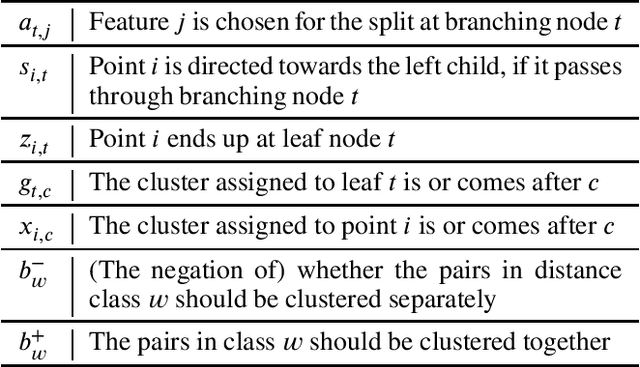
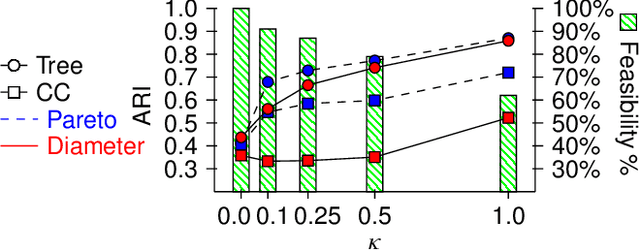
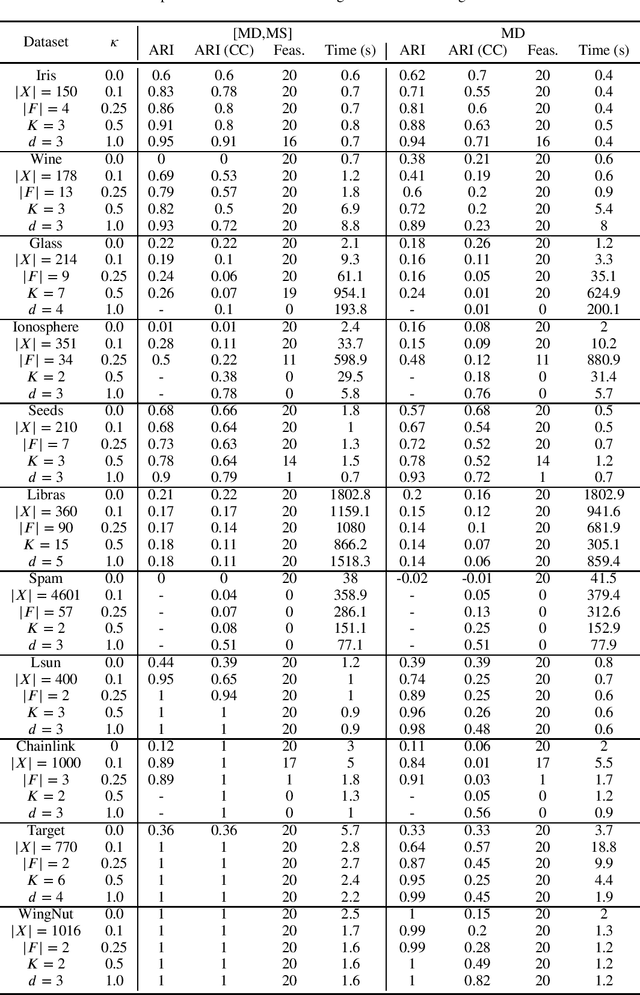
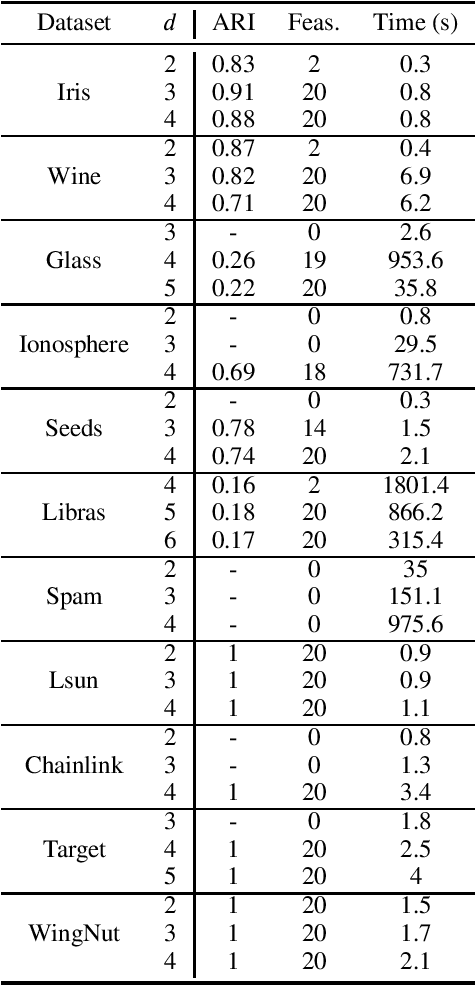
Constrained clustering is a semi-supervised task that employs a limited amount of labelled data, formulated as constraints, to incorporate domain-specific knowledge and to significantly improve clustering accuracy. Previous work has considered exact optimization formulations that can guarantee optimal clustering while satisfying all constraints, however these approaches lack interpretability. Recently, decision-trees have been used to produce inherently interpretable clustering solutions, however existing approaches do not support clustering constraints and do not provide strong theoretical guarantees on solution quality. In this work, we present a novel SAT-based framework for interpretable clustering that supports clustering constraints and that also provides strong theoretical guarantees on solution quality. We also present new insight into the trade-off between interpretability and satisfaction of such user-provided constraints. Our framework is the first approach for interpretable and constrained clustering. Experiments with a range of real-world and synthetic datasets demonstrate that our approach can produce high-quality and interpretable constrained clustering solutions.
Ising-based Consensus Clustering on Specialized Hardware
Mar 04, 2020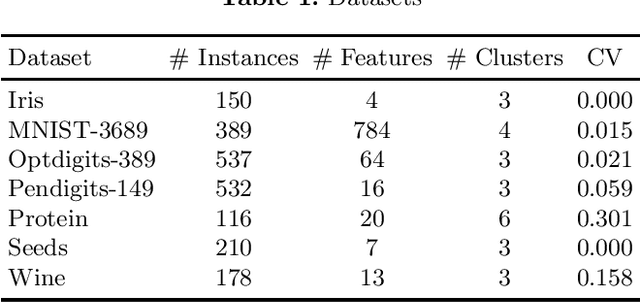
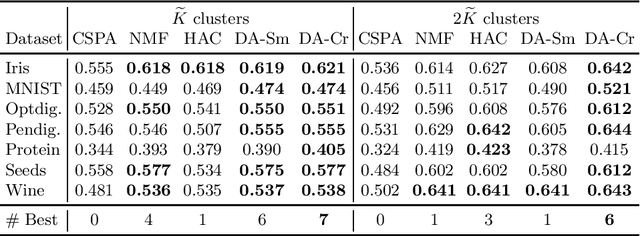
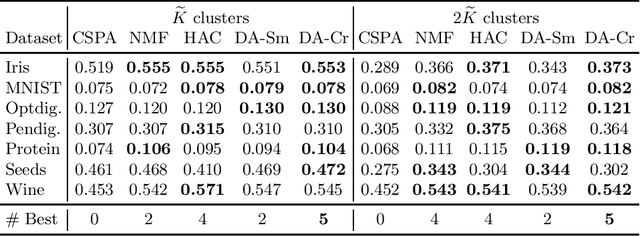
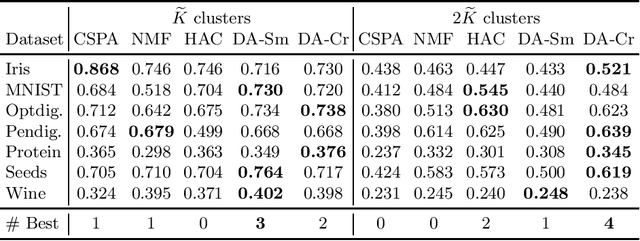
The emergence of specialized optimization hardware such as CMOS annealers and adiabatic quantum computers carries the promise of solving hard combinatorial optimization problems more efficiently in hardware. Recent work has focused on formulating different combinatorial optimization problems as Ising models, the core mathematical abstraction used by a large number of these hardware platforms, and evaluating the performance of these models when solved on specialized hardware. An interesting area of application is data mining, where combinatorial optimization problems underlie many core tasks. In this work, we focus on consensus clustering (clustering aggregation), an important combinatorial problem that has received much attention over the last two decades. We present two Ising models for consensus clustering and evaluate them using the Fujitsu Digital Annealer, a quantum-inspired CMOS annealer. Our empirical evaluation shows that our approach outperforms existing techniques and is a promising direction for future research.