 Add to Chrome
 Add to Firefox
 Add to Edge
Go Big or Go Home: Simulating Mobbing Behavior with Braitenbergian Robots
Apr 01, 2026
We used the Webots robotics simulation platform to simulate a dyadic avoiding and mobbing predator behavior in a group of Braitenbergian robots. Mobbing is an antipredator adaptation used by some animals in which the individuals cooperatively attack or harass a predator to protect themselves. One way of coordinating a mobbing attack is using mobbing calls to summon other individuals of the mobbing species. We imitated this mechanism and simulated Braitenbergian robots that use mobbing calls when they face a light source (representing an inanimate predator) and mob it if they can summon allies, otherwise, they escape from it. We explore the effects of range of mobbing call (infinite range, mid-range and low-range) and the size of the robot group (ten robots vs three) on the overall success of mobbing. Our results suggest that both variables have significant impacts. This work has implications for simulations of action selection in artificial life and designing control architectures for autonomous agents.

Play-Testing REMind: Evaluating an Educational Robot-Mediated Role-Play Game
Mar 31, 2026This paper presents REMind, an innovative educational robot-mediated role-play game designed to support anti-bullying bystander intervention among children. REMind invites players to observe a bullying scenario enacted by social robots, reflect on the perspectives of the characters, and rehearse defending strategies by puppeteering a robotic avatar. We evaluated REMind through a mixed-methods play-testing study with 18 children aged 9--10. The findings suggest that the experience supported key learning goals related to self-efficacy, perspective-taking, understanding outcomes of defending, and intervention strategies. These results highlight the promise of Robot-Mediated Applied Drama (RMAD) as a novel pedagogical framework to support Social-Emotional Learning.
Aesthetics of Robot-Mediated Applied Drama: A Case Study on REMind
Mar 25, 2026Social robots are increasingly used in education, but most applications cast them as tutors offering explanation-based instruction. We explore an alternative: Robot-Mediated Applied Drama (RMAD), in which robots function as life-like puppets in interactive dramatic experiences designed to support reflection and social-emotional learning. This paper presents REMind, an anti-bullying robot role-play game that helps children rehearse bystander intervention and peer support. We focus on a central design challenge in RMAD: how to make robot drama emotionally and aesthetically engaging despite the limited expressive capacities of current robotic platforms. Through the development of REMind, we show how performing arts expertise informed this process, and argue that the aesthetics of robot drama arise from the coordinated design of the wider experience, not from robot expressivity alone.
What Makes an Educational Robot Game Fun? Framework Analysis of Children's Design Ideas
Nov 05, 2024Fun acts as a catalyst for learning by enhancing motivation, active engagement and knowledge retention. As social robots gain traction as educational tools, understanding how their unique affordances can be leveraged to cultivate fun becomes crucial. This research investigates the concept of fun in educational games involving social robots to support the design of REMind:a robot-mediated role-play game aimed at encouraging bystander intervention against peer bullying among children. To incorporate fun elements into design of REMind, we conducted a user-centered Research through Design (RtD) study with focus groups of children to gain a deeper understanding of their perceptions of fun. We analyzed children's ideas by using Framework Analysis and leveraging LeBlanc's Taxonomy of Game Pleasures and identified 28 elements of fun that can be incorporated into robot-mediated games. We present our observations, discuss their impact on REMind's design, and offer recommendations for designing fun educational games using social robots.
Prosody for Intuitive Robotic Interface Design: It's Not What You Said, It's How You Said It
Mar 13, 2024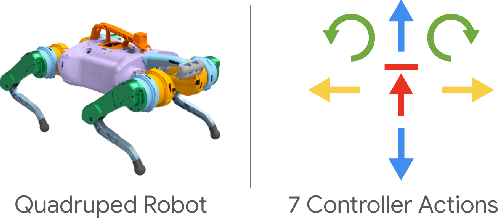
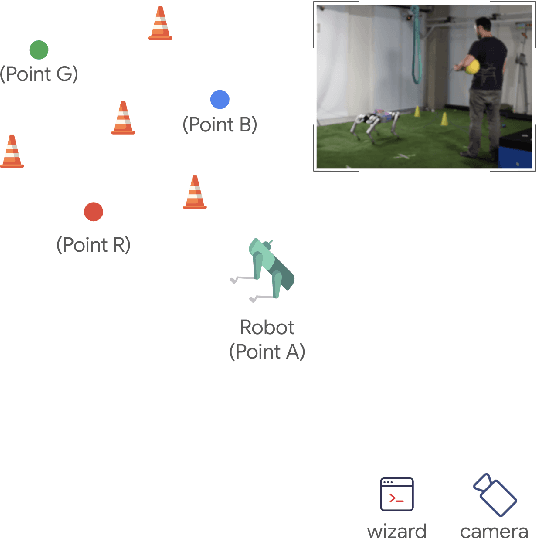
In this paper, we investigate the use of 'prosody' (the musical elements of speech) as a communicative signal for intuitive human-robot interaction interfaces. Our approach, rooted in Research through Design (RtD), examines the application of prosody in directing a quadruped robot navigation. We involved ten team members in an experiment to command a robot through an obstacle course using natural interaction. A human operator, serving as the robot's sensory and processing proxy, translated human communication into a basic set of navigation commands, effectively simulating an intuitive interface. During our analysis of interaction videos, when lexical and visual cues proved insufficient for accurate command interpretation, we turned to non-verbal auditory cues. Qualitative evidence suggests that participants intuitively relied on prosody to control robot navigation. We highlight specific distinct prosodic constructs that emerged from this preliminary exploration and discuss their pragmatic functions. This work contributes a discussion on the broader potential of prosody as a multifunctional communicative signal for designing future intuitive robotic interfaces, enabling lifelong learning and personalization in human-robot interaction.