 Add to Chrome
 Add to Firefox
 Add to Edge
Play-Testing REMind: Evaluating an Educational Robot-Mediated Role-Play Game
Mar 31, 2026
This paper presents REMind, an innovative educational robot-mediated role-play game designed to support anti-bullying bystander intervention among children. REMind invites players to observe a bullying scenario enacted by social robots, reflect on the perspectives of the characters, and rehearse defending strategies by puppeteering a robotic avatar. We evaluated REMind through a mixed-methods play-testing study with 18 children aged 9--10. The findings suggest that the experience supported key learning goals related to self-efficacy, perspective-taking, understanding outcomes of defending, and intervention strategies. These results highlight the promise of Robot-Mediated Applied Drama (RMAD) as a novel pedagogical framework to support Social-Emotional Learning.

Aesthetics of Robot-Mediated Applied Drama: A Case Study on REMind
Mar 25, 2026Social robots are increasingly used in education, but most applications cast them as tutors offering explanation-based instruction. We explore an alternative: Robot-Mediated Applied Drama (RMAD), in which robots function as life-like puppets in interactive dramatic experiences designed to support reflection and social-emotional learning. This paper presents REMind, an anti-bullying robot role-play game that helps children rehearse bystander intervention and peer support. We focus on a central design challenge in RMAD: how to make robot drama emotionally and aesthetically engaging despite the limited expressive capacities of current robotic platforms. Through the development of REMind, we show how performing arts expertise informed this process, and argue that the aesthetics of robot drama arise from the coordinated design of the wider experience, not from robot expressivity alone.
Virtual Agent-Based Communication Skills Training to Facilitate Health Persuasion Among Peers
Dec 16, 2024
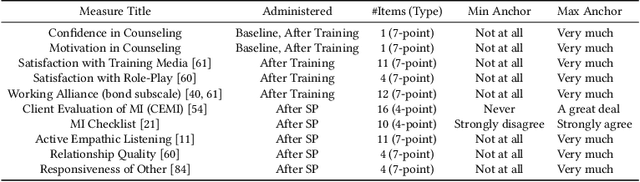
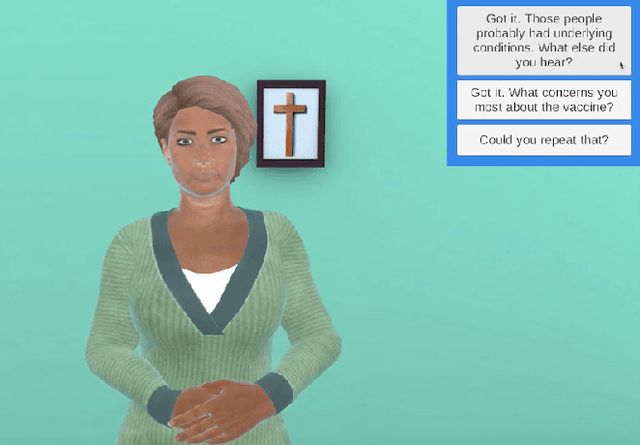
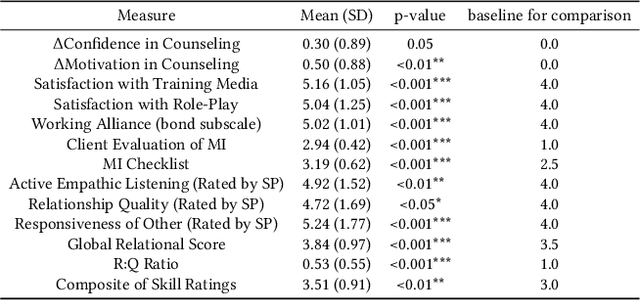
Many laypeople are motivated to improve the health behavior of their family or friends but do not know where to start, especially if the health behavior is potentially stigmatizing or controversial. We present an approach that uses virtual agents to coach community-based volunteers in health counseling techniques, such as motivational interviewing, and allows them to practice these skills in role-playing scenarios. We use this approach in a virtual agent-based system to increase COVID-19 vaccination by empowering users to influence their social network. In a between-subjects comparative design study, we test the effects of agent system interactivity and role-playing functionality on counseling outcomes, with participants evaluated by standardized patients and objective judges. We find that all versions are effective at producing peer counselors who score adequately on a standardized measure of counseling competence, and that participants were significantly more satisfied with interactive virtual agents compared to passive viewing of the training material. We discuss design implications for interpersonal skills training systems based on our findings.