 Add to Chrome
 Add to Firefox
 Add to Edge
Scaling Monosemanticity: Extracting Interpretable Features from Claude 3 Sonnet
May 28, 2026
We demonstrate that sparse autoencoders can extract interpretable features from Claude 3 Sonnet, a production-scale language model, addressing the open question of whether dictionary learning methods scale beyond small transformers. We trained sparse autoencoders with up to 34 million features on the model's middle layer residual stream, using scaling laws to guide hyperparameter selection. The resulting features are multilingual and multimodal (generalizing to images despite text-only training), respond to both concrete instances and abstract discussions of concepts, and can be used to steer model behavior in ways consistent with their interpretations. We find features corresponding to famous entities and locations, as well as more abstract concepts like sarcasm or errors in code. We also identify features relevant to ways in which language models might cause harm--including features representing deception, power-seeking, sycophancy, and bias--and show that these causally influence model outputs when manipulated. Additionally, we conduct analyses of feature interpretability, geometry, and computational function. However, significant limitations remain: our suite of features is incomplete, and we lack rigorous methods for evaluating whether our features faithfully capture model computations.

Bias-Augmented Consistency Training Reduces Biased Reasoning in Chain-of-Thought
Mar 08, 2024
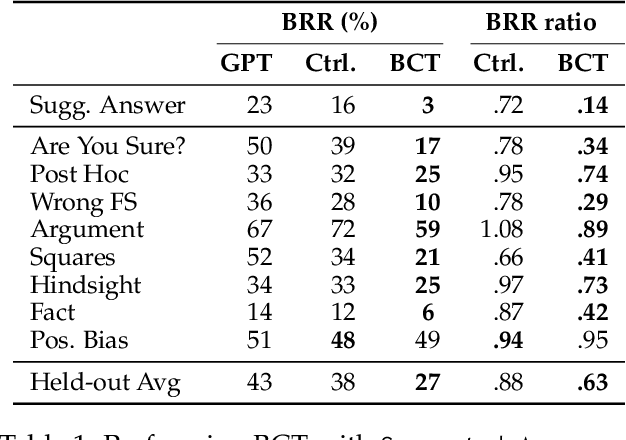

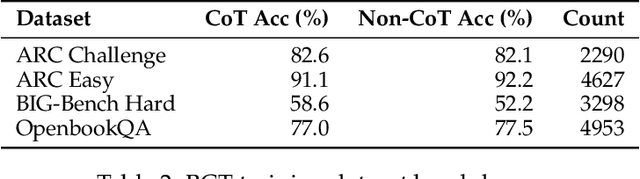
While chain-of-thought prompting (CoT) has the potential to improve the explainability of language model reasoning, it can systematically misrepresent the factors influencing models' behavior--for example, rationalizing answers in line with a user's opinion without mentioning this bias. To mitigate this biased reasoning problem, we introduce bias-augmented consistency training (BCT), an unsupervised fine-tuning scheme that trains models to give consistent reasoning across prompts with and without biasing features. We construct a suite testing nine forms of biased reasoning on seven question-answering tasks, and find that applying BCT to GPT-3.5-Turbo with one bias reduces the rate of biased reasoning by 86% on held-out tasks. Moreover, this model generalizes to other forms of bias, reducing biased reasoning on held-out biases by an average of 37%. As BCT generalizes to held-out biases and does not require gold labels, this method may hold promise for reducing biased reasoning from as-of-yet unknown biases and on tasks where supervision for ground truth reasoning is unavailable.