 Add to Chrome
 Add to Firefox
 Add to Edge
Multimodal Model Diffing for Feature Discovery and Control
Aug 10, 2026
Multimodal Large Language Models (MLLMs) exhibit strong visual understanding, yet the internal features that cause these behaviors remain difficult to identify, audit, or control. While applicable to post-hoc inspection, hidden states that are decomposed into interpretable feature directions using sparse autoencoders (SAEs) neither readily isolate which features are changed by multimodal training, nor are they directly useful for targeted control. We introduce MMDiff, a multimodal model-diffing framework that trains multimodal SAEs and turns them into feature-level interfaces for discovering and controlling multimodal behavior. MMDiff supports three uses: (i) feature isolation, by diffing a base-LM SAE against its multimodal-adapted counterpart to identify features altered by multimodal training; (ii) task-specific feature detection, via per-token contrastive firing analysis that isolates causal features; and (iii) feature-level control, by causally removing or steering the discovered feature directions. We train multimodal SAEs for three MLLM families, LLaVA-MORE, PaliGemma 2, and InternVL3.5, and evaluate on visual-spatial understanding, multimodal safety, and OCR. MMDiff discovers sparse, causally specific features whose removal selectively degrades target behaviors by an average of 12% on spatial tasks and 17% on OCR, and reduces attack success rate by 24% on multimodal safety attacks, with no impact on VQA performance. Steering these features improves spatial and OCR accuracy by +3.6% and +1.8% on average over a standard single-layer steering baseline. These results show that multimodal SAEs can serve not only as interpretability tools, but as mechanisms for auditing, steering, and controlling MLLMs behavior toward safer and more capable generations.

Constitutional Midtraining: Content Presence Drives Alignment Gains
Jul 29, 2026Post-training alignment is often shallow, eroding under fine-tuning. Whether midtraining interventions, cleanly isolated from post-training, can produce durable alignment remains untested. We test this via constitutional midtraining: inserting principled, values-based content into midtraining against a replay-only control at 120B scale. Our 394M-token constitutional corpus, built from Anthropic's Constitution, uses a 2x2 factorial design (curriculum ordering x deliberative reasoning) to produce four constitutionally midtrained conditions plus a control, evaluated on self-generated and established benchmarks including alignment under pressure, value conflict resolution, blackmail, and emergent misalignment across three stages: post-midtraining, post-SFT, and post-benign fine-tuning. Constitutionally midtrained models outperform the control on alignment generalization and durability, notably on blackmail: SFT instills a blackmail propensity in all models, but constitutional midtraining blunts it, with the advantage surviving benign fine-tuning (-17.5pp). This durability does not extend to settings requiring active resistance to in-context pressure or conflict, where the advantage attenuates after SFT. The presence of constitutional content at midtraining also matters more than its structure, and constitutional midtraining incurs no cost, on average, on the capabilities we test (MMLU, ARC-Easy, piqa, GSM8K) at any stage. A modest amount of constitutional content at midtraining could therefore yield broad, persistent alignment gains, offering a cheap, complementary addition to SFT-centered pipelines. Code, data, and models are available.
Reasoning Fine-Tuning Induces Persistent Latent Policy States
Jul 20, 2026Reasoning-specialized language models show large performance gains over base models, yet the internal changes responsible for improved multi-step reasoning remain poorly understood. It is unclear whether reasoning fine-tuning improves local token-level competence or globally reorganizes how models structure inference over time. We address this question by modeling Chain-of-Thought reasoning as a switching dynamical system (SDS), in which internal representations evolve under discrete latent policy states. Our framework combines time-aware contrastive representation learning with discrete regime discovery to recover latent policies from activation trajectories. Across four benchmarks and model scales from 1.5B to 32B parameters, reasoning-fine-tuned models exhibit richer latent-policy organization than their base counterparts, characterized by more differentiated transition structure and model-dependent changes in state utilization, persistence, and mixing. The recovered regimes exhibit functional specialization aligned with distinct reasoning stages, and extensive controls confirm that their structure is not explained by correctness, representation learning, or modeling priors, but depends on the coherent temporal organization of reasoning trajectories. Causal interventions further show that the regimes are functionally meaningful: state-swap ablations reduce one-step predictive fit, while transplanting reasoning dynamics into base models improves performance on challenging reasoning problems. Finally, SDS-guided pruning of failure-prone reasoning prefixes outperforms self-consistency in 11 of 12 model-dataset settings, with gains of up to 12.5 percentage points. Together, our results suggest that reasoning fine-tuning globally reorganizes latent dynamics, offering a new lens for mechanistic analysis and process-level control of reasoning models.
MCJudgeBench: A Benchmark for Constraint-Level Judge Evaluation in Multi-Constraint Instruction Following
May 05, 2026Multi-constraint instruction following requires verifying whether a response satisfies multiple individual requirements, yet LLM judges are often assessed only through overall-response judgments. We introduce MCJudgeBench, a benchmark for constraint-level judge evaluation in multi-constraint instruction following. Each instance includes an instruction, a candidate response, an explicit constraint list, per-constraint gold labels in {yes, partial, no}, and controlled response-side perturbations. The evaluation protocol further includes evaluation prompt variants to test judge stability. We evaluate proprietary and open-source LLM judges using both correctness and inconsistency metrics, distinguishing intrinsic inconsistency under stochastic decoding from procedural inconsistency under prompt and response perturbations. Our results show that judge reliability has multiple dimensions: strong overall performance does not guarantee equally reliable detection across label categories, especially for rarer partial and no cases. Judges with higher correctness do not always have lower inconsistency. Evaluation with reasoning improves correctness but does not uniformly improve stability. These findings motivate evaluating LLM judges at the constraint level to study these failure modes.
Towards Understanding Multimodal Fine-Tuning: Spatial Features
Feb 06, 2026Contemporary Vision-Language Models (VLMs) achieve strong performance on a wide range of tasks by pairing a vision encoder with a pre-trained language model, fine-tuned for visual-text inputs. Yet despite these gains, it remains unclear how language backbone representations adapt during multimodal training and when vision-specific capabilities emerge. In this work, we present the first mechanistic analysis of VLM adaptation. Using stage-wise model diffing, a technique that isolates representational changes introduced during multimodal fine-tuning, we reveal how a language model learns to "see". We first identify vision-preferring features that emerge or reorient during fine-tuning. We then show that a selective subset of these features reliably encodes spatial relations, revealed through controlled shifts to spatial prompts. Finally, we trace the causal activation of these features to a small group of attention heads. Our findings show that stage-wise model diffing reveals when and where spatially grounded multimodal features arise. It also provides a clearer view of modality fusion by showing how visual grounding reshapes features that were previously text-only. This methodology enhances the interpretability of multimodal training and provides a foundation for understanding and refining how pretrained language models acquire vision-grounded capabilities.
SpatialThinker: Reinforcing 3D Reasoning in Multimodal LLMs via Spatial Rewards
Nov 10, 2025Multimodal large language models (MLLMs) have achieved remarkable progress in vision-language tasks, but they continue to struggle with spatial understanding. Existing spatial MLLMs often rely on explicit 3D inputs or architecture-specific modifications, and remain constrained by large-scale datasets or sparse supervision. To address these limitations, we introduce SpatialThinker, a 3D-aware MLLM trained with RL to integrate structured spatial grounding with multi-step reasoning. The model simulates human-like spatial perception by constructing a scene graph of task-relevant objects and spatial relations, and reasoning towards an answer via dense spatial rewards. SpatialThinker consists of two key contributions: (1) a data synthesis pipeline that generates STVQA-7K, a high-quality spatial VQA dataset, and (2) online RL with a multi-objective dense spatial reward enforcing spatial grounding. SpatialThinker-7B outperforms supervised fine-tuning and the sparse RL baseline on spatial understanding and real-world VQA benchmarks, nearly doubling the base-model gain compared to sparse RL, and surpassing GPT-4o. These results showcase the effectiveness of combining spatial supervision with reward-aligned reasoning in enabling robust 3D spatial understanding with limited data and advancing MLLMs towards human-level visual reasoning.
EVCL: Elastic Variational Continual Learning with Weight Consolidation
Jun 23, 2024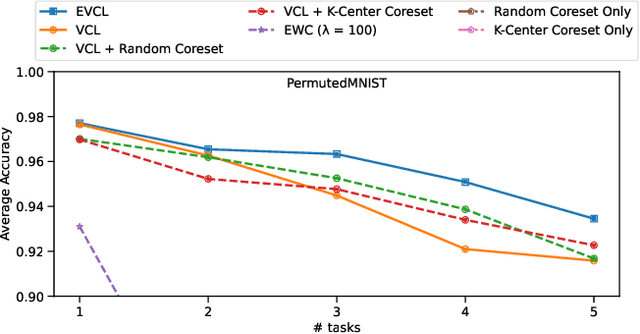
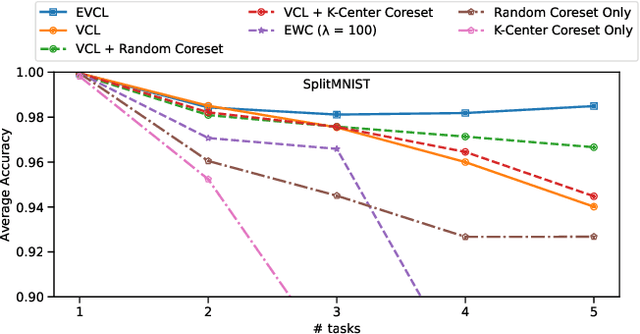
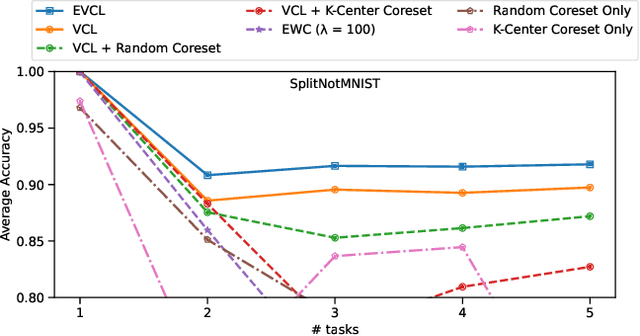
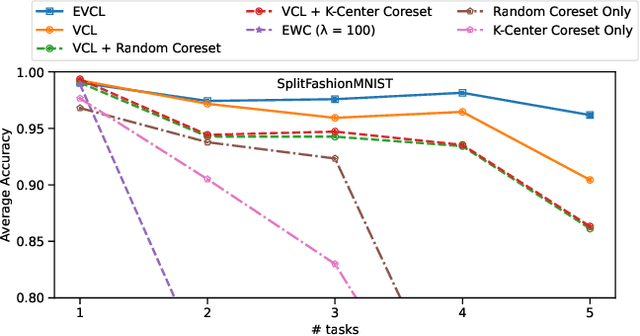
Continual learning aims to allow models to learn new tasks without forgetting what has been learned before. This work introduces Elastic Variational Continual Learning with Weight Consolidation (EVCL), a novel hybrid model that integrates the variational posterior approximation mechanism of Variational Continual Learning (VCL) with the regularization-based parameter-protection strategy of Elastic Weight Consolidation (EWC). By combining the strengths of both methods, EVCL effectively mitigates catastrophic forgetting and enables better capture of dependencies between model parameters and task-specific data. Evaluated on five discriminative tasks, EVCL consistently outperforms existing baselines in both domain-incremental and task-incremental learning scenarios for deep discriminative models.
Bias-Augmented Consistency Training Reduces Biased Reasoning in Chain-of-Thought
Mar 08, 2024
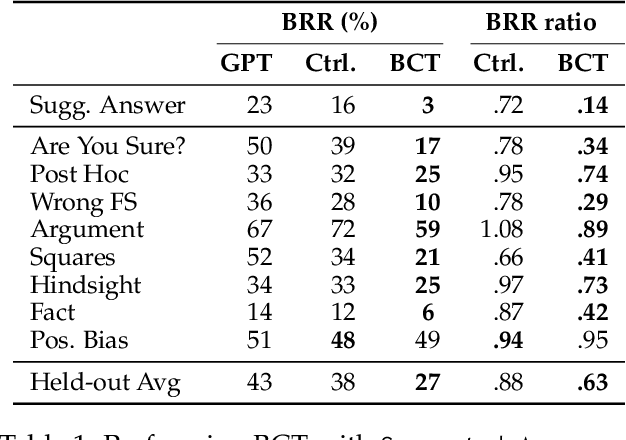

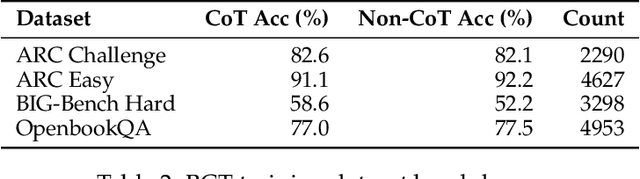
While chain-of-thought prompting (CoT) has the potential to improve the explainability of language model reasoning, it can systematically misrepresent the factors influencing models' behavior--for example, rationalizing answers in line with a user's opinion without mentioning this bias. To mitigate this biased reasoning problem, we introduce bias-augmented consistency training (BCT), an unsupervised fine-tuning scheme that trains models to give consistent reasoning across prompts with and without biasing features. We construct a suite testing nine forms of biased reasoning on seven question-answering tasks, and find that applying BCT to GPT-3.5-Turbo with one bias reduces the rate of biased reasoning by 86% on held-out tasks. Moreover, this model generalizes to other forms of bias, reducing biased reasoning on held-out biases by an average of 37%. As BCT generalizes to held-out biases and does not require gold labels, this method may hold promise for reducing biased reasoning from as-of-yet unknown biases and on tasks where supervision for ground truth reasoning is unavailable.