 Add to Chrome
 Add to Firefox
 Add to Edge
SGA-MCTS: Decoupling Planning from Execution via Training-Free Atomic Experience Retrieval
Apr 16, 2026
LLM-powered systems require complex multi-step decision-making abilities to solve real-world tasks, yet current planning approaches face a trade-off between the high latency of inference-time search and the limited generalization of supervised fine-tuning. To address this limitation, we introduce \textbf{SGA-MCTS}, a framework that casts LLM planning as non-parametric retrieval. Offline, we leverage Monte Carlo Tree Search (MCTS) to explore the solution space and distill high-fidelity trajectories into State-Goal-Action (SGA) atoms. These atoms are de-lexicalized primitives that abstract concrete entities into symbolic slots, preserving reusable causal logic while discarding domain-specific noise. Online, a retrieval-augmented agent employs a hybrid symbolic-semantic mechanism to fetch relevant SGAs and re-ground them into the current context as soft reasoning hints. Empirical results on complex benchmarks demonstrate that this paradigm enables frozen, open-weights models to match the performance of SOTA systems (e.g., GPT-5) without task-specific fine-tuning. By effectively amortizing the heavy computational cost of search, SGA-MCTS achieves System 2 reasoning depth at System 1 inference speeds, rendering autonomous planning both scalable and real-time feasible.

Multi-Level Aware Preference Learning: Enhancing RLHF for Complex Multi-Instruction Tasks
May 19, 2025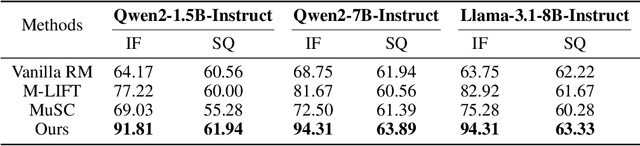
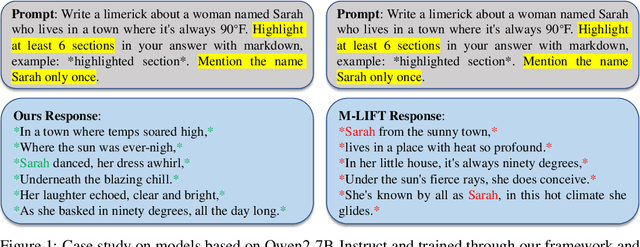
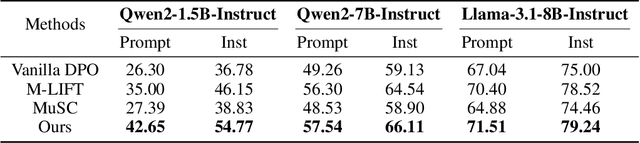
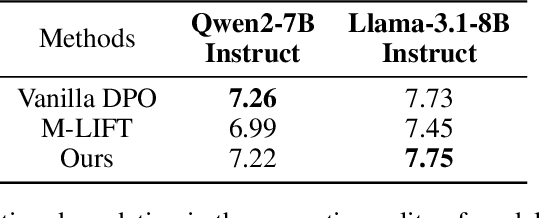
RLHF has emerged as a predominant approach for aligning artificial intelligence systems with human preferences, demonstrating exceptional and measurable efficacy in instruction following tasks; however, it exhibits insufficient compliance capabilities when confronted with complex multi-instruction tasks. Conventional approaches rely heavily on human annotation or more sophisticated large language models, thereby introducing substantial resource expenditure or potential bias concerns. Meanwhile, alternative synthetic methods that augment standard preference datasets often compromise the model's semantic quality. Our research identifies a critical oversight in existing techniques, which predominantly focus on comparing responses while neglecting valuable latent signals embedded within prompt inputs, and which only focus on preference disparities at the intra-sample level, while neglecting to account for the inter-sample level preference differentials that exist among preference data. To leverage these previously neglected indicators, we propose a novel Multi-level Aware Preference Learning (MAPL) framework, capable of enhancing multi-instruction capabilities. Specifically, for any given response in original preference data pairs, we construct varied prompts with a preference relation under different conditions, in order to learn intra-sample level preference disparities. Furthermore, for any given original preference pair, we synthesize multi-instruction preference pairs to capture preference discrepancies at the inter-sample level. Building on the two datasets constructed above, we consequently devise two sophisticated training objective functions. Subsequently, our framework integrates seamlessly into both Reward Modeling and Direct Preference Optimization paradigms. Through rigorous evaluation across multiple benchmarks, we empirically validate the efficacy of our framework.
Bias Fitting to Mitigate Length Bias of Reward Model in RLHF
May 19, 2025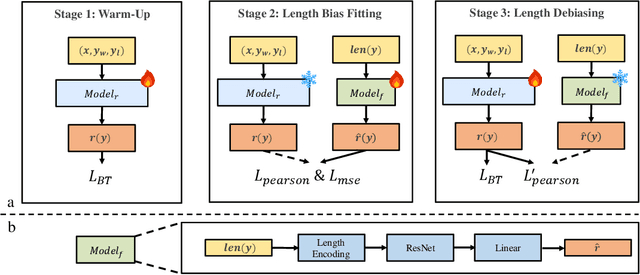
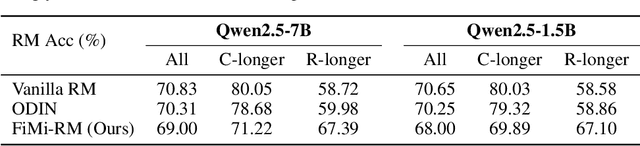
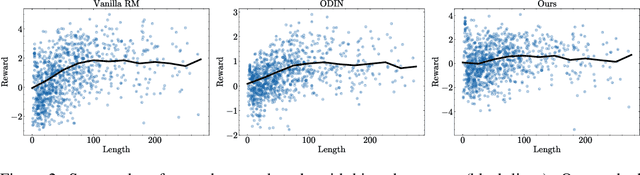

Reinforcement Learning from Human Feedback relies on reward models to align large language models with human preferences. However, RLHF often suffers from reward hacking, wherein policy learning exploits flaws in the trained reward model to maximize reward scores without genuinely aligning with human preferences. A significant example of such reward hacking is length bias, where reward models usually favor longer responses irrespective of actual response quality. Previous works on length bias have notable limitations, these approaches either mitigate bias without characterizing the bias form, or simply assume a linear length-reward relation. To accurately model the intricate nature of length bias and facilitate more effective bias mitigation, we propose FiMi-RM (Bias Fitting to Mitigate Length Bias of Reward Model in RLHF), a framework that autonomously learns and corrects underlying bias patterns. Our approach consists of three stages: First, we train a standard reward model which inherently contains length bias. Next, we deploy a lightweight fitting model to explicitly capture the non-linear relation between length and reward. Finally, we incorporate this learned relation into the reward model to debias. Experimental results demonstrate that FiMi-RM achieves a more balanced length-reward distribution. Furthermore, when applied to alignment algorithms, our debiased reward model improves length-controlled win rate and reduces verbosity without compromising its performance.