 Add to Chrome
 Add to Firefox
 Add to Edge
Sat2City v2: Native 3D City Asset Generation from a Single Satellite Image
Jun 23, 2026
Generating explicit 3D city assets from a single satellite image is important for digital twins, urban simulation, and geospatial intelligence. Unlike satellite-to-street-view synthesis, the task requires a reusable textured mesh with plausible geometry and controllable appearance rather than a 3D proxy optimized only for rendering a small set of images or videos. The ICCV Sat2City framework made a first step by conditioning cascaded sparse-voxel latent diffusion on satellite-derived height maps, but its appearance was random, its training data were synthetic, and its task-specific VAE did not scale well to noisy real-world reconstructions. We present Sat2City v2, a journal extension that adapts a pretrained native structured-latent 3D foundation model to weakly aligned satellite images and textured meshes. We build a real-world dataset with 16,241 satellite-mesh pairs across 24 regions in 9 cities. Instead of learning a 3D representation from noisy city meshes, Sat2City v2 encodes each mesh into a pretrained native 3D latent space, fine-tunes a satellite-conditioned geometry flow, and uses the decoded shape to anchor satellite-conditioned texturing. This retains Sat2City's geometry-to-appearance cascade while enabling appearance-controllable generation from the satellite input. Experiments on metric-scale DSM reconstruction and generative city-asset benchmarks for geometry and appearance show that Sat2City v2 achieves the best overall performance among evaluated baselines. Overall, Sat2City v2 advances satellite-to-city generation from rendering-oriented 3D proxies to explicit textured mesh assets, supported by, to the best of our knowledge, the first documented satellite-mesh paired dataset collected from matched geographic crops for this asset-level task. Project page: https://ai4city-hkust.github.io/Sat2City-v2/

GraspFoM: Towards Reconstruction-Driven Robotic Grasping with 3D Foundation Priors
Jun 07, 2026Robotic grasping is a fundamental capability in robotic manipulation. Yet grasping remains challenging under partial observations. Reliable grasping depends on both local contact cues and object-level 3D structure. Existing geometry-aware grasping methods recognize the value of reconstruction, but they typically treat geometry as an intermediate prediction rather than a reusable object prior for grasping. In this paper, we present GraspFoM, a unified framework that leverages 3D foundation priors (SAM3D) to build a shared 3D object latent for both reconstruction and grasp pose prediction. Built on this shared object latent, we introduce an anchor-initialized truncated pose-reasoning diffuser that predicts continuous and multimodal grasp poses without directly relying on discrete grasp candidates. We further investigate the interaction between reconstruction and grasping through a reconstruction-aware scorer and a residual latent updater. Reconstruction provides grounded geometric cues, while grasp supervision refines the shared object latent toward grasp-relevant affordances. GraspFoM jointly predicts grasp poses and reconstructs high-fidelity 3D assets in mesh and 3DGS forms. Comprehensive experiments demonstrate that GraspFoM achieves state-of-the-art results on both reconstruction and grasping. Notably, these improvements require only a small number of additional trainable parameters. Component-wise ablation studies also demonstrate the contribution of each component.
Feed-Forward Gaussian Splatting from Sparse Aerial Views
May 19, 2026Reconstructing large-scale urban scenes from sparse aerial views is a crucial yet challenging task. Due to biased top-down and shallow-oblique camera poses, sparse aerial captures exhibit strong evidence imbalance: roofs and open regions are repeatedly observed, while facades, distant buildings, and occluded structures receive little multi-view support. Existing feed-forward 3D Gaussian Splatting methods directly regress a deterministic representation from sparse inputs, but this often leads to ghosting, melted facades, and stretched textures. Recent pseudo-view and video-based generative reconstruction methods use additional supervision or generative priors. However, they often lack a clear separation between observed geometry and prior-driven content, which can lead to plausible but inconsistent structures. We propose AnyCity, an observation-grounded generative reconstruction framework for sparse aerial urban scenes. AnyCity first predicts an observation-supported geometry latent to anchor reliable structures, and then uses scaffold-conditioned aerial completion tokens to predict a gated residual update for weakly constrained content before Gaussian decoding. During training, dense-to-sparse distillation transfers structural cues from dense-view reconstruction, while an aerial-adapted video diffusion prior provides fine-grained urban appearance cues through gated token conditioning. Observation-preserving objectives keep the refined representation consistent with input-supported geometry. At inference time, AnyCity reconstructs the final 3D Gaussian scene from sparse aerial views in a single feed-forward pass, achieving coherent urban novel-view synthesis with second-level inference. Experiments on synthetic, aerial-domain, UAV-textured, and real-world scenes show consistent improvements over feed-forward baselines.
PhyMix: Towards Physically Consistent Single-Image 3D Indoor Scene Generation with Implicit--Explicit Optimization
Apr 11, 2026Existing single-image 3D indoor scene generators often produce results that look visually plausible but fail to obey real-world physics, limiting their reliability in robotics, embodied AI, and design. To examine this gap, we introduce a unified Physics Evaluator that measures four main aspects: geometric priors, contact, stability, and deployability, which are further decomposed into nine sub-constraints, establishing the first benchmark to measure physical consistency. Based on this evaluator, our analysis shows that state-of-the-art methods remain largely physics-unaware. To overcome this limitation, we further propose a framework that integrates feedback from the Physics Evaluator into both training and inference, enhancing the physical plausibility of generated scenes. Specifically, we propose PhyMix, which is composed of two complementary components: (i) implicit alignment via Scene-GRPO, a critic-free group-relative policy optimization that leverages the Physics Evaluator as a preference signal and biases sampling towards physically feasible layouts, and (ii) explicit refinement via a plug-and-play Test-Time Optimizer (TTO) that uses differentiable evaluator signals to correct residual violations during generation. Overall, our method unifies evaluation, reward shaping, and inference-time correction, producing 3D indoor scenes that are visually faithful and physically plausible. Extensive synthetic evaluations confirm state-of-the-art performance in both visual fidelity and physical plausibility, and extensive qualitative examples in stylized and real-world images further showcase the robustness of the method. We will release codes and models upon publication.
DNRSelect: Active Best View Selection for Deferred Neural Rendering
Jan 21, 2025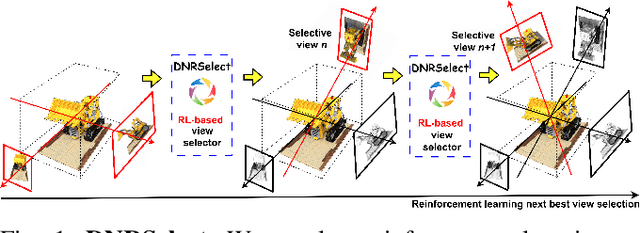
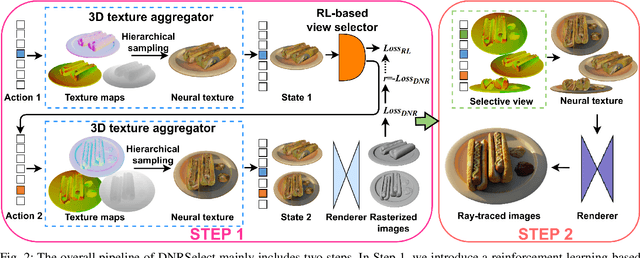
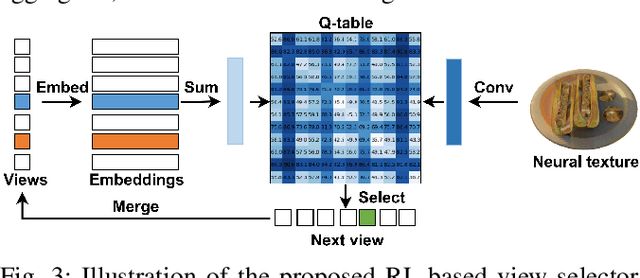
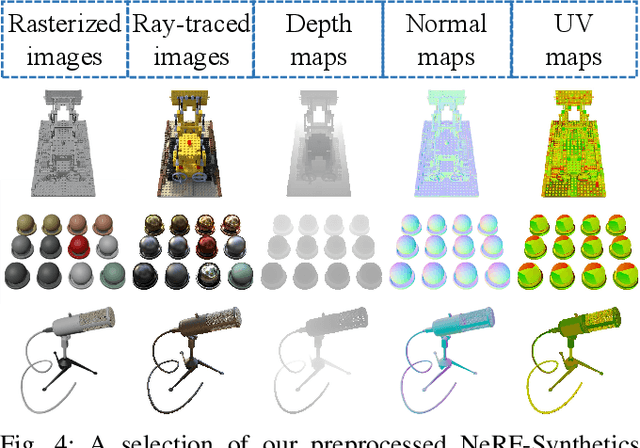
Deferred neural rendering (DNR) is an emerging computer graphics pipeline designed for high-fidelity rendering and robotic perception. However, DNR heavily relies on datasets composed of numerous ray-traced images and demands substantial computational resources. It remains under-explored how to reduce the reliance on high-quality ray-traced images while maintaining the rendering fidelity. In this paper, we propose DNRSelect, which integrates a reinforcement learning-based view selector and a 3D texture aggregator for deferred neural rendering. We first propose a novel view selector for deferred neural rendering based on reinforcement learning, which is trained on easily obtained rasterized images to identify the optimal views. By acquiring only a few ray-traced images for these selected views, the selector enables DNR to achieve high-quality rendering. To further enhance spatial awareness and geometric consistency in DNR, we introduce a 3D texture aggregator that fuses pyramid features from depth maps and normal maps with UV maps. Given that acquiring ray-traced images is more time-consuming than generating rasterized images, DNRSelect minimizes the need for ray-traced data by using only a few selected views while still achieving high-fidelity rendering results. We conduct detailed experiments and ablation studies on the NeRF-Synthetic dataset to demonstrate the effectiveness of DNRSelect. The code will be released.
SVGS-DSGAT: An IoT-Enabled Innovation in Underwater Robotic Object Detection Technology
Jan 21, 2025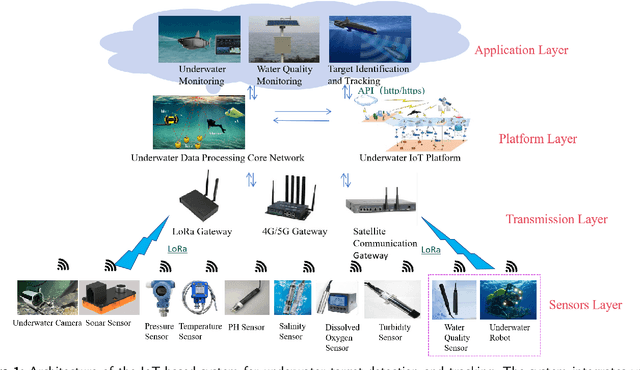
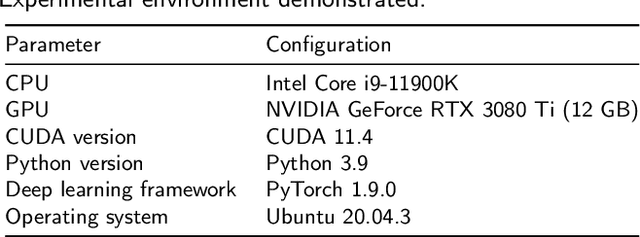
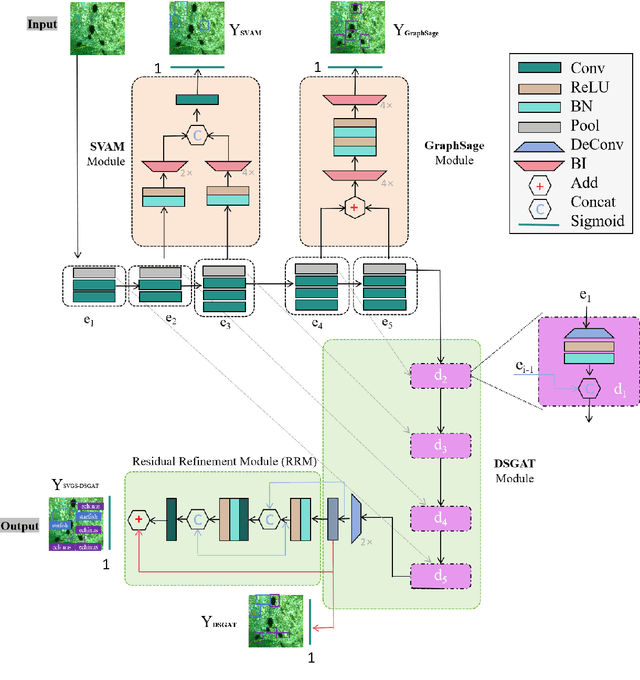
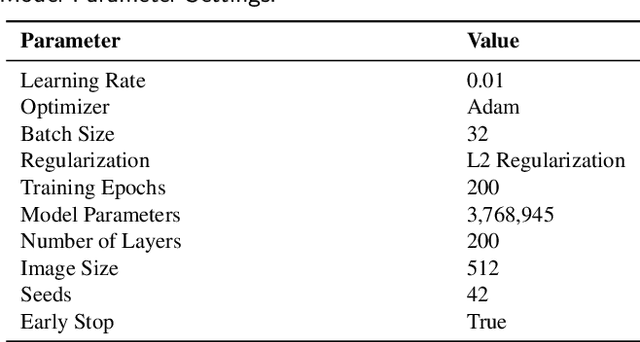
With the advancement of Internet of Things (IoT) technology, underwater target detection and tracking have become increasingly important for ocean monitoring and resource management. Existing methods often fall short in handling high-noise and low-contrast images in complex underwater environments, lacking precision and robustness. This paper introduces a novel SVGS-DSGAT model that combines GraphSage, SVAM, and DSGAT modules, enhancing feature extraction and target detection capabilities through graph neural networks and attention mechanisms. The model integrates IoT technology to facilitate real-time data collection and processing, optimizing resource allocation and model responsiveness. Experimental results demonstrate that the SVGS-DSGAT model achieves an mAP of 40.8% on the URPC 2020 dataset and 41.5% on the SeaDronesSee dataset, significantly outperforming existing mainstream models. This IoT-enhanced approach not only excels in high-noise and complex backgrounds but also improves the overall efficiency and scalability of the system. This research provides an effective IoT solution for underwater target detection technology, offering significant practical application value and broad development prospects.
* 17 pages, 8 figures