 Add to Chrome
 Add to Firefox
 Add to Edge
Rotational Symmetry based Object Pose Estimation from Point Clouds in the Absence of Known 3D Models
Jun 15, 2026
Object pose estimation is crucial to many industrial applications, with one example being automated spray painting using a robot. However, confidentiality concerns often limit access to high-quality 3D models, posing a significant challenge for point-cloud-based pose estimation. In such scenarios, rotational symmetry, a readily accessible characteristic of many industrial objects, can provide valuable prior information to facilitate pose estimation.In this paper, we propose a method that leverages the rotational symmetry commonly found in industrial objects to address the challenge caused by the absence of 3D models. The object pose is jointly estimated with point cloud refinement through an iterative optimization process. This optimization relies on a rotational symmetry constraint loss. To construct this loss, each 3D point is rotated according to the currently estimated pose, and multiple correspondences are identified using nearest-neighbor search by exploiting the rotational symmetry property. These correspondences are then used to compute the rotational symmetry constraint loss, which iteratively refines both the pose and the point cloud.By explicitly incorporating rotational symmetry into the optimization process, the proposed method achieves robust pose estimation and generalizes well across diverse object types. The proposed method is evaluated on a dataset specifically created for point clouds without known 3D models, consisting of four categories of synthetic objects and one real wheel hub collected from a production line. Experimental results demonstrate that the proposed method achieves performance comparable to methods that rely on known 3D models.

A Dataset for Evaluating Multi-spectral Motion Estimation Methods
Jul 01, 2020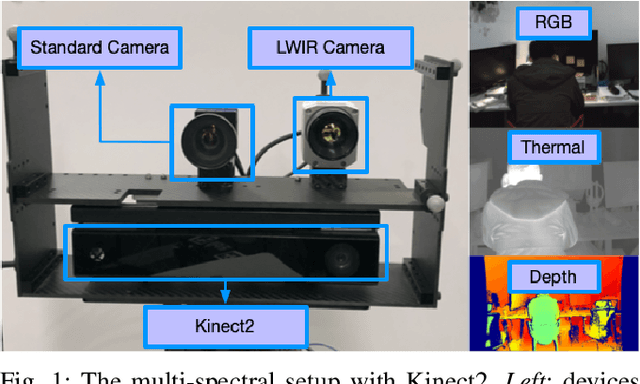
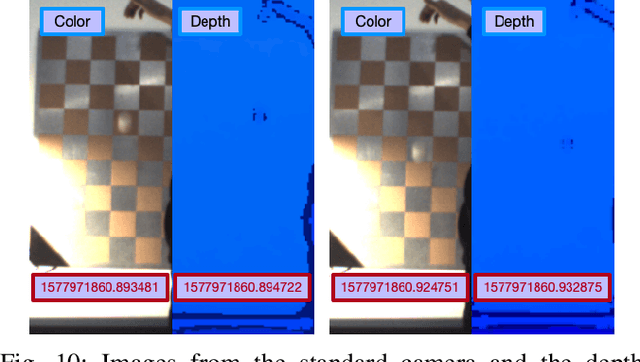
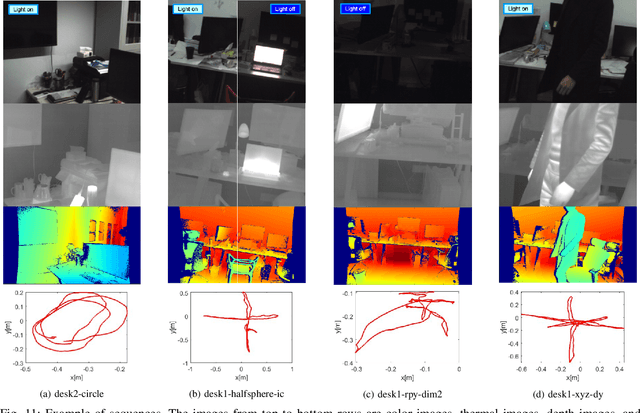
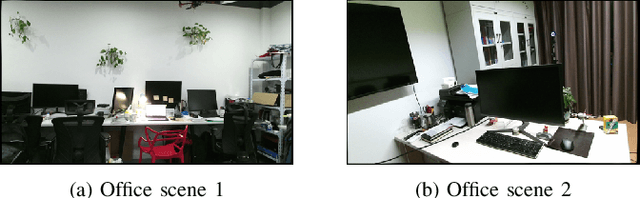
Visible images have been widely used for indoor motion estimation. Thermal images, in contrast, are more challenging to be used in motion estimation since they typically have lower resolution, less texture, and more noise. In this paper, a novel dataset for evaluating the performance of multi-spectral motion estimation systems is presented. The dataset includes both multi-spectral and dense depth images with accurate ground-truth camera poses provided by a motion capture system. All the sequences are recorded from a handheld multi-spectral device, which consists of a standard visible-light camera, a long-wave infrared camera, and a depth camera. The multi-spectral images, including both color and thermal images in full sensor resolution (640 $\times$ 480), are obtained from the hardware-synchronized standard and long-wave infrared camera at 32Hz. The depth images are captured by a Microsoft Kinect2 and can have benefits for learning cross-modalities stereo matching. In addition to the sequences with bright illumination, the dataset also contains scenes with dim or varying illumination. The full dataset, including both raw data and calibration data with detailed specifications of data format, is publicly available.
Multi-Spectral Visual Odometry without Explicit Stereo Matching
Aug 23, 2019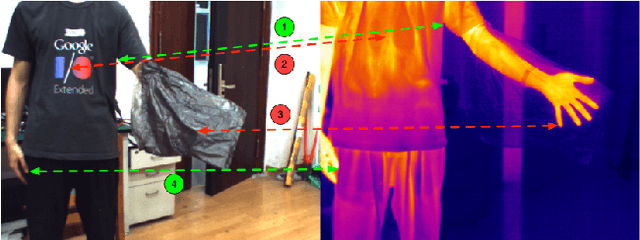
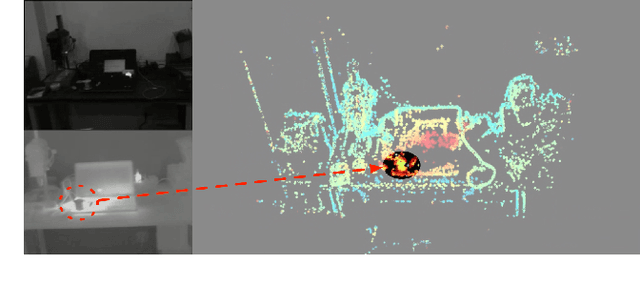
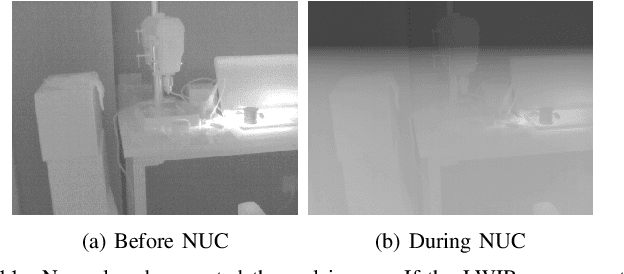
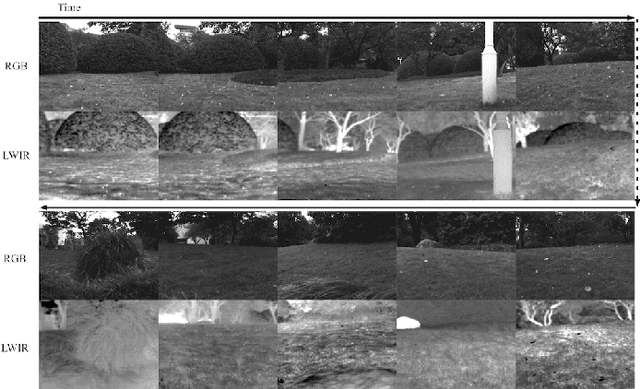
Multi-spectral sensors consisting of a standard (visible-light) camera and a long-wave infrared camera can simultaneously provide both visible and thermal images. Since thermal images are independent from environmental illumination, they can help to overcome certain limitations of standard cameras under complicated illumination conditions. However, due to the difference in the information source of the two types of cameras, their images usually share very low texture similarity. Hence, traditional texture-based feature matching methods cannot be directly applied to obtain stereo correspondences. To tackle this problem, a multi-spectral visual odometry method without explicit stereo matching is proposed in this paper. Bundle adjustment of multi-view stereo is performed on the visible and the thermal images using direct image alignment. Scale drift can be avoided by additional temporal observations of map points with the fixed-baseline stereo. Experimental results indicate that the proposed method can provide accurate visual odometry results with recovered metric scale. Moreover, the proposed method can also provide a metric 3D reconstruction in semi-dense density with multi-spectral information, which is not available from existing multi-spectral methods.