 Add to Chrome
 Add to Firefox
 Add to Edge
Heuristic Classification of Thoughts Prompting (HCoT): Integrating Expert System Heuristics for Structured Reasoning into Large Language Models
Apr 14, 2026
This paper addresses two limitations of large language models (LLMs) in solving complex problems: (1) their reasoning processes exhibit Bayesian-like stochastic generation, where each token is sampled from a context-dependent probability distribution, leading to inherently random decision trajectories rather than deterministic planning; (2) the reasoning and decision-making mechanisms are statically decoupled, meaning dynamically retrieved domain knowledge fails to dynamically adjust the underlying reasoning strategy. These dual deficiencies result in initial decisions lacking strategic anchoring and reasoning chains often failing to converge on correct solutions, as stochastic generation lacks mechanisms for trajectory correction or knowledge-guided optimization during sequential reasoning. To resolve these issues, we propose a problem-solving method integrated into the LLM's generation process to guide reasoning. This method, compatible with numerous LLMs and featuring reusable solutions, is grounded in a novel Heuristic-Classification-of-Thoughts prompting schema (HCoT). HCoT synergizes the LLM's reasoning ability with a structured problem space via a heuristic classification model that controls the reasoning process and provides reusable abstract solutions. Evaluated on two complex inductive reasoning tasks with ill-defined search spaces, HCoT outperforms existing approaches (e.g., Tree-of-Thoughts and Chain-of-Thoughts prompting) in performance. On the well-structured 24 Game task, HCoT demonstrates significantly higher token efficiency compared to the state-of-the-art Tree-of-Thoughts-Breadth-First-Search. In terms of both accuracy and token usage, HCoT achieves a Pareto frontier balance, offering a strong trade-off between performance and computational cost.

RoChBert: Towards Robust BERT Fine-tuning for Chinese
Oct 28, 2022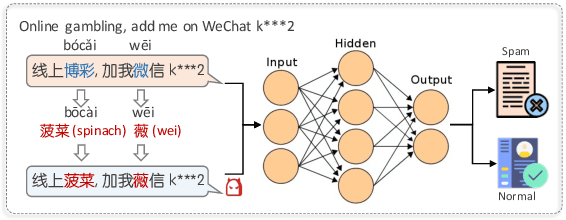
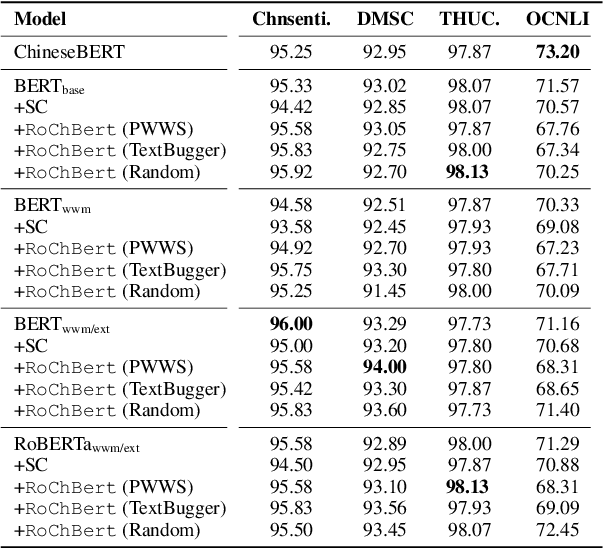
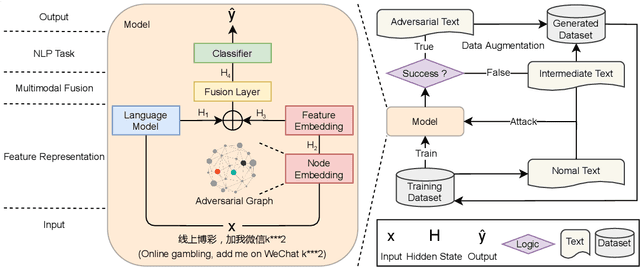
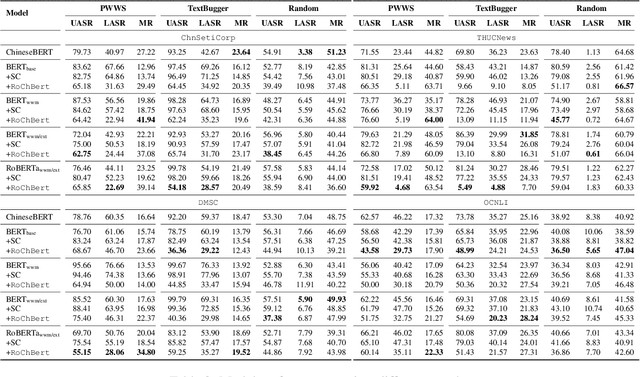
Despite of the superb performance on a wide range of tasks, pre-trained language models (e.g., BERT) have been proved vulnerable to adversarial texts. In this paper, we present RoChBERT, a framework to build more Robust BERT-based models by utilizing a more comprehensive adversarial graph to fuse Chinese phonetic and glyph features into pre-trained representations during fine-tuning. Inspired by curriculum learning, we further propose to augment the training dataset with adversarial texts in combination with intermediate samples. Extensive experiments demonstrate that RoChBERT outperforms previous methods in significant ways: (i) robust -- RoChBERT greatly improves the model robustness without sacrificing accuracy on benign texts. Specifically, the defense lowers the success rates of unlimited and limited attacks by 59.43% and 39.33% respectively, while remaining accuracy of 93.30%; (ii) flexible -- RoChBERT can easily extend to various language models to solve different downstream tasks with excellent performance; and (iii) efficient -- RoChBERT can be directly applied to the fine-tuning stage without pre-training language model from scratch, and the proposed data augmentation method is also low-cost.