 Add to Chrome
 Add to Firefox
 Add to Edge
Spatio-Temporal Similarity Volume Aggregation for Open-Vocabulary Action Recognition
May 22, 2026
Recent Open-Vocabulary Action Recognition (OVAR) methods typically aggregate visual features into a global representation before computing text alignment, a process that obscures local patch information and fine-grained spatio-temporal cues. We propose Similarity Volume Aggregation (SimVA), a framework that constructs a dense 4D spatio-temporal similarity volume from patch-level visual-text similarities. SimVA constructs a spatio-temporal similarity volume over local video tokens and action classes, and employs class sampling to ensure similarity aggregation scalable to large vocabularies. The similarity volume is refined by spatial aggregation, which contextualizes local similarity patterns to improve intra-frame consistency. Motion-aware modulation further injects inter-frame variation cues, highlighting dynamically changing regions. Mamba-based temporal aggregation then models the evolution of class-conditioned similarity patterns across frames. By maintaining dense visual-text correspondence, SimVA effectively transfers CLIP to video action recognition, achieving competitive performance across zero-shot, few-shot, and base-to-novel benchmarks.

Enhancing Alignment for Unified Multimodal Models via Semantically-Grounded Supervision
Mar 20, 2026Unified Multimodal Models (UMMs) have emerged as a promising paradigm that integrates multimodal understanding and generation within a unified modeling framework. However, current generative training paradigms suffer from inherent limitations. We present Semantically-Grounded Supervision (SeGroS), a fine-tuning framework designed to resolve the granularity mismatch and supervisory redundancy in UMMs. At its core, we propose a novel visual grounding map to construct two complementary supervision signals. First, we formulate semantic Visual Hints to compensate for the sparsity of text prompts. Second, we generate a semantically-grounded Corrupted Input to explicitly enhance the supervision of masking-based UMMs by restricting the reconstruction loss to core text-aligned regions. Extensive evaluations on GenEval, DPGBench, and CompBench demonstrate that SeGroS significantly improves generation fidelity and cross-modal alignment across various UMM architectures.
FluoCLIP: Stain-Aware Focus Quality Assessment in Fluorescence Microscopy
Feb 27, 2026Accurate focus quality assessment (FQA) in fluorescence microscopy remains challenging, as the stain-dependent optical properties of fluorescent dyes cause abrupt and heterogeneous focus shifts. However, existing datasets and models overlook this variability, treating focus quality as a stain-agnostic problem. In this work, we formulate the task of stain-aware FQA, emphasizing that focus behavior in fluorescence microscopy must be modeled as a function of staining characteristics. Through quantitative analysis of existing datasets (FocusPath, BBBC006) and our newly curated FluoMix, we demonstrate that focus-rank relationships vary substantially across stains, underscoring the need for stain-aware modeling in fluorescence microscopy. To support this new formulation, we propose FluoMix, the first dataset for stain-aware FQA that encompasses multiple tissues, fluorescent stains, and focus variations. Building on this dataset, we propose FluoCLIP, a two-stage vision-language framework that leverages CLIP's alignment capability to interpret focus quality in the context of biological staining. In the stain-grounding phase, FluoCLIP learns general stain representations by aligning textual stain tokens with visual features, while in the stain-guided ranking phase, it optimizes stain-specific rank prompts for ordinal focus prediction. Together, our formulation, dataset, and framework establish the first foundation for stain-aware FQA, and FluoCLIP achieves strong generalization across diverse fluorescence microscopy conditions.
Difficulty-Aware Label-Guided Denoising for Monocular 3D Object Detection
Nov 17, 2025Monocular 3D object detection is a cost-effective solution for applications like autonomous driving and robotics, but remains fundamentally ill-posed due to inherently ambiguous depth cues. Recent DETR-based methods attempt to mitigate this through global attention and auxiliary depth prediction, yet they still struggle with inaccurate depth estimates. Moreover, these methods often overlook instance-level detection difficulty, such as occlusion, distance, and truncation, leading to suboptimal detection performance. We propose MonoDLGD, a novel Difficulty-Aware Label-Guided Denoising framework that adaptively perturbs and reconstructs ground-truth labels based on detection uncertainty. Specifically, MonoDLGD applies stronger perturbations to easier instances and weaker ones into harder cases, and then reconstructs them to effectively provide explicit geometric supervision. By jointly optimizing label reconstruction and 3D object detection, MonoDLGD encourages geometry-aware representation learning and improves robustness to varying levels of object complexity. Extensive experiments on the KITTI benchmark demonstrate that MonoDLGD achieves state-of-the-art performance across all difficulty levels.
RobIA: Robust Instance-aware Continual Test-time Adaptation for Deep Stereo
Nov 13, 2025Stereo Depth Estimation in real-world environments poses significant challenges due to dynamic domain shifts, sparse or unreliable supervision, and the high cost of acquiring dense ground-truth labels. While recent Test-Time Adaptation (TTA) methods offer promising solutions, most rely on static target domain assumptions and input-invariant adaptation strategies, limiting their effectiveness under continual shifts. In this paper, we propose RobIA, a novel Robust, Instance-Aware framework for Continual Test-Time Adaptation (CTTA) in stereo depth estimation. RobIA integrates two key components: (1) Attend-and-Excite Mixture-of-Experts (AttEx-MoE), a parameter-efficient module that dynamically routes input to frozen experts via lightweight self-attention mechanism tailored to epipolar geometry, and (2) Robust AdaptBN Teacher, a PEFT-based teacher model that provides dense pseudo-supervision by complementing sparse handcrafted labels. This strategy enables input-specific flexibility, broad supervision coverage, improving generalization under domain shift. Extensive experiments demonstrate that RobIA achieves superior adaptation performance across dynamic target domains while maintaining computational efficiency.
TADFormer : Task-Adaptive Dynamic Transformer for Efficient Multi-Task Learning
Jan 08, 2025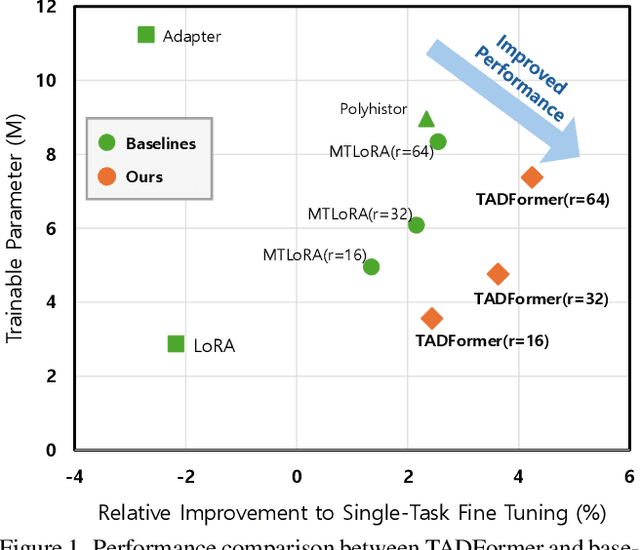
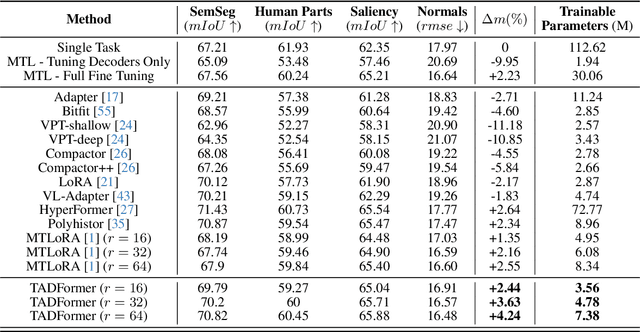
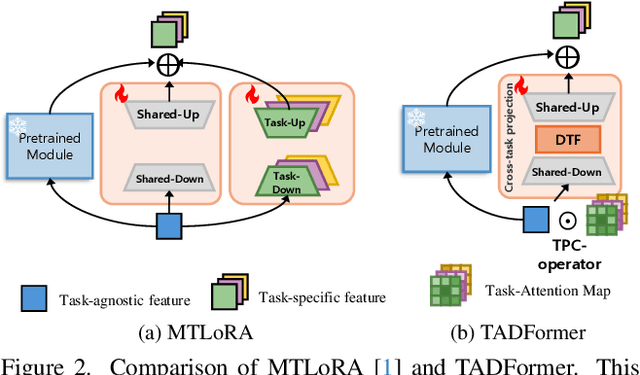

Transfer learning paradigm has driven substantial advancements in various vision tasks. However, as state-of-the-art models continue to grow, classical full fine-tuning often becomes computationally impractical, particularly in multi-task learning (MTL) setup where training complexity increases proportional to the number of tasks. Consequently, recent studies have explored Parameter-Efficient Fine-Tuning (PEFT) for MTL architectures. Despite some progress, these approaches still exhibit limitations in capturing fine-grained, task-specific features that are crucial to MTL. In this paper, we introduce Task-Adaptive Dynamic transFormer, termed TADFormer, a novel PEFT framework that performs task-aware feature adaptation in the fine-grained manner by dynamically considering task-specific input contexts. TADFormer proposes the parameter-efficient prompting for task adaptation and the Dynamic Task Filter (DTF) to capture task information conditioned on input contexts. Experiments on the PASCAL-Context benchmark demonstrate that the proposed method achieves higher accuracy in dense scene understanding tasks, while reducing the number of trainable parameters by up to 8.4 times when compared to full fine-tuning of MTL models. TADFormer also demonstrates superior parameter efficiency and accuracy compared to recent PEFT methods.
Improving Generative Pre-Training: An In-depth Study of Masked Image Modeling and Denoising Models
Dec 26, 2024
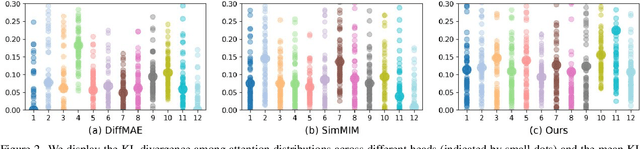


In this work, we dive deep into the impact of additive noise in pre-training deep networks. While various methods have attempted to use additive noise inspired by the success of latent denoising diffusion models, when used in combination with masked image modeling, their gains have been marginal when it comes to recognition tasks. We thus investigate why this would be the case, in an attempt to find effective ways to combine the two ideas. Specifically, we find three critical conditions: corruption and restoration must be applied within the encoder, noise must be introduced in the feature space, and an explicit disentanglement between noised and masked tokens is necessary. By implementing these findings, we demonstrate improved pre-training performance for a wide range of recognition tasks, including those that require fine-grained, high-frequency information to solve.
Hybrid-TTA: Continual Test-time Adaptation via Dynamic Domain Shift Detection
Sep 13, 2024Continual Test Time Adaptation (CTTA) has emerged as a critical approach for bridging the domain gap between the controlled training environments and the real-world scenarios, enhancing model adaptability and robustness. Existing CTTA methods, typically categorized into Full-Tuning (FT) and Efficient-Tuning (ET), struggle with effectively addressing domain shifts. To overcome these challenges, we propose Hybrid-TTA, a holistic approach that dynamically selects instance-wise tuning method for optimal adaptation. Our approach introduces the Dynamic Domain Shift Detection (DDSD) strategy, which identifies domain shifts by leveraging temporal correlations in input sequences and dynamically switches between FT and ET to adapt to varying domain shifts effectively. Additionally, the Masked Image Modeling based Adaptation (MIMA) framework is integrated to ensure domain-agnostic robustness with minimal computational overhead. Our Hybrid-TTA achieves a notable 1.6%p improvement in mIoU on the Cityscapes-to-ACDC benchmark dataset, surpassing previous state-of-the-art methods and offering a robust solution for real-world continual adaptation challenges.
SG-MIM: Structured Knowledge Guided Efficient Pre-training for Dense Prediction
Sep 04, 2024Masked Image Modeling (MIM) techniques have redefined the landscape of computer vision, enabling pre-trained models to achieve exceptional performance across a broad spectrum of tasks. Despite their success, the full potential of MIM-based methods in dense prediction tasks, particularly in depth estimation, remains untapped. Existing MIM approaches primarily rely on single-image inputs, which makes it challenging to capture the crucial structured information, leading to suboptimal performance in tasks requiring fine-grained feature representation. To address these limitations, we propose SG-MIM, a novel Structured knowledge Guided Masked Image Modeling framework designed to enhance dense prediction tasks by utilizing structured knowledge alongside images. SG-MIM employs a lightweight relational guidance framework, allowing it to guide structured knowledge individually at the feature level rather than naively combining at the pixel level within the same architecture, as is common in traditional multi-modal pre-training methods. This approach enables the model to efficiently capture essential information while minimizing discrepancies between pre-training and downstream tasks. Furthermore, SG-MIM employs a selective masking strategy to incorporate structured knowledge, maximizing the synergy between general representation learning and structured knowledge-specific learning. Our method requires no additional annotations, making it a versatile and efficient solution for a wide range of applications. Our evaluations on the KITTI, NYU-v2, and ADE20k datasets demonstrate SG-MIM's superiority in monocular depth estimation and semantic segmentation.
UniTT-Stereo: Unified Training of Transformer for Enhanced Stereo Matching
Sep 04, 2024


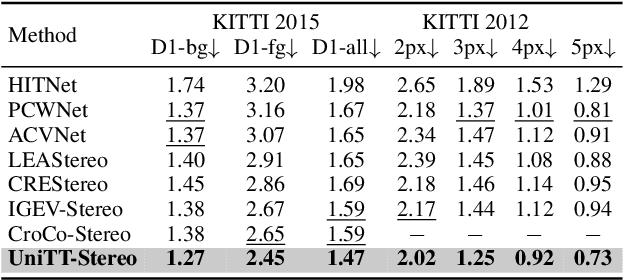
Unlike other vision tasks where Transformer-based approaches are becoming increasingly common, stereo depth estimation is still dominated by convolution-based approaches. This is mainly due to the limited availability of real-world ground truth for stereo matching, which is a limiting factor in improving the performance of Transformer-based stereo approaches. In this paper, we propose UniTT-Stereo, a method to maximize the potential of Transformer-based stereo architectures by unifying self-supervised learning used for pre-training with stereo matching framework based on supervised learning. To be specific, we explore the effectiveness of reconstructing features of masked portions in an input image and at the same time predicting corresponding points in another image from the perspective of locality inductive bias, which is crucial in training models with limited training data. Moreover, to address these challenging tasks of reconstruction-and-prediction, we present a new strategy to vary a masking ratio when training the stereo model with stereo-tailored losses. State-of-the-art performance of UniTT-Stereo is validated on various benchmarks such as ETH3D, KITTI 2012, and KITTI 2015 datasets. Lastly, to investigate the advantages of the proposed approach, we provide a frequency analysis of feature maps and the analysis of locality inductive bias based on attention maps.