 Add to Chrome
 Add to Firefox
 Add to Edge
ProgVLA: Progress-Aware Robot Manipulation Skill Learning
May 27, 2026
We present ProgVLA, a compact vision-language-action (VLA) model designed for reliable robot manipulation under tight compute and memory budgets. The model specifically focuses on efficiently processing long multi-modal sequences by maintaining an explicit representation of task progress over extended horizons. To this end, ProgVLA integrates two key components. First, a multi-modal encoder with a two-stage Perceiver resampling scheme compresses variable-length visual, language, and proprioceptive streams into a fixed set of control-ready context tokens, substantially reducing sequence length while preserving cross-modal grounding. Second, an auxiliary set of progress heads is trained with offline reinforcement learning (RL) objectives to jointly learn critics over normalized remaining-horizon targets. This provides the policy with an internal estimate of task progress and enables advantage- and success-weighted flow-matching imitation learning. On two well-established multi-task robot manipulation benchmarks, a 0.1B-parameter ProgVLA model reaches success rates that are competitive with, and on long-horizon and harder task tiers exceed, substantially larger pretrained baselines. Ablations indicate that the learned context resampler and task-adaptive visual fine-tuning are the largest single contributors, while progress-aware training provides a consistent additional gain that is concentrated on long-horizon and multi-object tasks. We further validate the approach in real-world toy-kitchen environments.

Difficulty-Aware Label-Guided Denoising for Monocular 3D Object Detection
Nov 17, 2025Monocular 3D object detection is a cost-effective solution for applications like autonomous driving and robotics, but remains fundamentally ill-posed due to inherently ambiguous depth cues. Recent DETR-based methods attempt to mitigate this through global attention and auxiliary depth prediction, yet they still struggle with inaccurate depth estimates. Moreover, these methods often overlook instance-level detection difficulty, such as occlusion, distance, and truncation, leading to suboptimal detection performance. We propose MonoDLGD, a novel Difficulty-Aware Label-Guided Denoising framework that adaptively perturbs and reconstructs ground-truth labels based on detection uncertainty. Specifically, MonoDLGD applies stronger perturbations to easier instances and weaker ones into harder cases, and then reconstructs them to effectively provide explicit geometric supervision. By jointly optimizing label reconstruction and 3D object detection, MonoDLGD encourages geometry-aware representation learning and improves robustness to varying levels of object complexity. Extensive experiments on the KITTI benchmark demonstrate that MonoDLGD achieves state-of-the-art performance across all difficulty levels.
TADFormer : Task-Adaptive Dynamic Transformer for Efficient Multi-Task Learning
Jan 08, 2025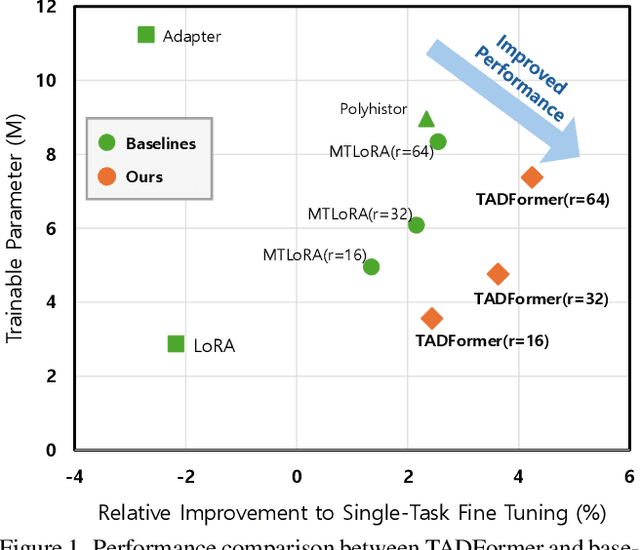
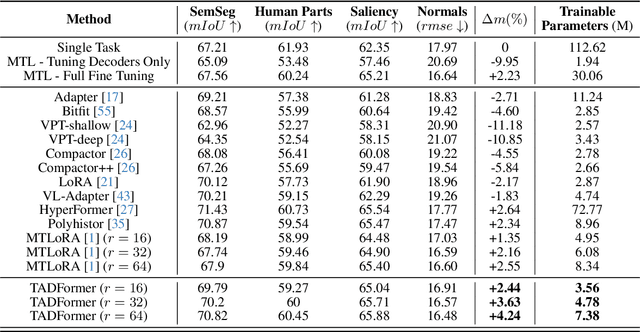
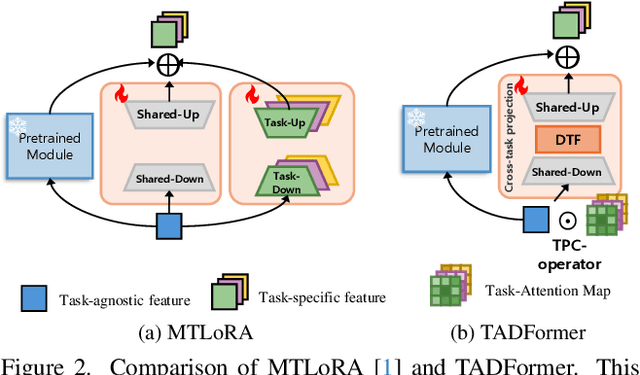

Transfer learning paradigm has driven substantial advancements in various vision tasks. However, as state-of-the-art models continue to grow, classical full fine-tuning often becomes computationally impractical, particularly in multi-task learning (MTL) setup where training complexity increases proportional to the number of tasks. Consequently, recent studies have explored Parameter-Efficient Fine-Tuning (PEFT) for MTL architectures. Despite some progress, these approaches still exhibit limitations in capturing fine-grained, task-specific features that are crucial to MTL. In this paper, we introduce Task-Adaptive Dynamic transFormer, termed TADFormer, a novel PEFT framework that performs task-aware feature adaptation in the fine-grained manner by dynamically considering task-specific input contexts. TADFormer proposes the parameter-efficient prompting for task adaptation and the Dynamic Task Filter (DTF) to capture task information conditioned on input contexts. Experiments on the PASCAL-Context benchmark demonstrate that the proposed method achieves higher accuracy in dense scene understanding tasks, while reducing the number of trainable parameters by up to 8.4 times when compared to full fine-tuning of MTL models. TADFormer also demonstrates superior parameter efficiency and accuracy compared to recent PEFT methods.