 Add to Chrome
 Add to Firefox
 Add to Edge
When Eyes Betray AI: Social Gaze Consistency as a Semantic Cue for AI-Generated Image Detection
May 27, 2026
Recent generative models have largely closed the gap on low-level artifacts - pixel fingerprints, frequency anomalies, upsampling traces - particularly in person-centric and partial-edit settings where the manipulated region is small and surrounded by photometrically authentic content. We introduce Social Gaze Consistency, a high-level semantic cue defined as the mutual coherence of gaze direction, head-eye alignment, and pupil placement between interacting individuals, and show that it constitutes a previously underutilized detection axis orthogonal to existing low-level paradigms. We instantiate this insight through three coupled mechanisms: (i) a controlled diagnostic dataset with region-specific perturbations of gaze-consistent imagery, where strict pair-level grouping forecloses generator-fingerprint memorization as an optimization-time shortcut rather than relying on augmentation; (ii) Block-Compositional Caption Supervision, which holds a single 5-block reasoning skeleton invariant across 1,250 macro-combined captions, decoupling reasoning consistency from surface diversity; (iii) Cross-architecture validation showing the same supervision improves a vision-language backbone (FakeVLM) by +3.7 pp on the COCOAI Interaction subset (balanced accuracy 67.8 -> 71.5) and +1.3 pp on the COCOAI Person subset (83.0 -> 84.3), with consistent gains on a vision-only backbone (Effort), evidencing a backbone-agnostic cue. Real- and fake-class recalls rise simultaneously, ruling out a "predict-all-fake" artifact. A four-step mechanistic account - paired-edit shortcut blocking, hard-to-easy difficulty transfer, CLIP prior preservation, and diffusion-family shared spectral weakness in periocular structure - explains why training on a single inpainter (FLUX.1-Fill) transfers to multi-generator suites. We will release the code upon acceptance to facilitate reproducibility.

AdaMerge: Salience-Aware Adaptive Token Merging for Training-Free Acceleration of Vision Transformers
May 26, 2026The quadratic cost of self-attention in Vision Transformers (ViTs) constitutes a fundamental bottleneck for practical deployment, motivating a vibrant line of research on token reduction. Among existing approaches, token merging (ToMe) has emerged as an elegant training-free solution; yet its design rests on an unspoken premise of token equality, which contravenes the well-documented non-uniformity of self-attention and leads to information loss in high-salience tokens under aggressive compression. We address this limitation with AdaMerge, a token-merging framework based on two complementary mechanisms. First, salience-weighted similarity leverages column-wise feature-affinity centrality as a token-importance proxy and incorporates the resulting salience scores into the bipartite matching score, ensuring that pivotal tokens contribute more strongly to the merged representation. Second, adaptive merging intensity uses pre-computed layer-wise similarity statistics to dynamically modulate the per-layer reduction count in accordance with input-specific redundancy. On ImageNet-1k with ViT-B/16, AdaMerge consistently outperforms ToMe, PiToMe, and DSM across all FLOPs-matched regimes. The accuracy gap widens monotonically with compression: at the 13.4G FLOPs operating point, AdaMerge sustains a Top-1 degradation of only -1.06%, compared to -1.45% for PiToMe and -4.62% for DSM. To our knowledge, AdaMerge is the first to combine salience-weighted similarity and adaptive per-layer reduction into a single training-free token merging framework, advancing the accuracy-FLOPs Pareto frontier of ViT acceleration.
The Rescue Effect: Spatio-Semantic Early Exit Bypasses Quantization Collapse in CLIP
May 26, 2026Deploying Vision-Language Models on resource-constrained hardware typically requires INT8 quantization, but in joint-embedding architectures such as CLIP this introduces a failure mode distinct from quantized CNN classifiers: activation noise accumulated across transformer blocks perturbs the direction of the multimodal embedding, eroding the cosine alignment on which zero-shot retrieval depends. We characterize this as Quantization-Induced Representation Collapse (QIRC) and quantify it on INT8 CLIP ViT-B/32, where the layer-wise noise-to-signal ratio grows from below 10% in shallow blocks to 52% at Layer 11. We propose LRA-EE (Layer-wise Representation-Aware Early Exit), which bypasses noise-saturated deep layers via Spatio-Semantic Aggregation (replacing the immature shallow [CLS] with a global patch-token average), a learned multi-feature gate (confidence, top-2 margin, spatial-activation variance), and Layer-adaptive Confidence Thresholding calibrated to each layer's Information-to-Noise Ratio. On ImageNet-1K zero-shot classification, LRA-EE reduces FLOPs by 13.4% and improves Top-1 accuracy by +2.44%p (58.72% -> 61.16%) over the INT8 baseline. A four-quadrant decomposition isolates the Rescue Effect: 9.5% of samples are correctly classified at shallow exits but lost to noise at full depth, against only 7.1% suffering the inverse.
What Does the Caption Really Say? Counterfactual Phrase Intervention for Compositional Data Selection in Vision-Language Pretraining
May 21, 2026CLIP-style contrastive pretraining typically curates web-scale image-text pairs using sample-level filtering signals, often based on pair-level alignment. We show that this signal saturates: once coarse mismatches are removed, stricter global filtering no longer tracks the compositional supervision provided by the retained captions. The reason is structural - a global score conflates whether a pair is broadly plausible with whether the individual object, attribute, and relation phrases inside the caption materially support the image-text match. The latter is what compositional generalization demands, yet pair-level filters are blind to it. We address this with Counterfactual Phrase Intervention (CPI), a phrase-level curation framework that converts controlled nonce-token substitutions into image-conditioned phrase-sensitivity scores. CPI uses global alignment only for coarse mismatch removal, then ranks the surviving pool by whether caption phrases measurably affect the image-text score under controlled substitution. We frame CPI as a first-order phrase-sensitivity signal rather than a grounding or identification result, and evaluate it at CC3M scale. Ranking by this signal yields a 50%-data subset that improves VL-CheckList-VG Relation by +1.91 over the full-data baseline and +1.00 over alignment-only filtering at matched budget, while improving SugarCrepe overall and preserving general transfer. CPI is loss-orthogonal: applied unchanged to NegCLIP, it further improves VL-CheckList-VG Relation by +3.84, with additional CE-CLIP gains in the main text.
Enhancing Alignment for Unified Multimodal Models via Semantically-Grounded Supervision
Mar 20, 2026Unified Multimodal Models (UMMs) have emerged as a promising paradigm that integrates multimodal understanding and generation within a unified modeling framework. However, current generative training paradigms suffer from inherent limitations. We present Semantically-Grounded Supervision (SeGroS), a fine-tuning framework designed to resolve the granularity mismatch and supervisory redundancy in UMMs. At its core, we propose a novel visual grounding map to construct two complementary supervision signals. First, we formulate semantic Visual Hints to compensate for the sparsity of text prompts. Second, we generate a semantically-grounded Corrupted Input to explicitly enhance the supervision of masking-based UMMs by restricting the reconstruction loss to core text-aligned regions. Extensive evaluations on GenEval, DPGBench, and CompBench demonstrate that SeGroS significantly improves generation fidelity and cross-modal alignment across various UMM architectures.
RobIA: Robust Instance-aware Continual Test-time Adaptation for Deep Stereo
Nov 13, 2025Stereo Depth Estimation in real-world environments poses significant challenges due to dynamic domain shifts, sparse or unreliable supervision, and the high cost of acquiring dense ground-truth labels. While recent Test-Time Adaptation (TTA) methods offer promising solutions, most rely on static target domain assumptions and input-invariant adaptation strategies, limiting their effectiveness under continual shifts. In this paper, we propose RobIA, a novel Robust, Instance-Aware framework for Continual Test-Time Adaptation (CTTA) in stereo depth estimation. RobIA integrates two key components: (1) Attend-and-Excite Mixture-of-Experts (AttEx-MoE), a parameter-efficient module that dynamically routes input to frozen experts via lightweight self-attention mechanism tailored to epipolar geometry, and (2) Robust AdaptBN Teacher, a PEFT-based teacher model that provides dense pseudo-supervision by complementing sparse handcrafted labels. This strategy enables input-specific flexibility, broad supervision coverage, improving generalization under domain shift. Extensive experiments demonstrate that RobIA achieves superior adaptation performance across dynamic target domains while maintaining computational efficiency.
TADFormer : Task-Adaptive Dynamic Transformer for Efficient Multi-Task Learning
Jan 08, 2025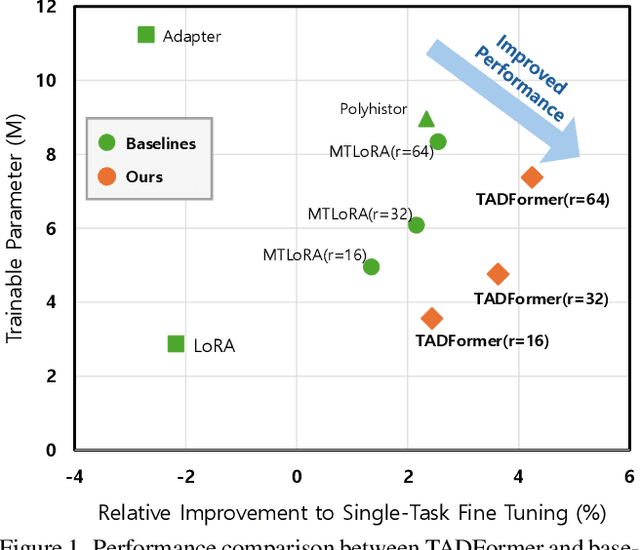
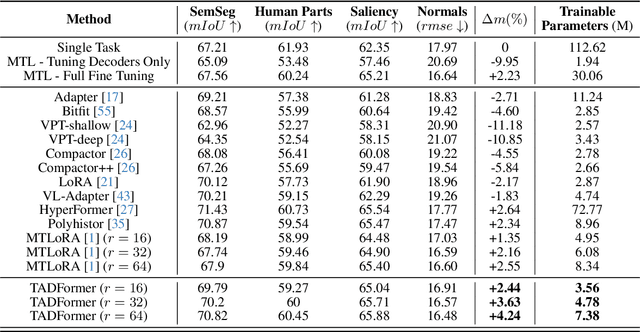
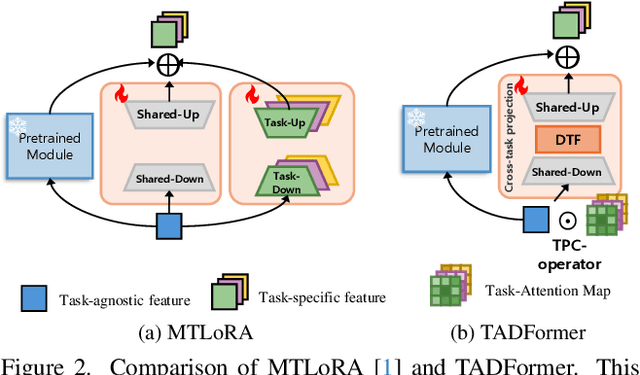

Transfer learning paradigm has driven substantial advancements in various vision tasks. However, as state-of-the-art models continue to grow, classical full fine-tuning often becomes computationally impractical, particularly in multi-task learning (MTL) setup where training complexity increases proportional to the number of tasks. Consequently, recent studies have explored Parameter-Efficient Fine-Tuning (PEFT) for MTL architectures. Despite some progress, these approaches still exhibit limitations in capturing fine-grained, task-specific features that are crucial to MTL. In this paper, we introduce Task-Adaptive Dynamic transFormer, termed TADFormer, a novel PEFT framework that performs task-aware feature adaptation in the fine-grained manner by dynamically considering task-specific input contexts. TADFormer proposes the parameter-efficient prompting for task adaptation and the Dynamic Task Filter (DTF) to capture task information conditioned on input contexts. Experiments on the PASCAL-Context benchmark demonstrate that the proposed method achieves higher accuracy in dense scene understanding tasks, while reducing the number of trainable parameters by up to 8.4 times when compared to full fine-tuning of MTL models. TADFormer also demonstrates superior parameter efficiency and accuracy compared to recent PEFT methods.
Improving Generative Pre-Training: An In-depth Study of Masked Image Modeling and Denoising Models
Dec 26, 2024
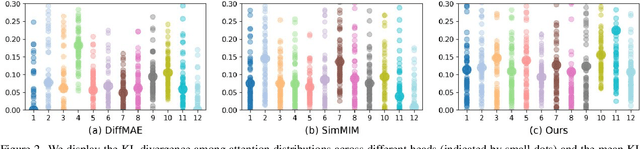


In this work, we dive deep into the impact of additive noise in pre-training deep networks. While various methods have attempted to use additive noise inspired by the success of latent denoising diffusion models, when used in combination with masked image modeling, their gains have been marginal when it comes to recognition tasks. We thus investigate why this would be the case, in an attempt to find effective ways to combine the two ideas. Specifically, we find three critical conditions: corruption and restoration must be applied within the encoder, noise must be introduced in the feature space, and an explicit disentanglement between noised and masked tokens is necessary. By implementing these findings, we demonstrate improved pre-training performance for a wide range of recognition tasks, including those that require fine-grained, high-frequency information to solve.
SG-MIM: Structured Knowledge Guided Efficient Pre-training for Dense Prediction
Sep 04, 2024Masked Image Modeling (MIM) techniques have redefined the landscape of computer vision, enabling pre-trained models to achieve exceptional performance across a broad spectrum of tasks. Despite their success, the full potential of MIM-based methods in dense prediction tasks, particularly in depth estimation, remains untapped. Existing MIM approaches primarily rely on single-image inputs, which makes it challenging to capture the crucial structured information, leading to suboptimal performance in tasks requiring fine-grained feature representation. To address these limitations, we propose SG-MIM, a novel Structured knowledge Guided Masked Image Modeling framework designed to enhance dense prediction tasks by utilizing structured knowledge alongside images. SG-MIM employs a lightweight relational guidance framework, allowing it to guide structured knowledge individually at the feature level rather than naively combining at the pixel level within the same architecture, as is common in traditional multi-modal pre-training methods. This approach enables the model to efficiently capture essential information while minimizing discrepancies between pre-training and downstream tasks. Furthermore, SG-MIM employs a selective masking strategy to incorporate structured knowledge, maximizing the synergy between general representation learning and structured knowledge-specific learning. Our method requires no additional annotations, making it a versatile and efficient solution for a wide range of applications. Our evaluations on the KITTI, NYU-v2, and ADE20k datasets demonstrate SG-MIM's superiority in monocular depth estimation and semantic segmentation.
CLDA: Collaborative Learning for Enhanced Unsupervised Domain Adaptation
Sep 04, 2024
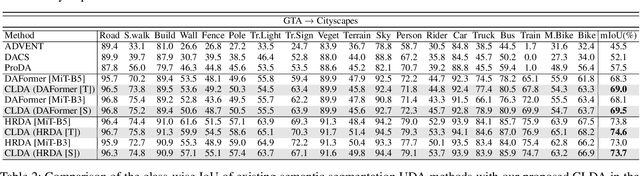

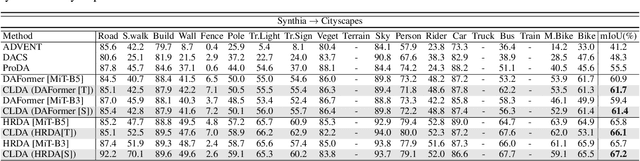
Unsupervised Domain Adaptation (UDA) endeavors to bridge the gap between a model trained on a labeled source domain and its deployment in an unlabeled target domain. However, current high-performance models demand significant resources, resulting in prohibitive deployment costs and highlighting the need for small yet effective models. For UDA of lightweight models, Knowledge Distillation (KD) in a Teacher-Student framework can be a common approach, but we find that domain shift in UDA leads to a significant increase in non-salient parameters in the teacher model, degrading model's generalization ability and transferring misleading information to the student model. Interestingly, we observed that this phenomenon occurs considerably less in the student model. Driven by this insight, we introduce Collaborative Learning, a method that updates the teacher's non-salient parameters using the student model and at the same time enhance the student's performance using the updated teacher model. Experiments across various tasks and datasets show consistent performance improvements for both student and teacher models. For example, in semantic segmentation, CLDA achieves an improvement of +0.7% mIoU for teacher and +1.4% mIoU for student compared to the baseline model in the GTA to Cityscapes. In the Synthia to Cityscapes, it achieves an improvement of +0.8% mIoU for teacher and +2.0% mIoU for student.