 Add to Chrome
 Add to Firefox
 Add to Edge
World Action Models Enable Continual Imitation Learning with Recurrent Generative Replays
Jun 25, 2026
Going beyond predicting robot actions, World Action Models (WAMs) can also generate future visual observations. We build on this generative capability to propose Recurrent Generative Replay (REGEN), a continual imitation learning framework that synthesizes pseudo-replay trajectories, enabling a robot policy to rehearse previously learned tasks without storing their original human demonstrations. During continual adaptation, REGEN recursively queries the WAM to synthesize pseudo-replay trajectories conditioned only on prior task instructions and current-task observations. Experiments in both simulation and real-world manipulation settings show that REGEN reduces catastrophic forgetting by up to $50\%$ relative to sequential fine-tuning, while approaching the performance of privileged experience replay methods that require access to real replay data. Finally, we analyze the factors limiting generated replay, identifying long-horizon visual degradation and action-observation inconsistency as the primary bottlenecks. Our results establish WAMs as a promising foundation for continual robot learning without stored demonstrations.

Design and Development of an ML/DL Attack Resistance of RC-Based PUF for IoT Security
Mar 26, 2026Physically Unclonable Functions (PUFs) provide promising hardware security for IoT authentication, leveraging inherent randomness suitable for resource constrained environments. However, ML/DL modeling attacks threaten PUF security by learning challenge-response patterns. This work introduces a custom resistor-capacitor (RC) based dynamically reconfigurable PUF using 32-bit challenge-response pairs (CRPs) designed to resist such attacks. We systematically evaluated robustness by generating a CRP dataset and splitting it into training, validation, and test sets. Multiple ML techniques including Artificial Neural Networks (ANN), Gradient Boosted Neural Networks (GBNN), Decision Trees (DT), Random Forests (RF), and XGBoost, were trained to model PUF behavior. While all models achieved 100% training accuracy, test performance remained near random guessing: 51.05% (ANN), 53.27% (GBNN), 50.06% (DT), 52.08% (RF), and 50.97% (XGBoost). These results demonstrate the proposed PUF's strong resistance to ML-driven modeling attacks, as advanced algorithms fail to reproduce accurate responses. The dynamically reconfigurable architecture enhances robustness against adversarial threats with minimal resource overhead. This simple RC-PUF offers an effective, low-cost alternative to complex encryption for securing next-generation IoT authentication against machine learning-based threats, ensuring reliable device verification without compromising computational efficiency or scalability in deployed IoT networks.
Heterogeneous Time Constants Improve Stability in Equilibrium Propagation
Mar 03, 2026Equilibrium propagation (EP) is a biologically plausible alternative to backpropagation for training neural networks. However, existing EP models use a uniform scalar time step dt, which corresponds biologically to a membrane time constant that is heterogeneous across neurons. Here, we introduce heterogeneous time steps (HTS) for EP by assigning neuron-specific time constants drawn from biologically motivated distributions. We show that HTS improves training stability while maintaining competitive task performance. These results suggest that incorporating heterogeneous temporal dynamics enhances both the biological realism and robustness of equilibrium propagation.
JUSTICE: A Benchmark Dataset for Supreme Court's Judgment Prediction
Dec 06, 2021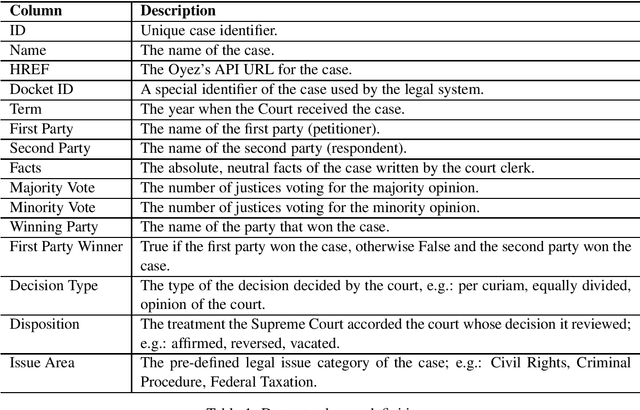
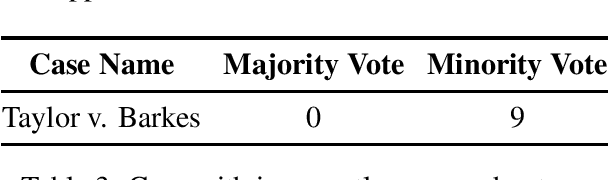
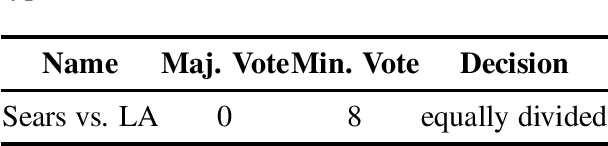
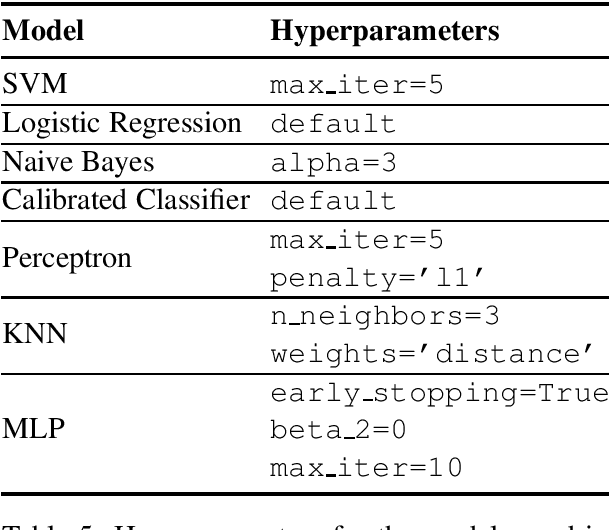
Artificial intelligence is being utilized in many domains as of late, and the legal system is no exception. However, as it stands now, the number of well-annotated datasets pertaining to legal documents from the Supreme Court of the United States (SCOTUS) is very limited for public use. Even though the Supreme Court rulings are public domain knowledge, trying to do meaningful work with them becomes a much greater task due to the need to manually gather and process that data from scratch each time. Hence, our goal is to create a high-quality dataset of SCOTUS court cases so that they may be readily used in natural language processing (NLP) research and other data-driven applications. Additionally, recent advances in NLP provide us with the tools to build predictive models that can be used to reveal patterns that influence court decisions. By using advanced NLP algorithms to analyze previous court cases, the trained models are able to predict and classify a court's judgment given the case's facts from the plaintiff and the defendant in textual format; in other words, the model is emulating a human jury by generating a final verdict.