 Add to Chrome
 Add to Firefox
 Add to Edge
Midpoint Generative Models
May 28, 2026
We introduce Midpoint Generative Models (MGM), a principled framework for training one-step generative models. MGM is based on a simple symmetry of Flow Matching with linear interpolation: when the two endpoint distributions coincide, the corresponding drift field vanishes at the midpoint time, $t=1/2$. We show that the norm of this field defines a valid discrepancy between distributions, which we call the Midpoint Divergence. We extend this discrepancy beyond the midpoint by introducing randomly flipped interpolations and further generalize it by replacing deterministic linear Flow Matching interpolations with symmetric stochastic interpolants, yielding a generalized Midpoint Divergence. Finally, we derive a variational formulation of our generalized divergence, yielding a tractable objective for training a one-step generator. The resulting MGM algorithm offers an effective and theoretically grounded approach to generative modeling, achieving competitive performance against existing one-step generative modeling methods.

Plan, Don't Pose: Long Composite Motion Generation with Text-Aligned BFM
May 28, 2026Text-to-motion (T2M) generation has broad applications in character animation, virtual avatars, and human-robot interaction. Existing methods typically generate pose trajectories or motion tokens directly from language, forcing a single model to handle semantic interpretation, long-horizon structure, and low-level physical realization. This coupling makes them costly and often unreliable for long, compositional, or semantically dense prompts. We propose Text2BFM, the first framework that aligns natural language with pretrained Behavioral Foundation Models (BFMs) for T2M generation without relying on heavy end-to-end motion generators. Text2BFM operates in the latent policy space of a frozen BFM, using it as an executable motion prior. A text-aligned variational behavioral bottleneck compresses BFM policy-latent sequences into compact motion representations that are compatible with language and preserve long-horizon behavioral structure. Generation is performed in this compact behavioral manifold with a lightweight conditional generator, and the resulting latent encoded behaviors are decoded into policy latents that drive the pretrained frozen BFM. By decoupling semantic planning from motion execution, Text2BFM achieves efficient, robust T2M generation and strong performance on long, compositional textual descriptions.
Convex Compositional Reasoning Models
May 25, 2026Compositional energy-based models can generalize to larger combinatorial reasoning problems by reusing a learned factor energy across many local constraints. In our paper, we show that a key bottleneck in compositional reasoning is not composition itself, but the non-convex geometry of the learned energy landscape. To solve this problem, we introduce Convex Compositional Energy Minimization (CCEM), a framework that parameterizes each factor with an input-convex neural network and optimizes the composed energy over a tight convex relaxation of the feasible set. Because convexity is preserved under summation, the global relaxed objective remains convex, enabling deterministic projected first-order optimization. CCEM is trained in two stages: factor-level contrastive learning to shape local energy basins, followed by end-to-end refinement through an unrolled projected solver. Our experiments show that our models trained on small subproblems or a single problem size transfer to larger instances without retraining.
ChexFract: From General to Specialized -- Enhancing Fracture Description Generation
Nov 11, 2025Generating accurate and clinically meaningful radiology reports from chest X-ray images remains a significant challenge in medical AI. While recent vision-language models achieve strong results in general radiology report generation, they often fail to adequately describe rare but clinically important pathologies like fractures. This work addresses this gap by developing specialized models for fracture pathology detection and description. We train fracture-specific vision-language models with encoders from MAIRA-2 and CheXagent, demonstrating significant improvements over general-purpose models in generating accurate fracture descriptions. Analysis of model outputs by fracture type, location, and age reveals distinct strengths and limitations of current vision-language model architectures. We publicly release our best-performing fracture-reporting model, facilitating future research in accurate reporting of rare pathologies.
HOTA: Hamiltonian framework for Optimal Transport Advection
Jul 23, 2025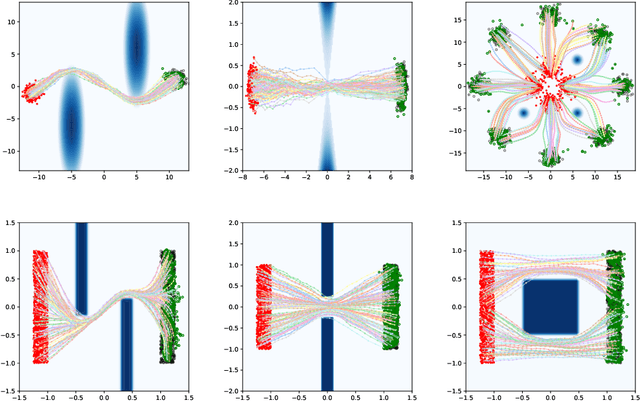
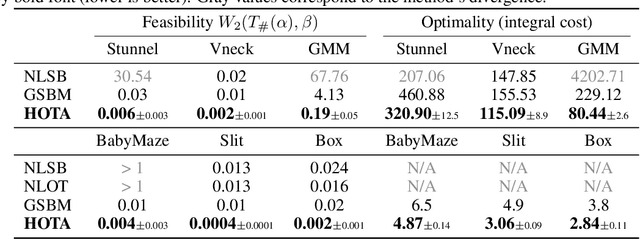
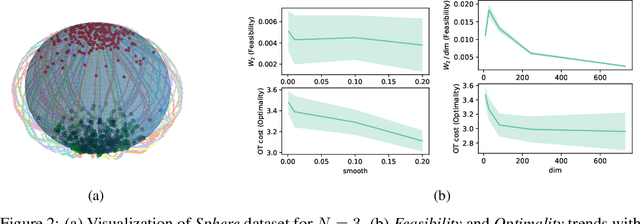
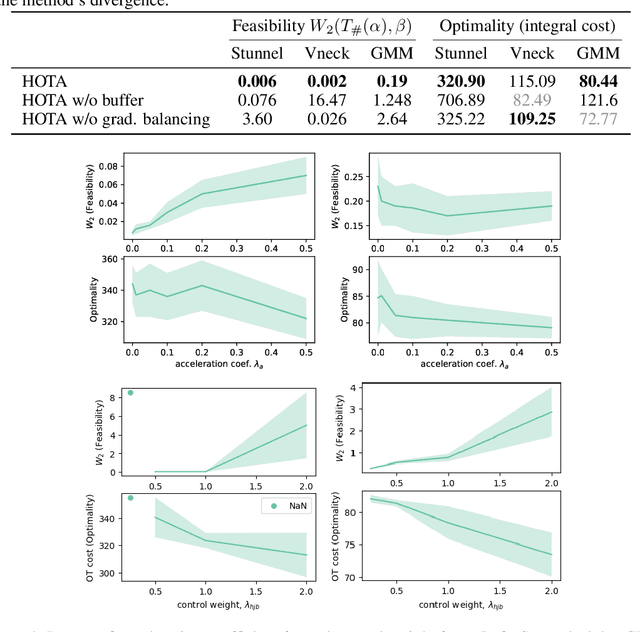
Optimal transport (OT) has become a natural framework for guiding the probability flows. Yet, the majority of recent generative models assume trivial geometry (e.g., Euclidean) and rely on strong density-estimation assumptions, yielding trajectories that do not respect the true principles of optimality in the underlying manifold. We present Hamiltonian Optimal Transport Advection (HOTA), a Hamilton-Jacobi-Bellman based method that tackles the dual dynamical OT problem explicitly through Kantorovich potentials, enabling efficient and scalable trajectory optimization. Our approach effectively evades the need for explicit density modeling, performing even when the cost functionals are non-smooth. Empirically, HOTA outperforms all baselines in standard benchmarks, as well as in custom datasets with non-differentiable costs, both in terms of feasibility and optimality.
Suppressing Modulation Instability with Reinforcement Learning
Apr 05, 2024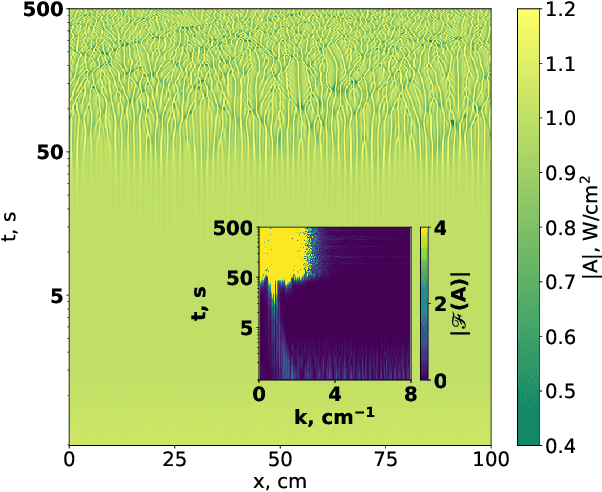
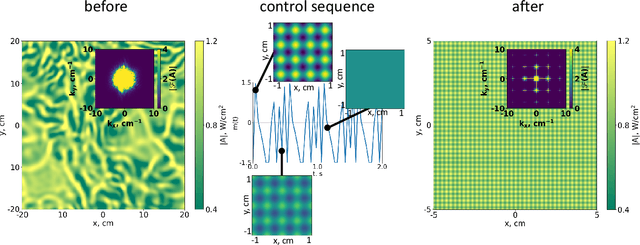
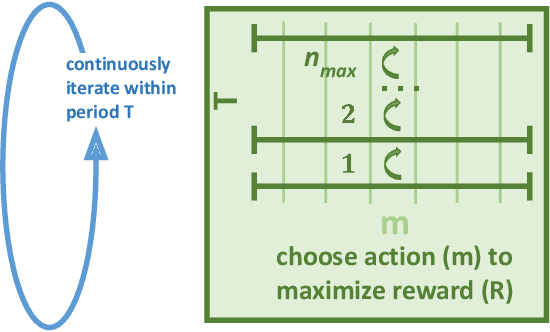
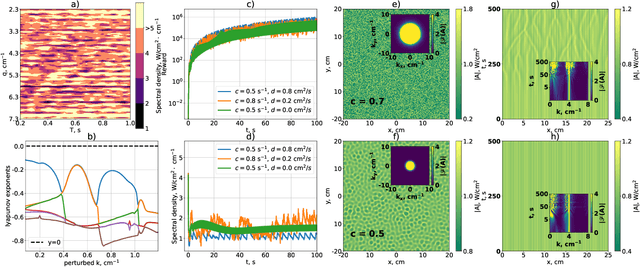
Modulation instability is a phenomenon of spontaneous pattern formation in nonlinear media, oftentimes leading to an unpredictable behaviour and a degradation of a signal of interest. We propose an approach based on reinforcement learning to suppress the unstable modes by optimizing the parameters for the time modulation of the potential in the nonlinear system. We test our approach in 1D and 2D cases and propose a new class of physically-meaningful reward functions to guarantee tamed instability.
The state-of-the-art in Cardiac MRI Reconstruction: Results of the CMRxRecon Challenge in MICCAI 2023
Apr 01, 2024

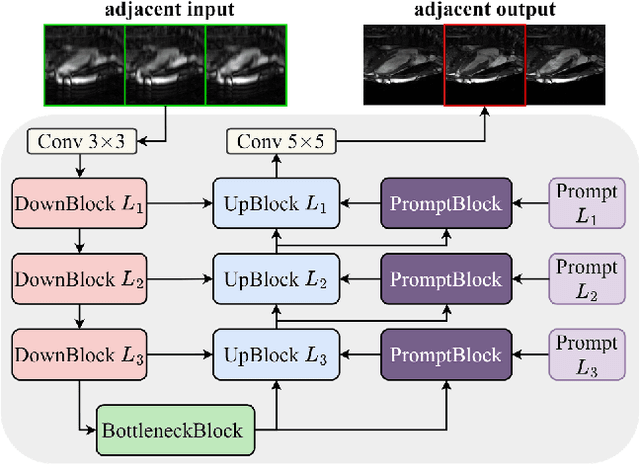

Cardiac MRI, crucial for evaluating heart structure and function, faces limitations like slow imaging and motion artifacts. Undersampling reconstruction, especially data-driven algorithms, has emerged as a promising solution to accelerate scans and enhance imaging performance using highly under-sampled data. Nevertheless, the scarcity of publicly available cardiac k-space datasets and evaluation platform hinder the development of data-driven reconstruction algorithms. To address this issue, we organized the Cardiac MRI Reconstruction Challenge (CMRxRecon) in 2023, in collaboration with the 26th International Conference on MICCAI. CMRxRecon presented an extensive k-space dataset comprising cine and mapping raw data, accompanied by detailed annotations of cardiac anatomical structures. With overwhelming participation, the challenge attracted more than 285 teams and over 600 participants. Among them, 22 teams successfully submitted Docker containers for the testing phase, with 7 teams submitted for both cine and mapping tasks. All teams use deep learning based approaches, indicating that deep learning has predominately become a promising solution for the problem. The first-place winner of both tasks utilizes the E2E-VarNet architecture as backbones. In contrast, U-Net is still the most popular backbone for both multi-coil and single-coil reconstructions. This paper provides a comprehensive overview of the challenge design, presents a summary of the submitted results, reviews the employed methods, and offers an in-depth discussion that aims to inspire future advancements in cardiac MRI reconstruction models. The summary emphasizes the effective strategies observed in Cardiac MRI reconstruction, including backbone architecture, loss function, pre-processing techniques, physical modeling, and model complexity, thereby providing valuable insights for further developments in this field.
QUASAR: QUality and Aesthetics Scoring with Advanced Representations
Mar 20, 2024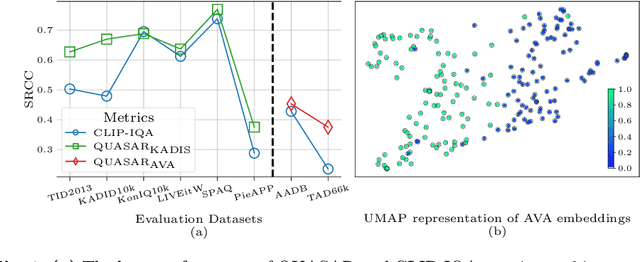
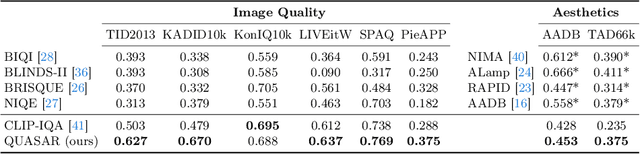

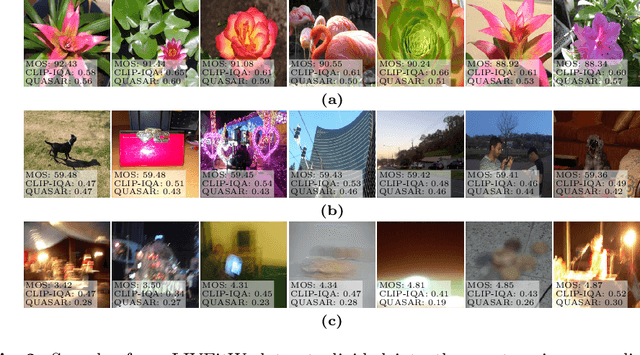
This paper introduces a new data-driven, non-parametric method for image quality and aesthetics assessment, surpassing existing approaches and requiring no prompt engineering or fine-tuning. We eliminate the need for expressive textual embeddings by proposing efficient image anchors in the data. Through extensive evaluations of 7 state-of-the-art self-supervised models, our method demonstrates superior performance and robustness across various datasets and benchmarks. Notably, it achieves high agreement with human assessments even with limited data and shows high robustness to the nature of data and their pre-processing pipeline. Our contributions offer a streamlined solution for assessment of images while providing insights into the perception of visual information.
ENOT: Expectile Regularization for Fast and Accurate Training of Neural Optimal Transport
Mar 06, 2024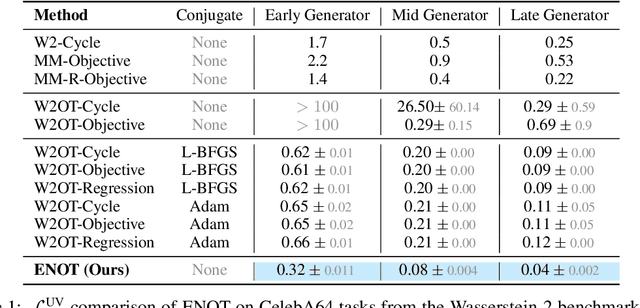
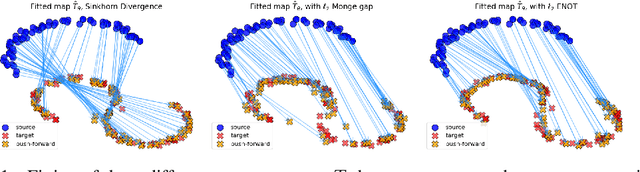
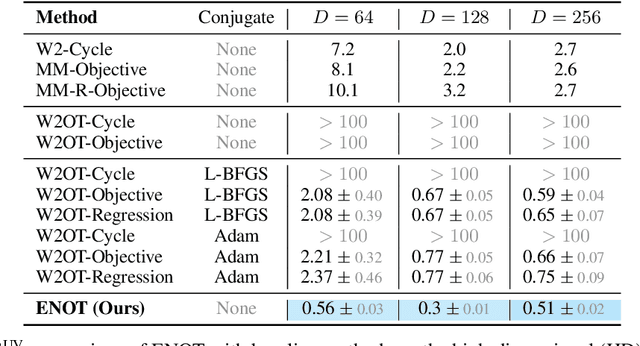
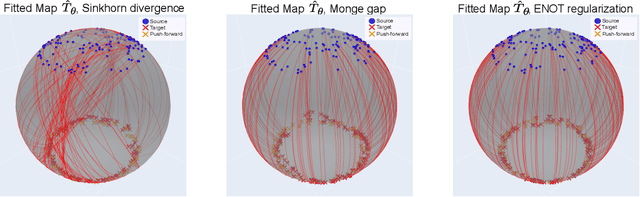
We present a new extension for Neural Optimal Transport (NOT) training procedure, capable of accurately and efficiently estimating optimal transportation plan via specific regularisation on conjugate potentials. The main bottleneck of existing NOT solvers is associated with the procedure of finding a near-exact approximation of the conjugate operator (i.e., the c-transform), which is done either by optimizing over maximin objectives or by the computationally-intensive fine-tuning of the initial approximated prediction. We resolve both issues by proposing a new, theoretically justified loss in the form of expectile regularization that enforces binding conditions on the learning dual potentials. Such a regularization provides the upper bound estimation over the distribution of possible conjugate potentials and makes the learning stable, eliminating the need for additional extensive finetuning. We formally justify the efficiency of our method, called Expectile-Regularised Neural Optimal Transport (ENOT). ENOT outperforms previous state-of-the-art approaches on the Wasserstein-2 benchmark tasks by a large margin (up to a 3-fold improvement in quality and up to a 10-fold improvement in runtime).
Align Your Intents: Offline Imitation Learning via Optimal Transport
Feb 20, 2024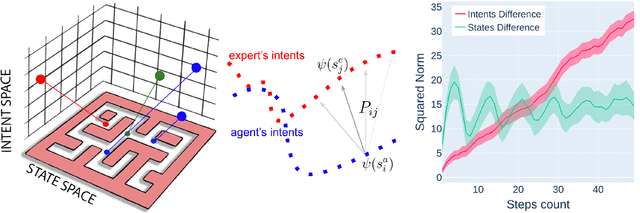
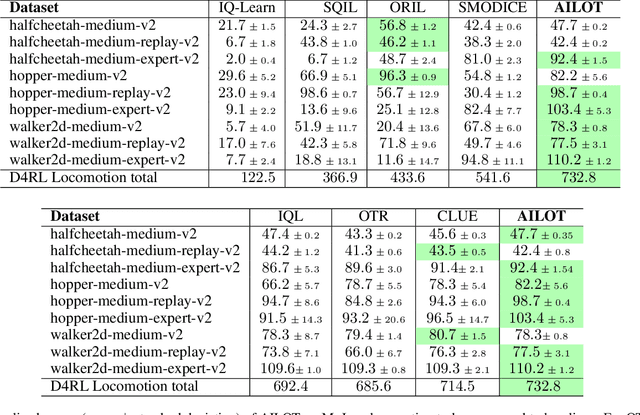

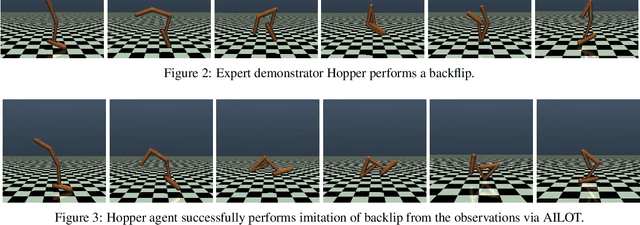
Offline reinforcement learning (RL) addresses the problem of sequential decision-making by learning optimal policy through pre-collected data, without interacting with the environment. As yet, it has remained somewhat impractical, because one rarely knows the reward explicitly and it is hard to distill it retrospectively. Here, we show that an imitating agent can still learn the desired behavior merely from observing the expert, despite the absence of explicit rewards or action labels. In our method, AILOT (Aligned Imitation Learning via Optimal Transport), we involve special representation of states in a form of intents that incorporate pairwise spatial distances within the data. Given such representations, we define intrinsic reward function via optimal transport distance between the expert's and the agent's trajectories. We report that AILOT outperforms state-of-the art offline imitation learning algorithms on D4RL benchmarks and improves the performance of other offline RL algorithms in the sparse-reward tasks.