 Add to Chrome
 Add to Firefox
 Add to Edge
Program-Synthesis-Driven Autodesign of Universal Unitary Operators
Jul 11, 2026
We demonstrate that AI-driven program synthesis can autonomously discover fundamental strategies for decomposing unitary matrices in photonic networks. By extending DreamCoder to complex-valued linear algebra, the system generates decomposition programs achieving the minimal $N(N-1)/2$ Mach-Zehnder interferometers, distinct from both Reck and Clements architectures. Learned programs encode dimension-agnostic invariants: strategies discovered for $5 \times 5$ matrices generalize to higher dimensions such as $64 \times 64$. The discovered programs encode interpretable, dimension-agnostic construction rules. These rules generalize across matrix sizes without retraining, demonstrating that autonomous program synthesis can serve as a scalable paradigm for algorithm discovery and the automated design of universal unitary operators. Beyond universal decompositions, the system automatically exploits matrix structure to reduce the interferometer count below the universal theoretical bound. For instance, for Householder matrices, it discovers a dimension-independent rule that requires only $2N-3$ MZIs. This achieves linear, rather than quadratic, scaling and generalizes to arbitrary $N$ without retraining. For matrices obtained from the singular value decomposition of sparse matrices, reductions generally increase with sparsity, reaching up to 38% fewer MZIs than the universal theoretical bound $N(N-1)/2$ at 95% sparsity. These MZI reductions translate directly into practical hardware benefits for scalable photonic implementations. Taken together, the system functions as a single unified engine that discovers both universal decomposition rules and matrix-specific optimizations, without being provided with the structural or analytical properties of the input matrices.

DSAM-GN:Graph Network based on Dynamic Similarity Adjacency Matrices for Vehicle Re-identification
Oct 25, 2023
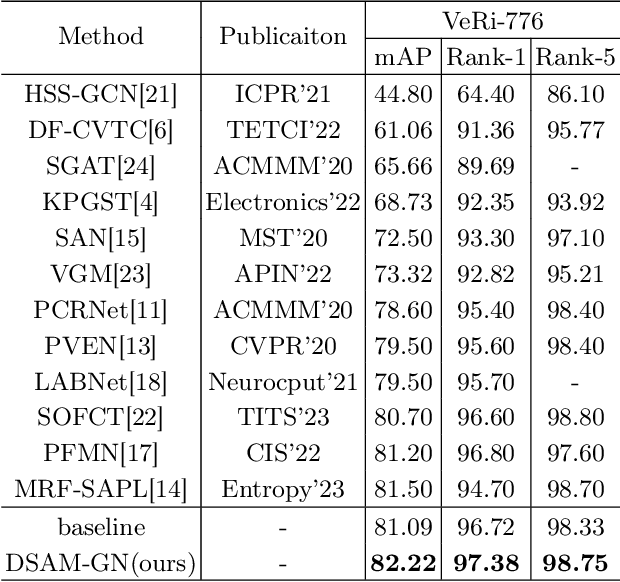


In recent years, vehicle re-identification (Re-ID) has gained increasing importance in various applications such as assisted driving systems, traffic flow management, and vehicle tracking, due to the growth of intelligent transportation systems. However, the presence of extraneous background information and occlusions can interfere with the learning of discriminative features, leading to significant variations in the same vehicle image across different scenarios. This paper proposes a method, named graph network based on dynamic similarity adjacency matrices (DSAM-GN), which incorporates a novel approach for constructing adjacency matrices to capture spatial relationships of local features and reduce background noise. Specifically, the proposed method divides the extracted vehicle features into different patches as nodes within the graph network. A spatial attention-based similarity adjacency matrix generation (SASAMG) module is employed to compute similarity matrices of nodes, and a dynamic erasure operation is applied to disconnect nodes with low similarity, resulting in similarity adjacency matrices. Finally, the nodes and similarity adjacency matrices are fed into graph networks to extract more discriminative features for vehicle Re-ID. Experimental results on public datasets VeRi-776 and VehicleID demonstrate the effectiveness of the proposed method compared with recent works.