 Add to Chrome
 Add to Firefox
 Add to Edge
Align and Segment: Unsupervised Learning for Building Segmentation From Misaligned Labels
Jul 12, 2026
Supervised learning for image segmentation typically requires spatially aligned image and label sets. When images and labels originate from different sources, the pairing may be misaligned, which can significantly deteriorate the performance of the learned models. This is especially common in remote sensing, when aerial or satellite images are co-registered with labels from another source (e.g., OpenStreetMap). In this work, we propose a novel approach for training on misaligned labels, where we simultaneously learn the label alignment. Our align and segment (AnS) approach builds on the spatial transformer module to transform the misaligned labels using an affine transformation to provide a better learning target for a canonical semantic segmentation network. We prevent shortcut learning of misaligned labels in these semantic segmentation networks through a self-supervised regularization loss and show that it is complementary to data augmentation, especially for systematically misaligned training data. A decisive characteristic of our AnS approach is that it learns without requiring any golden labels. We experimentally show on both synthetic and real-world data from different cities that our approach enables high-quality building segmentation and precise label-image alignment at the same time. Code and derived datasets are available at https://github.com/venkanna37/align-and-segment

Uncertainty-aware tree height change regression
Jul 01, 2026Monitoring canopy height change is essential for understanding carbon sinks and forest dynamics. Remote sensing enables consistent, large-scale observations of such changes, increasingly integrated with deep learning architectures such as Geospatial Foundation Models (GFMs). However, existing methods and datasets frame the problem as binary change detection, which overlooks both the continuous nature of change, especially for vegetation, and the inherent uncertainty in labels. We present the Canopy Height Change (CHC) dataset, providing 3 $\mathrm{m}$ resolution continuous canopy height differences and associated spatially resolved uncertainties across 10598 $\mathrm{km}^2$ of northern and western Spain. The dataset is paired with a co-located time series of PlanetScope satellite imagery. Based on the dataset, we introduce the task of uncertainty-aware change regression, associated metrics and strategies for fine-tuning GFMs. Furthermore, we evaluate state-of-the-art GFMs and highlight promising directions and remaining challenges for advancing continuous canopy height change estimation.
Counting Trees from Satellite Imagery with Noisy Supervision
Jun 25, 2026Counting individual trees is a fundamental task for environmental monitoring, yet remains largely unexplored with satellite imagery. At these resolutions, isolated trees may still be identifiable, but crown boundaries become ambiguous in dense forests, making the notion of an individual tree inherently ill-defined. Moreover, large-scale manual annotations of individual trees are prohibitively expensive. While scalable supervision can be derived from airborne LiDAR, the resulting annotations are noisy and difficult to exploit effectively. We address these challenges by formulating tree counting as a spatial density matching problem supervised through Unbalanced Optimal Transport. This formulation naturally accommodates both precise localization of isolate trees and robust density estimation in dense forests. We further introduce a self-correction mechanism that leverages transport residuals to progressively refine noisy supervision during training. We evaluate our approach on TinyTrees, a new benchmark spanning three continents and three satellite sensors, comprising over 216 million tree annotations (including 639k manually verified instances) across $25\,890$ km$^2$. Our method consistently outperforms detection-based, regression-based, and transport-based distribution-matching baselines, demonstrating the effectiveness of unbalanced transport and reliability-aware supervision for large-scale tree counting from satellite imagery. Code, data and models are available at https://github.com/dgominski/treematch.
Mining Field Data for Tree Species Recognition at Scale
Aug 28, 2024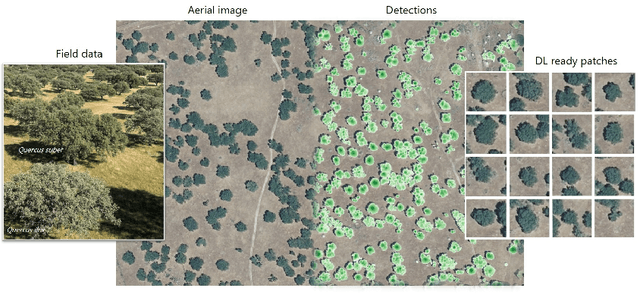

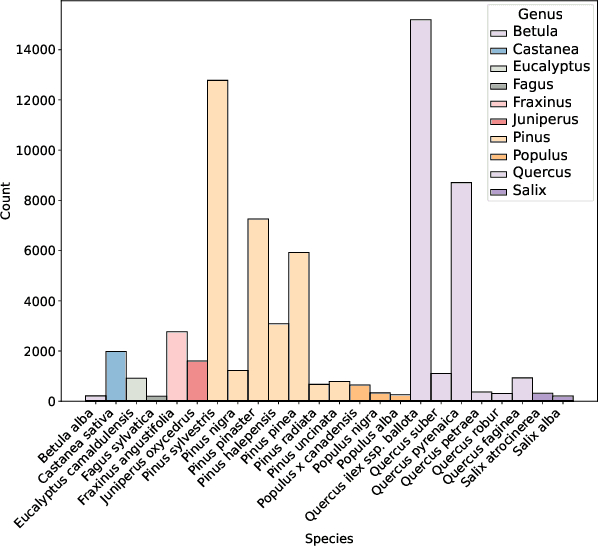
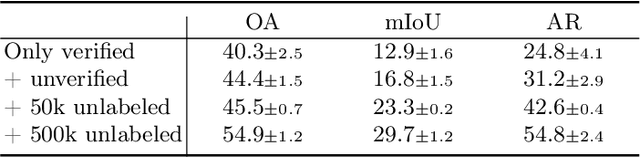
Individual tree species labels are particularly hard to acquire due to the expert knowledge needed and the limitations of photointerpretation. Here, we present a methodology to automatically mine species labels from public forest inventory data, using available pretrained tree detection models. We identify tree instances in aerial imagery and match them with field data with close to zero human involvement. We conduct a series of experiments on the resulting dataset, and show a beneficial effect when adding noisy or even unlabeled data points, highlighting a strong potential for large-scale individual species mapping.
Get Your Embedding Space in Order: Domain-Adaptive Regression for Forest Monitoring
May 01, 2024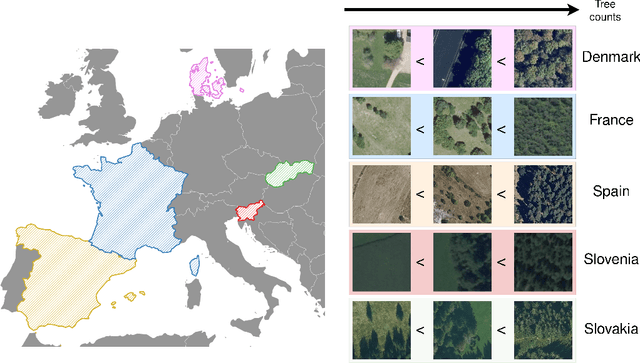

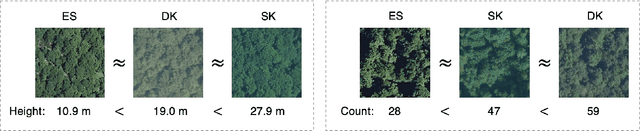
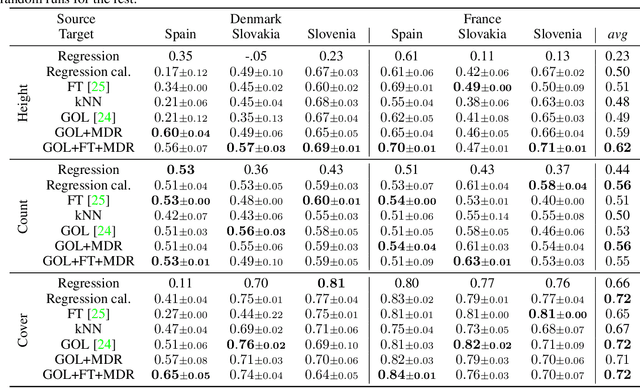
Image-level regression is an important task in Earth observation, where visual domain and label shifts are a core challenge hampering generalization. However, cross-domain regression with remote sensing data remains understudied due to the absence of suited datasets. We introduce a new dataset with aerial and satellite imagery in five countries with three forest-related regression tasks. To match real-world applicative interests, we compare methods through a restrictive setup where no prior on the target domain is available during training, and models are adapted with limited information during testing. Building on the assumption that ordered relationships generalize better, we propose manifold diffusion for regression as a strong baseline for transduction in low-data regimes. Our comparison highlights the comparative advantages of inductive and transductive methods in cross-domain regression.
Benchmarking Individual Tree Mapping with Sub-meter Imagery
Nov 14, 2023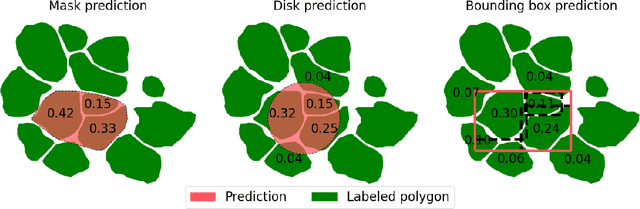
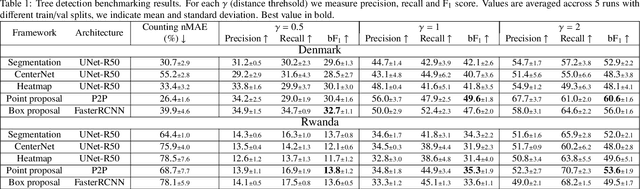
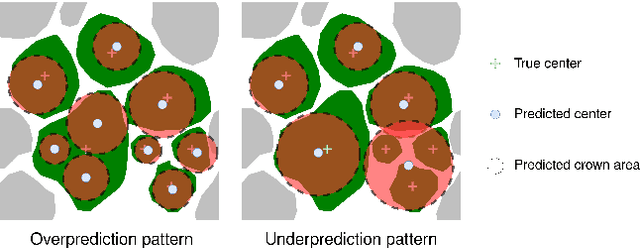
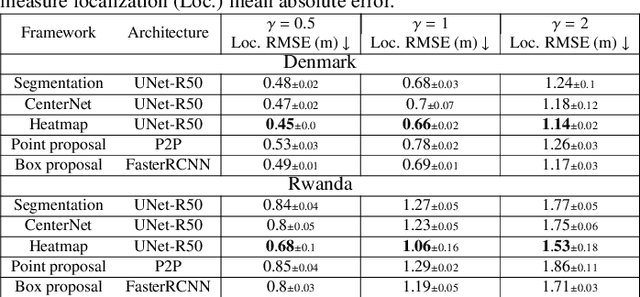
There is a rising interest in mapping trees using satellite or aerial imagery, but there is no standardized evaluation protocol for comparing and enhancing methods. In dense canopy areas, the high variability of tree sizes and their spatial proximity makes it arduous to define the quality of the predictions. Concurrently, object-centric approaches such as bounding box detection usuallyperform poorly on small and dense objects. It thus remains unclear what is the ideal framework for individual tree mapping, in regards to detection and segmentation approaches, convolutional neural networks and transformers. In this paper, we introduce an evaluation framework suited for individual tree mapping in any physical environment, with annotation costs and applicative goals in mind. We review and compare different approaches and deep architectures, and introduce a new method that we experimentally prove to be a good compromise between segmentation and detection.
Connecting Images through Time and Sources: Introducing Low-data, Heterogeneous Instance Retrieval
Mar 19, 2021
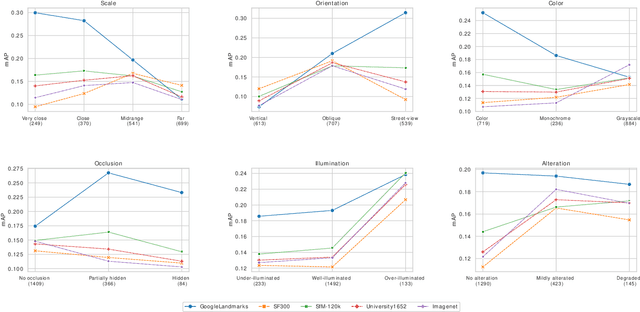
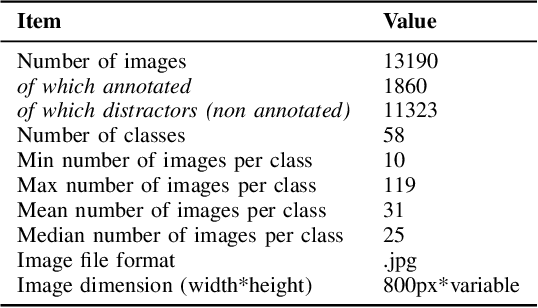

With impressive results in applications relying on feature learning, deep learning has also blurred the line between algorithm and data. Pick a training dataset, pick a backbone network for feature extraction, and voil\`a ; this usually works for a variety of use cases. But the underlying hypothesis that there exists a training dataset matching the use case is not always met. Moreover, the demand for interconnections regardless of the variations of the content calls for increasing generalization and robustness in features. An interesting application characterized by these problematics is the connection of historical and cultural databases of images. Through the seemingly simple task of instance retrieval, we propose to show that it is not trivial to pick features responding well to a panel of variations and semantic content. Introducing a new enhanced version of the Alegoria benchmark, we compare descriptors using the detailed annotations. We further give insights about the core problems in instance retrieval, testing four state-of-the-art additional techniques to increase performance.
Unifying Remote Sensing Image Retrieval and Classification with Robust Fine-tuning
Feb 26, 2021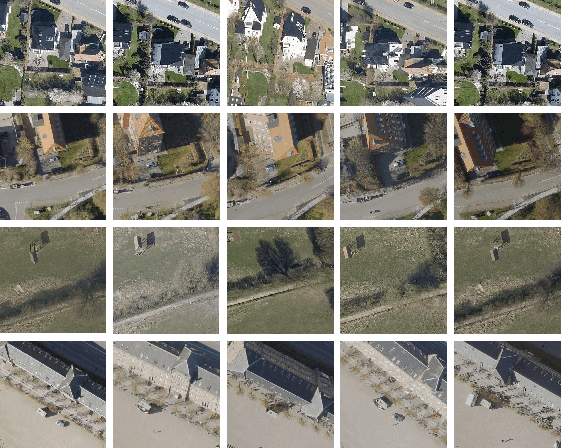

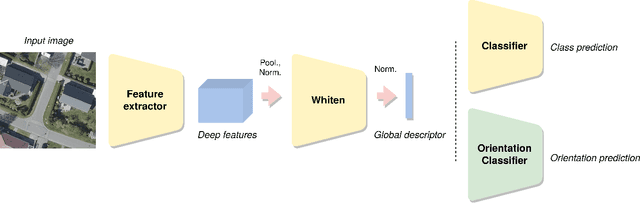
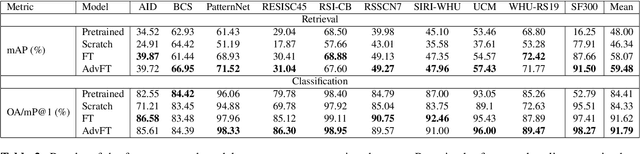
Advances in high resolution remote sensing image analysis are currently hampered by the difficulty of gathering enough annotated data for training deep learning methods, giving rise to a variety of small datasets and associated dataset-specific methods. Moreover, typical tasks such as classification and retrieval lack a systematic evaluation on standard benchmarks and training datasets, which make it hard to identify durable and generalizable scientific contributions. We aim at unifying remote sensing image retrieval and classification with a new large-scale training and testing dataset, SF300, including both vertical and oblique aerial images and made available to the research community, and an associated fine-tuning method. We additionally propose a new adversarial fine-tuning method for global descriptors. We show that our framework systematically achieves a boost of retrieval and classification performance on nine different datasets compared to an ImageNet pretrained baseline, with currently no other method to compare to.
Challenging deep image descriptors for retrieval in heterogeneous iconographic collections
Sep 19, 2019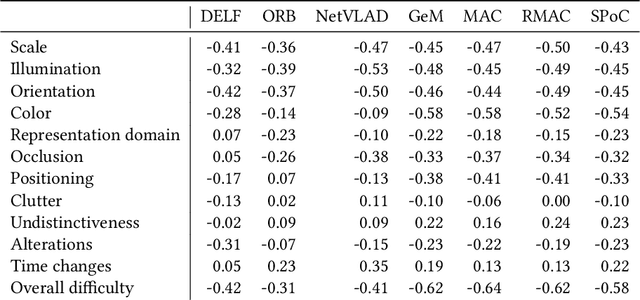
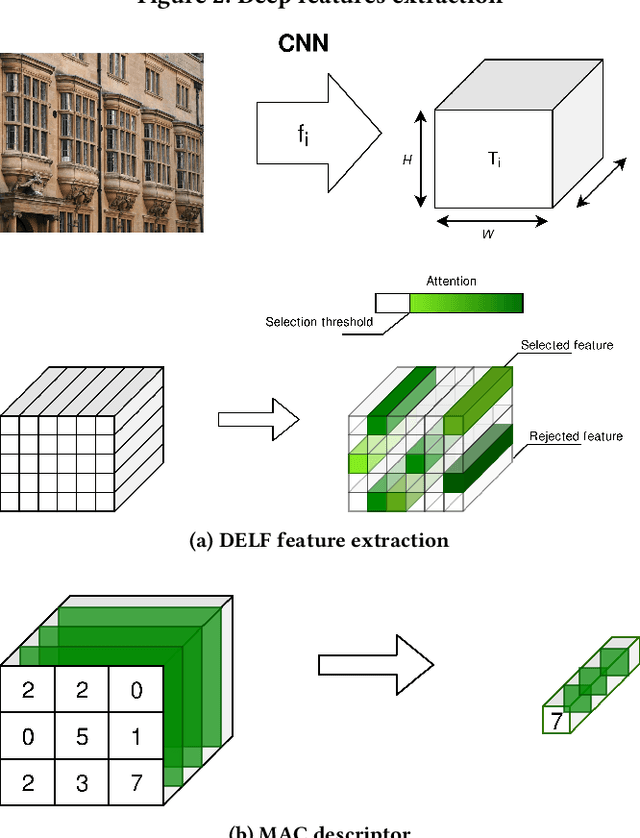

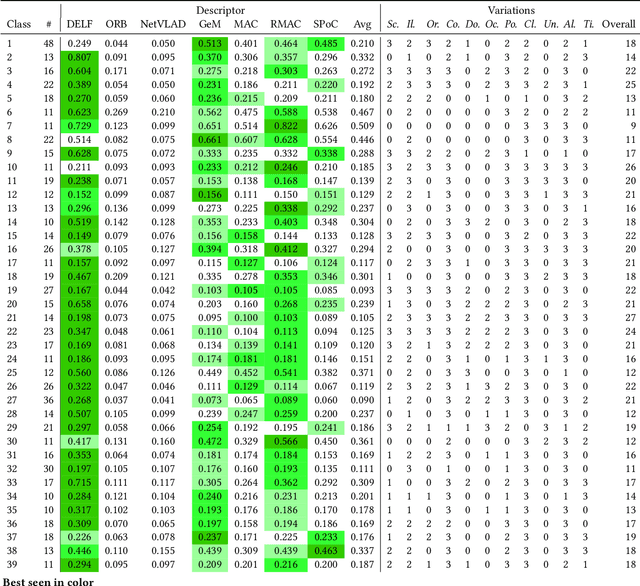
This article proposes to study the behavior of recent and efficient state-of-the-art deep-learning based image descriptors for content-based image retrieval, facing a panel of complex variations appearing in heterogeneous image datasets, in particular in cultural collections that may involve multi-source, multi-date and multi-view Permission to make digital