 Add to Chrome
 Add to Firefox
 Add to Edge
S$^3$-Attention:Attention-Aligned Endogenous Retrieval for Memory-Bounded Long-Context Inference
Jan 25, 2026
Large language models are increasingly applied to multi-document and long-form inputs, yet long-context inference remains memory- and noise-inefficient. Key-value (KV) caching scales linearly with context length, while external retrieval methods often return lexically similar but causally irrelevant passages. We present S3-Attention, a memory-first inference-time framework that treats long-context processing as attention-aligned endogenous retrieval. S3-Attention decodes transient key and query projections into top-k sparse feature identifiers using lightweight sparse autoencoders, and constructs a CPU-based inverted index mapping features to token positions or spans during a single streaming scan. This design allows the KV cache to be discarded entirely and bounds GPU memory usage by the scan chunk size. At generation time, feature co-activation is used to retrieve compact evidence spans, optionally fused with BM25 for exact lexical matching. Under a unified LongBench evaluation protocol with fixed prompting, decoding, and matched token budgets, S3-Hybrid closely matches full-context inference across multiple model families and improves robustness in several information-dense settings. We also report an engineering limitation of the current prototype, which incurs higher wall-clock latency than optimized full-KV baselines, motivating future kernel-level optimization.

Unlocking the Address Book: Dissecting the Sparse Semantic Structure of LLM Key-Value Caches via Sparse Autoencoders
Dec 11, 2025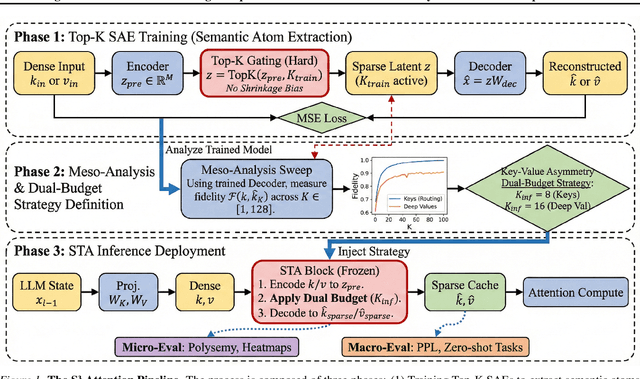
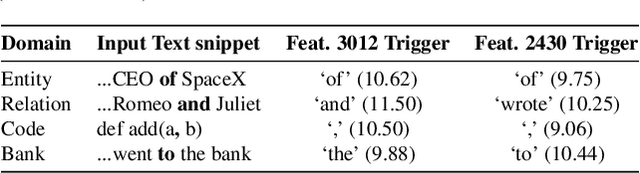
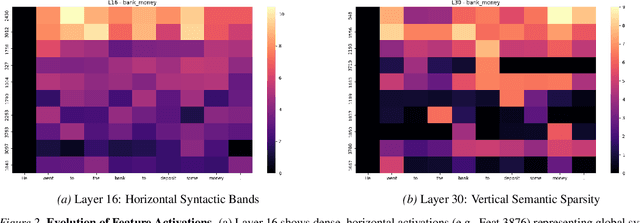
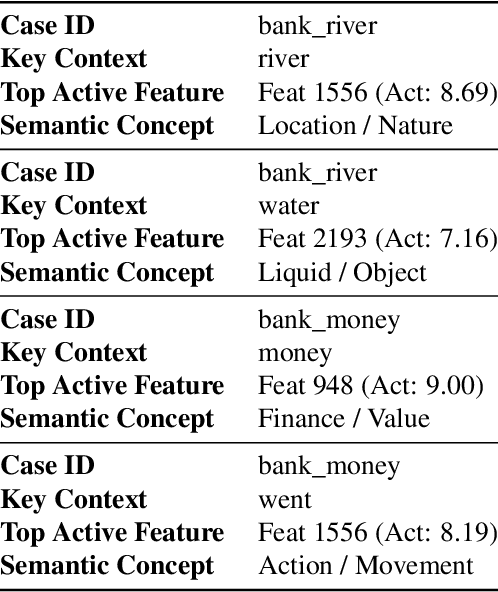
The Key-Value (KV) cache is the primary memory bottleneck in long-context Large Language Models, yet it is typically treated as an opaque numerical tensor. In this work, we propose \textbf{STA-Attention}, a framework that utilizes Top-K Sparse Autoencoders (SAEs) to decompose the KV cache into interpretable ``semantic atoms.'' Unlike standard $L_1$-regularized SAEs, our Top-K approach eliminates shrinkage bias, preserving the precise dot-product geometry required for attention. Our analysis uncovers a fundamental \textbf{Key-Value Asymmetry}: while Key vectors serve as highly sparse routers dominated by a ``Semantic Elbow,'' deep Value vectors carry dense content payloads requiring a larger budget. Based on this structure, we introduce a Dual-Budget Strategy that selectively preserves the most informative semantic components while filtering representational noise. Experiments on Yi-6B, Mistral-7B, Qwen2.5-32B, and others show that our semantic reconstructions maintain perplexity and zero-shot performance comparable to the original models, effectively bridging the gap between mechanistic interpretability and faithful attention modeling.