 Add to Chrome
 Add to Firefox
 Add to Edge
AgenticVAU: Multi-Agent Explore-Verify Reasoning for Video Anomaly Understanding
Aug 04, 2026
Video anomaly understanding (VAU) focuses on comprehensively interpreting abnormal events in videos, requiring models to identify anomalous occurrences, discover their supporting evidence, and explain the underlying causes beyond simple anomaly detection. Existing VAU methods often rely on specialized training or limited observations, restricting generalization or evidence coverage. Although single-agent alternatives support adaptive video observation, they still integrate exploration, observation, and decision-making within a unified reasoning process, offering limited role specialization and structured evidence coordination. To address these limitations, we present AgenticVAU, a training-free multi-agent framework that casts VAU as an explore--verify process, where the system first discovers potential anomalies and then verifies them through targeted observations. To achieve this, four specialized agents are introduced to handle visual-rule construction, search planning, video observation, and final decision, respectively. These agents communicate through an anchor registry, a shared evidence memory that binds each observation. Guided by this agent framework, AgenticVAU interleaves broad temporal exploration, dense local verification, and cross-interval comparison until sufficient evidence is collected. We conduct extensive experiments on the ECVA, UCF-Crime, and MSAD subsets of VAU-Bench, the results show that AgenticVAU outperforms zero-shot inference and reinforcement learning-based baselines, demonstrating the value of multi-agent collaboration for video anomaly understanding.

KnowHal: A Knowledge-Driven Benchmark for Comprehensive Multimodal Hallucination Evaluation
Aug 04, 2026Hallucination remains a critical challenge for developing trustworthy Multimodal Large Language Models (MLLMs). While existing benchmarks mainly focus on entity, attribute, and relation hallucinations, knowledge-related failures are often investigated separately, lacking a unified evaluation framework across different hallucination dimensions. To overcome this, we propose \textbf{KnowHal}, a benchmark that explicitly incorporates knowledge hallucination into multimodal hallucination evaluation spanning four dimensions: entity, attribute, relation, and knowledge. KnowHal constructs paired positive and negative questions over shared images and entities, enabling controlled comparisons among perceptual errors, knowledge-related errors, and false-premise acceptance. The benchmark contains 1,800 samples across 10 domains and 50 categories, constructed through a semi-automated pipeline combining LLM assistance, CLIP-based filtering, and human verification. We evaluate 14 representative MLLMs on KnowHal and conduct extensive analyses. Results show that the knowledge dimension consistently presents the greatest challenge for nearly all evaluated models, while most models exhibit substantial performance degradation on negative questions, revealing limited robustness to false premises. By unifying four hallucination dimensions with paired question design, KnowHal addresses an important gap in existing evaluation frameworks and enables a more comprehensive assessment of hallucinations in MLLMs.
Unlocking the Address Book: Dissecting the Sparse Semantic Structure of LLM Key-Value Caches via Sparse Autoencoders
Dec 11, 2025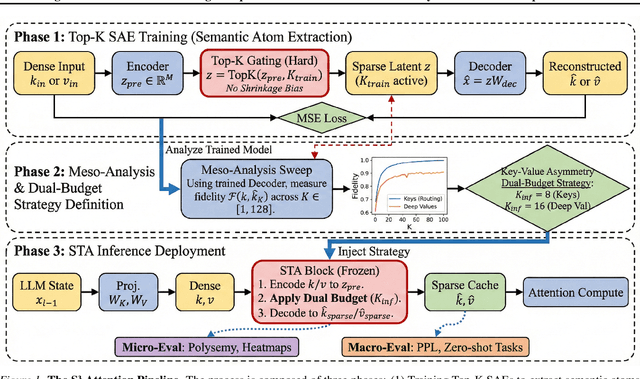
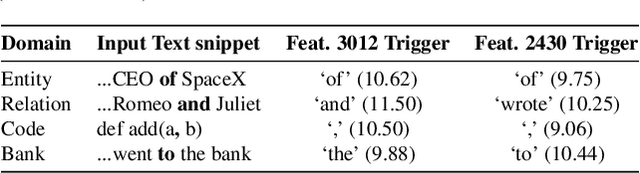
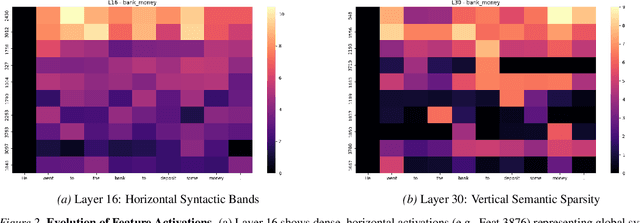
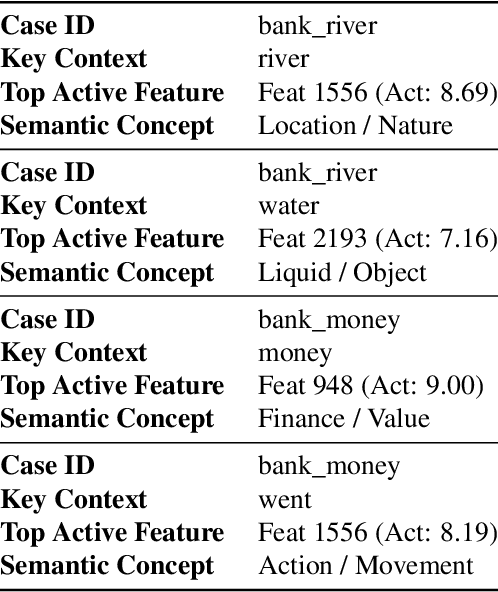
The Key-Value (KV) cache is the primary memory bottleneck in long-context Large Language Models, yet it is typically treated as an opaque numerical tensor. In this work, we propose \textbf{STA-Attention}, a framework that utilizes Top-K Sparse Autoencoders (SAEs) to decompose the KV cache into interpretable ``semantic atoms.'' Unlike standard $L_1$-regularized SAEs, our Top-K approach eliminates shrinkage bias, preserving the precise dot-product geometry required for attention. Our analysis uncovers a fundamental \textbf{Key-Value Asymmetry}: while Key vectors serve as highly sparse routers dominated by a ``Semantic Elbow,'' deep Value vectors carry dense content payloads requiring a larger budget. Based on this structure, we introduce a Dual-Budget Strategy that selectively preserves the most informative semantic components while filtering representational noise. Experiments on Yi-6B, Mistral-7B, Qwen2.5-32B, and others show that our semantic reconstructions maintain perplexity and zero-shot performance comparable to the original models, effectively bridging the gap between mechanistic interpretability and faithful attention modeling.
An Approach for Multi-Object Tracking with Two-Stage Min-Cost Flow
Nov 05, 2023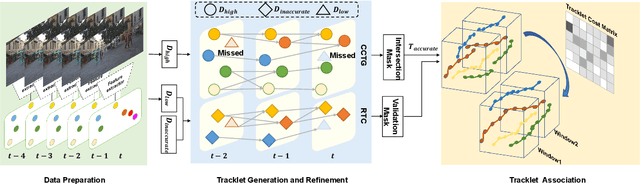
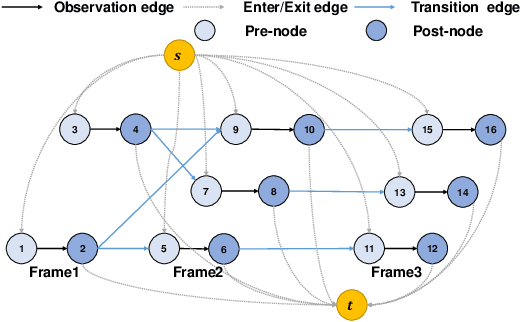

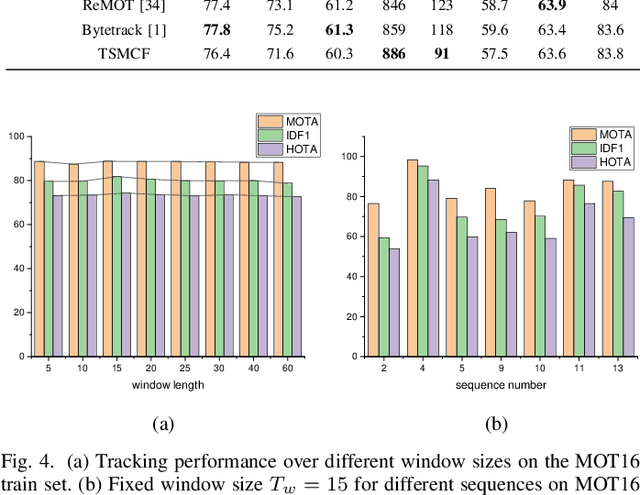
The minimum network flow algorithm is widely used in multi-target tracking. However, the majority of the present methods concentrate exclusively on minimizing cost functions whose values may not indicate accurate solutions under occlusions. In this paper, by exploiting the properties of tracklets intersections and low-confidence detections, we develop a two-stage tracking pipeline with an intersection mask that can accurately locate inaccurate tracklets which are corrected in the second stage. Specifically, we employ the minimum network flow algorithm with high-confidence detections as input in the first stage to obtain the candidate tracklets that need correction. Then we leverage the intersection mask to accurately locate the inaccurate parts of candidate tracklets. The second stage utilizes low-confidence detections that may be attributed to occlusions for correcting inaccurate tracklets. This process constructs a graph of nodes in inaccurate tracklets and low-confidence nodes and uses it for the second round of minimum network flow calculation. We perform sufficient experiments on popular MOT benchmark datasets and achieve 78.4 MOTA on the test set of MOT16, 79.2 on MOT17, and 76.4 on MOT20, which shows that the proposed method is effective.