 Add to Chrome
 Add to Firefox
 Add to Edge
GDPO-Listener: Expressive Interactive Head Generation via Auto-Regressive Flow Matching and Group reward-Decoupled Policy Optimization
Mar 26, 2026
Generating realistic 3D head motion for dyadic interactions is a significant challenge in virtual human synthesis. While recent methods achieve impressive results with speaking heads, they frequently suffer from the `Regression-to-the-Mean' problem in listener motions, collapsing into static faces, and lack the parameter space for complex nonverbal motions. In this paper, we propose GDPO-Listener, a novel framework that achieves highly expressive speaking and listening motion generation. First, we introduce an Auto-Regressive Flow Matching architecture enabling stable supervised learning. Second, to overcome kinematic stillness, we apply the Group reward-Decoupled Policy Optimization (GDPO). By isolating reward normalization across distinct FLAME parameter groups, GDPO explicitly incentivizes high variance expressive generations. Finally, we enable explicit semantic text control for customizable responses. Extensive evaluations across the Seamless Interaction and DualTalk datasets demonstrate superior performance compared to existing baselines on long-term kinematic variance, visual expressivity and semantic controllability.

Can LLMs Truly Embody Human Personality? Analyzing AI and Human Behavior Alignment in Dispute Resolution
Feb 07, 2026Large language models (LLMs) are increasingly used to simulate human behavior in social settings such as legal mediation, negotiation, and dispute resolution. However, it remains unclear whether these simulations reproduce the personality-behavior patterns observed in humans. Human personality, for instance, shapes how individuals navigate social interactions, including strategic choices and behaviors in emotionally charged interactions. This raises the question: Can LLMs, when prompted with personality traits, reproduce personality-driven differences in human conflict behavior? To explore this, we introduce an evaluation framework that enables direct comparison of human-human and LLM-LLM behaviors in dispute resolution dialogues with respect to Big Five Inventory (BFI) personality traits. This framework provides a set of interpretable metrics related to strategic behavior and conflict outcomes. We additionally contribute a novel dataset creation methodology for LLM dispute resolution dialogues with matched scenarios and personality traits with respect to human conversations. Finally, we demonstrate the use of our evaluation framework with three contemporary closed-source LLMs and show significant divergences in how personality manifests in conflict across different LLMs compared to human data, challenging the assumption that personality-prompted agents can serve as reliable behavioral proxies in socially impactful applications. Our work highlights the need for psychological grounding and validation in AI simulations before real-world use.
Personality Expression Across Contexts: Linguistic and Behavioral Variation in LLM Agents
Feb 01, 2026Large Language Models (LLMs) can be conditioned with explicit personality prompts, yet their behavioral realization often varies depending on context. This study examines how identical personality prompts lead to distinct linguistic, behavioral, and emotional outcomes across four conversational settings: ice-breaking, negotiation, group decision, and empathy tasks. Results show that contextual cues systematically influence both personality expression and emotional tone, suggesting that the same traits are expressed differently depending on social and affective demands. This raises an important question for LLM-based dialogue agents: whether such variations reflect inconsistency or context-sensitive adaptation akin to human behavior. Viewed through the lens of Whole Trait Theory, these findings highlight that LLMs exhibit context-sensitive rather than fixed personality expression, adapting flexibly to social interaction goals and affective conditions.
ASTRA: A Negotiation Agent with Adaptive and Strategic Reasoning through Action in Dynamic Offer Optimization
Mar 10, 2025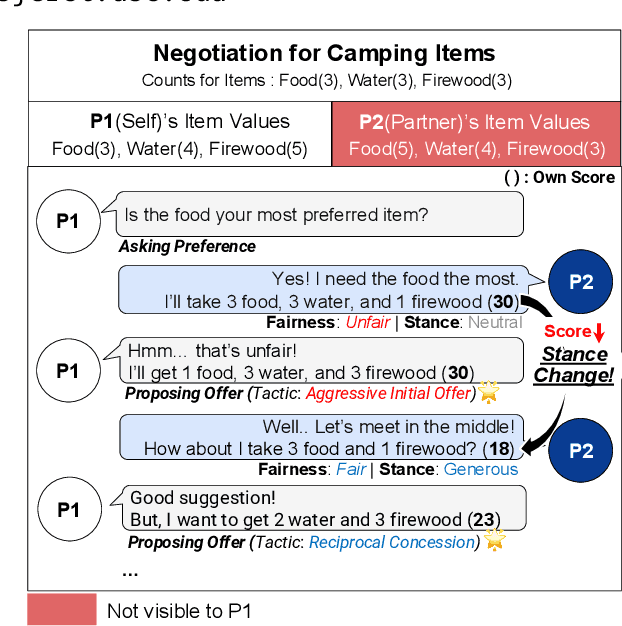
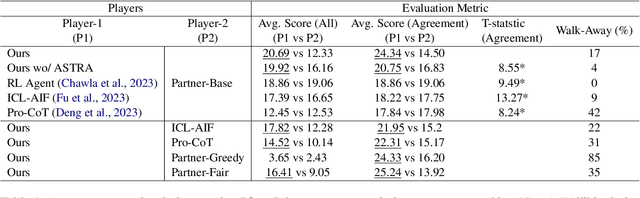
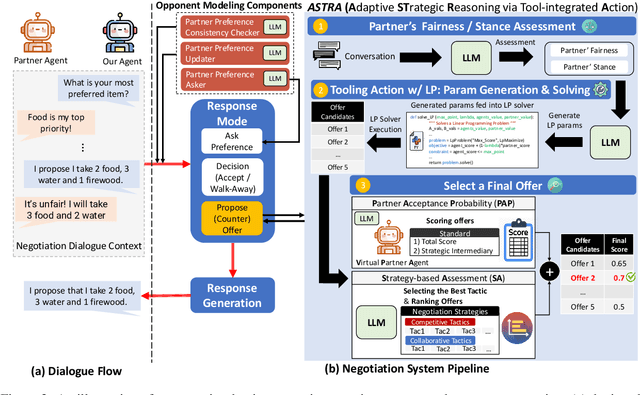
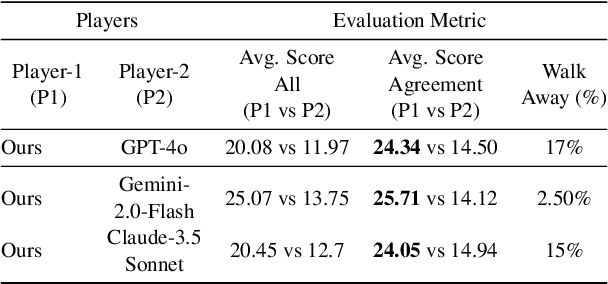
Negotiation requires dynamically balancing self-interest and cooperation to maximize one's own utility. Yet, existing agents struggle due to bounded rationality in human data, low adaptability to counterpart behavior, and limited strategic reasoning. To address this, we introduce principle-driven negotiation agents, powered by ASTRA, a novel framework for turn-level offer optimization grounded in two core principles: opponent modeling and Tit-for-Tat reciprocity. ASTRA operates in three stages: (1) interpreting counterpart behavior, (2) optimizing counteroffers via a linear programming (LP) solver, and (3) selecting offers based on negotiation tactics and the partner's acceptance probability. Through simulations and human evaluations, our agent effectively adapts to an opponent's shifting stance and achieves favorable outcomes through enhanced adaptability and strategic reasoning. Beyond improving negotiation performance, it also serves as a powerful coaching tool, offering interpretable strategic feedback and optimal offer recommendations.
Are LLMs Effective Negotiators? Systematic Evaluation of the Multifaceted Capabilities of LLMs in Negotiation Dialogues
Feb 21, 2024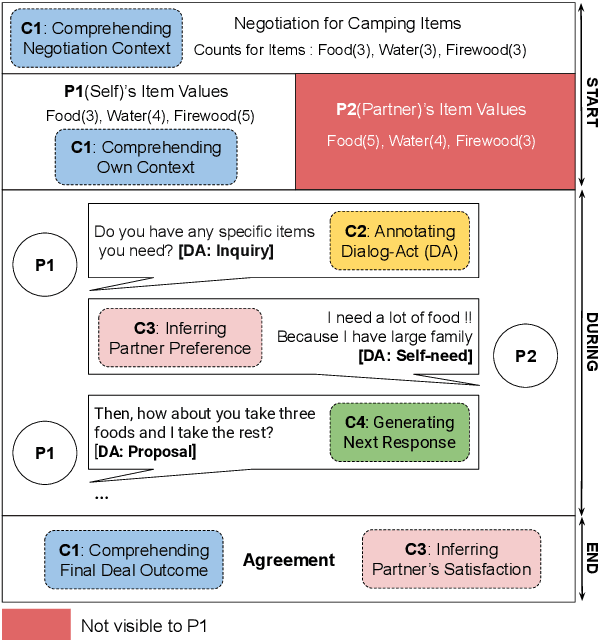
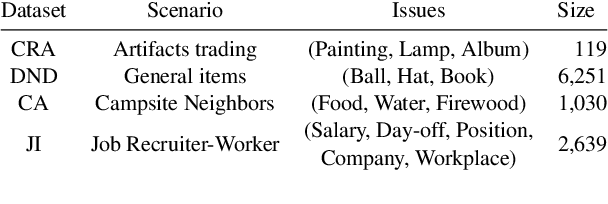
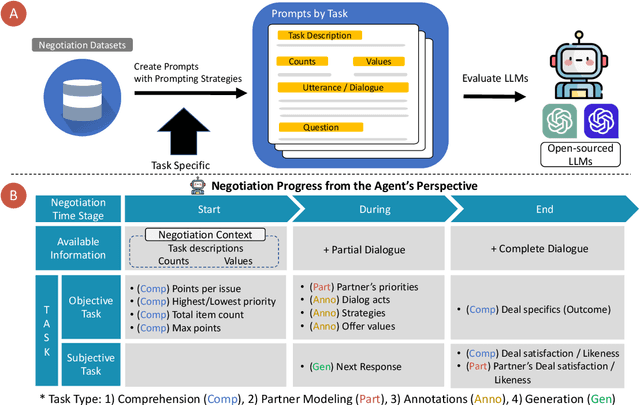
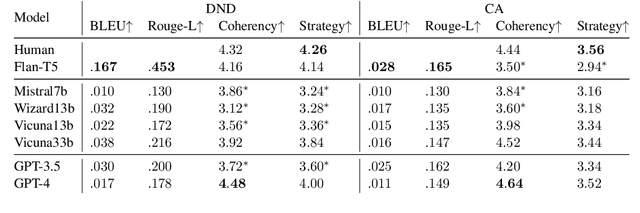
A successful negotiation demands a deep comprehension of the conversation context, Theory-of-Mind (ToM) skills to infer the partner's motives, as well as strategic reasoning and effective communication, making it challenging for automated systems. Given the remarkable performance of LLMs across a variety of NLP tasks, in this work, we aim to understand how LLMs can advance different aspects of negotiation research, ranging from designing dialogue systems to providing pedagogical feedback and scaling up data collection practices. To this end, we devise a methodology to analyze the multifaceted capabilities of LLMs across diverse dialogue scenarios covering all the time stages of a typical negotiation interaction. Our analysis adds to the increasing evidence for the superiority of GPT-4 across various tasks while also providing insights into specific tasks that remain difficult for LLMs. For instance, the models correlate poorly with human players when making subjective assessments about the negotiation dialogues and often struggle to generate responses that are contextually appropriate as well as strategically advantageous.
WHAT, WHEN, and HOW to Ground: Designing User Persona-Aware Conversational Agents for Engaging Dialogue
Jun 21, 2023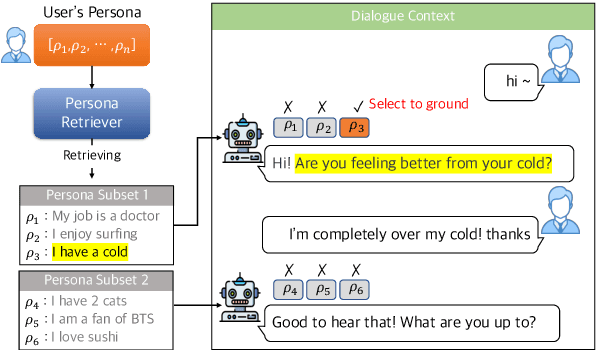

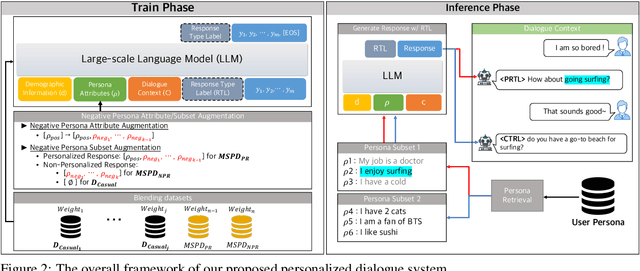
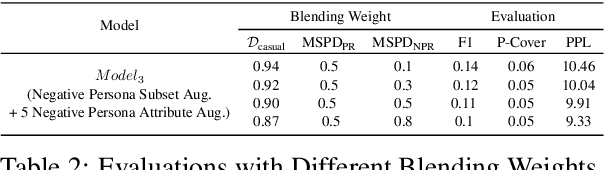
This paper presents a method for building a personalized open-domain dialogue system to address the $\textit{WWH}$ ($\textit{WHAT}$, $\textit{WHEN}$, and $\textit{HOW}$) problem for natural response generation in a commercial setting, where personalized dialogue responses are heavily interleaved with casual response turns. The proposed approach involves weighted dataset blending, negative persona information augmentation methods, and the design of personalized conversation datasets to address the challenges of $\textit{WWH}$ in personalized, open-domain dialogue systems. Our work effectively balances dialogue fluency and tendency to ground, while also introducing a response-type label to improve the controllability and explainability of the grounded responses. The combination of these methods leads to more fluent conversations, as evidenced by subjective human evaluations as well as objective evaluations.