 Add to Chrome
 Add to Firefox
 Add to Edge
Learning Discrete Decisions for MIPs with Constraint-Aware Diffusion
Aug 14, 2026
This paper proposes a novel learning-based approach to approximately solve instances of mixed-integer optimization problems. These problems are computationally challenging, as they require jointly determining discrete and continuous decisions while satisfying complex combinatorial constraints. The proposed method relies on a graph-based generative diffusion model that learns the discrete component of mixed-integer optimization problems while integrating a training-free feasibility projection operator directly into the reverse diffusion process to steer intermediate samples toward the feasible set throughout generation. Once the discrete decisions are generated, the remaining optimization reduces to a continuous problem that can be solved efficiently (relative to the original problem) using existing numerical methods. The resulting framework named Constrained Graph Diffusion (CGD), is problem-agnostic and can accommodate a broad class of mixed-integer optimization problems through suitable projection operators. We evaluate CGD on optimal transmission switching for ACOPF and discrete portfolio optimization, demonstrating substantial improvements in feasibility and solution quality over learning-based baselines while achieving speedups of up to $425\times$ over state-of-the-art numerical solvers for MINLPs.

Power Flow Approximations for Multiphase Distribution Networks using Gaussian Processes
Apr 30, 2025Learning-based approaches are increasingly leveraged to manage and coordinate the operation of grid-edge resources in active power distribution networks. Among these, model-based techniques stand out for their superior data efficiency and robustness compared to model-free methods. However, effective model learning requires a learning-based approximator for the underlying power flow model. This study extends existing work by introducing a data-driven power flow method based on Gaussian Processes (GPs) to approximate the multiphase power flow model, by mapping net load injections to nodal voltages. Simulation results using the IEEE 123-bus and 8500-node distribution test feeders demonstrate that the trained GP model can reliably predict the nonlinear power flow solutions with minimal training data. We also conduct a comparative analysis of the training efficiency and testing performance of the proposed GP-based power flow approximator against a deep neural network-based approximator, highlighting the advantages of our data-efficient approach. Results over realistic operating conditions show that despite an 85% reduction in the training sample size (corresponding to a 92.8% improvement in training time), GP models produce a 99.9% relative reduction in mean absolute error compared to the baselines of deep neural networks.
Learning Networks from Wide-Sense Stationary Stochastic Processes
Dec 04, 2024Complex networked systems driven by latent inputs are common in fields like neuroscience, finance, and engineering. A key inference problem here is to learn edge connectivity from node outputs (potentials). We focus on systems governed by steady-state linear conservation laws: $X_t = {L^{\ast}}Y_{t}$, where $X_t, Y_t \in \mathbb{R}^p$ denote inputs and potentials, respectively, and the sparsity pattern of the $p \times p$ Laplacian $L^{\ast}$ encodes the edge structure. Assuming $X_t$ to be a wide-sense stationary stochastic process with a known spectral density matrix, we learn the support of $L^{\ast}$ from temporally correlated samples of $Y_t$ via an $\ell_1$-regularized Whittle's maximum likelihood estimator (MLE). The regularization is particularly useful for learning large-scale networks in the high-dimensional setting where the network size $p$ significantly exceeds the number of samples $n$. We show that the MLE problem is strictly convex, admitting a unique solution. Under a novel mutual incoherence condition and certain sufficient conditions on $(n, p, d)$, we show that the ML estimate recovers the sparsity pattern of $L^\ast$ with high probability, where $d$ is the maximum degree of the graph underlying $L^{\ast}$. We provide recovery guarantees for $L^\ast$ in element-wise maximum, Frobenius, and operator norms. Finally, we complement our theoretical results with several simulation studies on synthetic and benchmark datasets, including engineered systems (power and water networks), and real-world datasets from neural systems (such as the human brain).
Optimization Proxies using Limited Labeled Data and Training Time -- A Semi-Supervised Bayesian Neural Network Approach
Oct 04, 2024
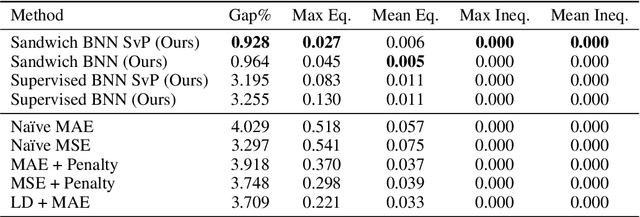
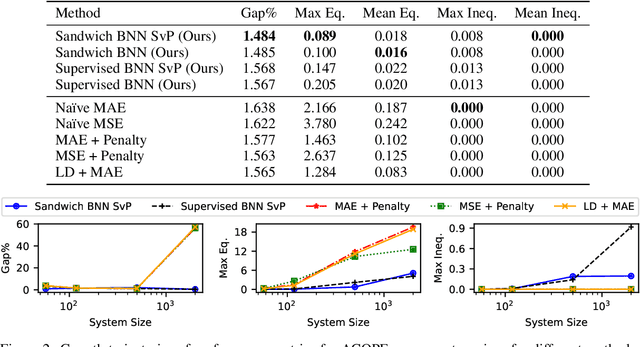

Constrained optimization problems arise in various engineering system operations such as inventory management and electric power grids. However, the requirement to repeatedly solve such optimization problems with uncertain parameters poses a significant computational challenge. This work introduces a learning scheme using Bayesian Neural Networks (BNNs) to solve constrained optimization problems under limited labeled data and restricted model training times. We propose a semi-supervised BNN for this practical but complex regime, wherein training commences in a sandwiched fashion, alternating between a supervised learning step (using labeled data) for minimizing cost, and an unsupervised learning step (using unlabeled data) for enforcing constraint feasibility. Both supervised and unsupervised steps use a Bayesian approach, where Stochastic Variational Inference is employed for approximate Bayesian inference. We show that the proposed semi-supervised learning method outperforms conventional BNN and deep neural network (DNN) architectures on important non-convex constrained optimization problems from energy network operations, achieving up to a tenfold reduction in expected maximum equality gap and halving the optimality and inequality (feasibility) gaps, without requiring any correction or projection step. By leveraging the BNN's ability to provide posterior samples at minimal computational cost, we demonstrate that a Selection via Posterior (SvP) scheme can further reduce equality gaps by more than 10%. We also provide tight and practically meaningful probabilistic confidence bounds that can be constructed using a low number of labeled testing data and readily adapted to other applications.
Equitable Routing -- Rethinking the Multiple Traveling Salesman Problem
Apr 15, 2024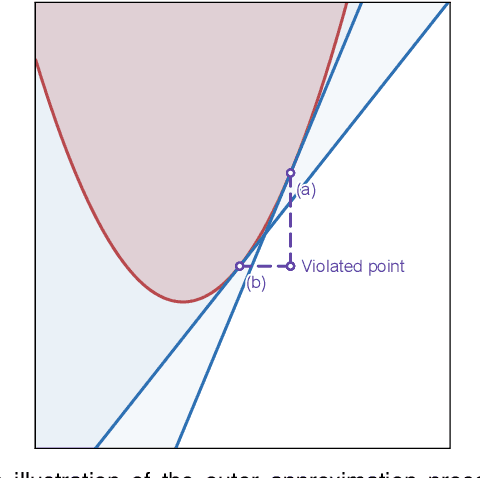
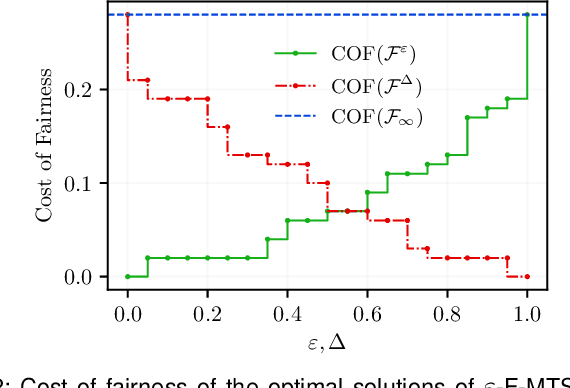
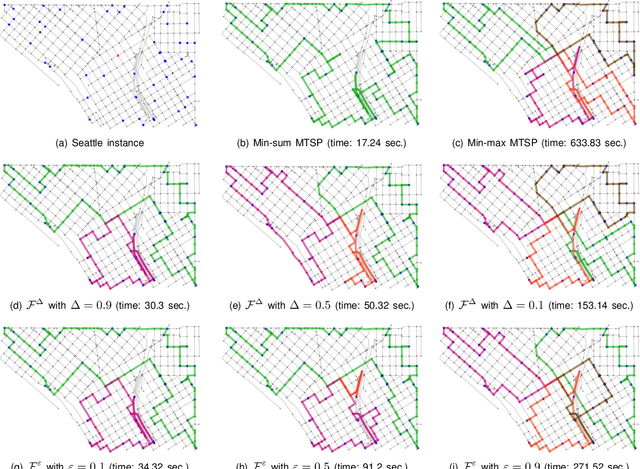
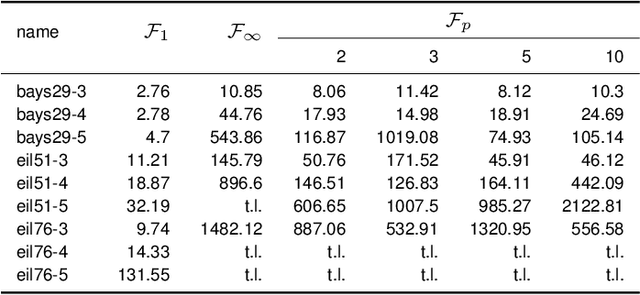
The Multiple Traveling Salesman Problem (MTSP) with a single depot is a generalization of the well-known Traveling Salesman Problem (TSP) that involves an additional parameter, namely, the number of salesmen. In the MTSP, several salesmen at the depot need to visit a set of interconnected targets, such that each target is visited precisely once by at most one salesman while minimizing the total length of their tours. An equally important variant of the MTSP, the min-max MTSP, aims to distribute the workload (length of the individual tours) among salesmen by requiring the longest tour of all the salesmen to be as short as possible, i.e., minimizing the maximum tour length among all salesmen. The min-max MTSP appears in real-life applications to ensure a good balance of workloads for the salesmen. It is known in the literature that the min-max MTSP is notoriously difficult to solve to optimality due to the poor lower bounds its linear relaxations provide. In this paper, we formulate two novel parametric variants of the MTSP called the "fair-MTSP". One variant is formulated as a Mixed-Integer Second Order Cone Program (MISOCP), and the other as a Mixed Integer Linear Program (MILP). Both focus on enforcing the workloads for the salesmen to be equitable, i.e., the distribution of tour lengths for the salesmen to be fair while minimizing the total cost of their tours. We present algorithms to solve the two variants of the fair-MTSP to global optimality and computational results on benchmark and real-world test instances that make a case for fair-MTSP as a viable alternative to the min-max MTSP.
Data-Efficient Power Flow Learning for Network Contingencies
Oct 06, 2023This work presents an efficient data-driven method to learn power flows in grids with network contingencies and to estimate corresponding probabilistic voltage envelopes (PVE). First, a network-aware Gaussian process (GP) termed Vertex-Degree Kernel (VDK-GP), developed in prior work, is used to estimate voltage-power functions for a few network configurations. The paper introduces a novel multi-task vertex degree kernel (MT-VDK) that amalgamates the learned VDK-GPs to determine power flows for unseen networks, with a significant reduction in the computational complexity and hyperparameter requirements compared to alternate approaches. Simulations on the IEEE 30-Bus network demonstrate the retention and transfer of power flow knowledge in both N-1 and N-2 contingency scenarios. The MT-VDK-GP approach achieves over 50% reduction in mean prediction error for novel N-1 contingency network configurations in low training data regimes (50-250 samples) over VDK-GP. Additionally, MT-VDK-GP outperforms a hyper-parameter based transfer learning approach in over 75% of N-2 contingency network structures, even without historical N-2 outage data. The proposed method demonstrates the ability to achieve PVEs using sixteen times fewer power flow solutions compared to Monte-Carlo sampling-based methods.
Information Theoretically Optimal Sample Complexity of Learning Dynamical Directed Acyclic Graphs
Aug 31, 2023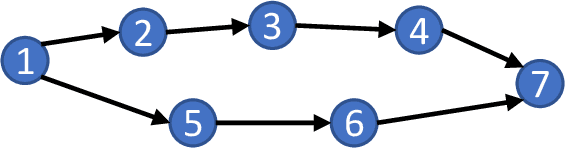
In this article, the optimal sample complexity of learning the underlying interaction/dependencies of a Linear Dynamical System (LDS) over a Directed Acyclic Graph (DAG) is studied. The sample complexity of learning a DAG's structure is well-studied for static systems, where the samples of nodal states are independent and identically distributed (i.i.d.). However, such a study is less explored for DAGs with dynamical systems, where the nodal states are temporally correlated. We call such a DAG underlying an LDS as \emph{dynamical} DAG (DDAG). In particular, we consider a DDAG where the nodal dynamics are driven by unobserved exogenous noise sources that are wide-sense stationary (WSS) in time but are mutually uncorrelated, and have the same {power spectral density (PSD)}. Inspired by the static settings, a metric and an algorithm based on the PSD matrix of the observed time series are proposed to reconstruct the DDAG. The equal noise PSD assumption can be relaxed such that identifiability conditions for DDAG reconstruction are not violated. For the LDS with WSS (sub) Gaussian exogenous noise sources, it is shown that the optimal sample complexity (or length of state trajectory) needed to learn the DDAG is $n=\Theta(q\log(p/q))$, where $p$ is the number of nodes and $q$ is the maximum number of parents per node. To prove the sample complexity upper bound, a concentration bound for the PSD estimation is derived, under two different sampling strategies. A matching min-max lower bound using generalized Fano's inequality also is provided, thus showing the order optimality of the proposed algorithm.
Graph-Structured Kernel Design for Power Flow Learning using Gaussian Processes
Aug 15, 2023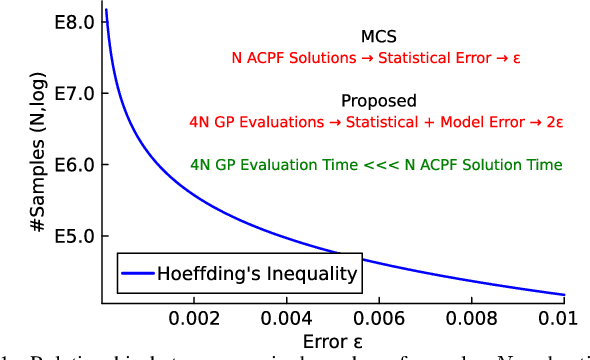
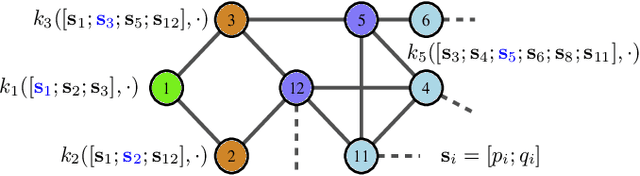
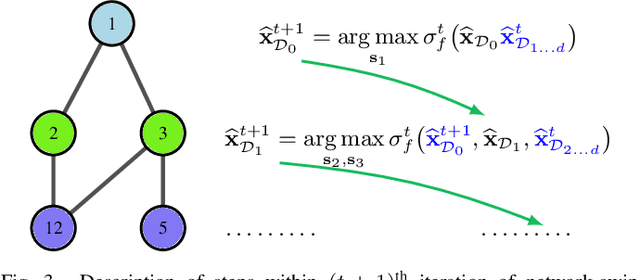
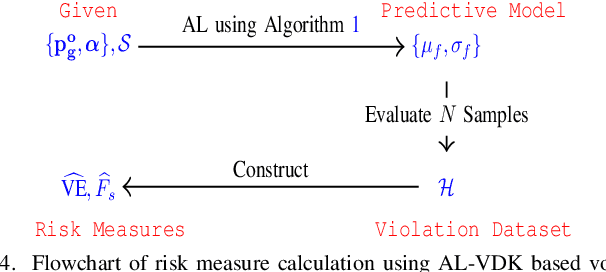
This paper presents a physics-inspired graph-structured kernel designed for power flow learning using Gaussian Process (GP). The kernel, named the vertex-degree kernel (VDK), relies on latent decomposition of voltage-injection relationship based on the network graph or topology. Notably, VDK design avoids the need to solve optimization problems for kernel search. To enhance efficiency, we also explore a graph-reduction approach to obtain a VDK representation with lesser terms. Additionally, we propose a novel network-swipe active learning scheme, which intelligently selects sequential training inputs to accelerate the learning of VDK. Leveraging the additive structure of VDK, the active learning algorithm performs a block-descent type procedure on GP's predictive variance, serving as a proxy for information gain. Simulations demonstrate that the proposed VDK-GP achieves more than two fold sample complexity reduction, compared to full GP on medium scale 500-Bus and large scale 1354-Bus power systems. The network-swipe algorithm outperforms mean performance of 500 random trials on test predictions by two fold for medium-sized 500-Bus systems and best performance of 25 random trials for large-scale 1354-Bus systems by 10%. Moreover, we demonstrate that the proposed method's performance for uncertainty quantification applications with distributionally shifted testing data sets.
GP CC-OPF: Gaussian Process based optimization tool for Chance-Constrained Optimal Power Flow
Feb 16, 2023The Gaussian Process (GP) based Chance-Constrained Optimal Power Flow (CC-OPF) is an open-source Python code developed for solving economic dispatch (ED) problem in modern power grids. In recent years, integrating a significant amount of renewables into a power grid causes high fluctuations and thus brings a lot of uncertainty to power grid operations. This fact makes the conventional model-based CC-OPF problem non-convex and computationally complex to solve. The developed tool presents a novel data-driven approach based on the GP regression model for solving the CC-OPF problem with a trade-off between complexity and accuracy. The proposed approach and developed software can help system operators to effectively perform ED optimization in the presence of large uncertainties in the power grid.
Data-Driven Chance Constrained AC-OPF using Hybrid Sparse Gaussian Processes
Aug 30, 2022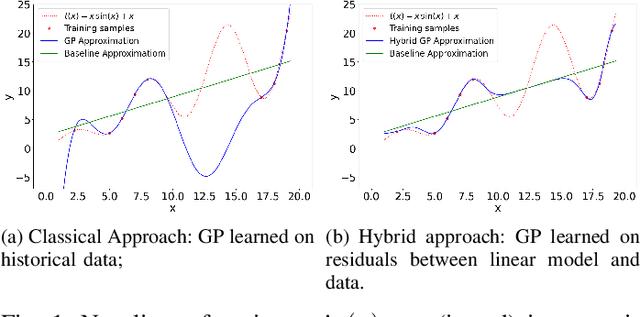
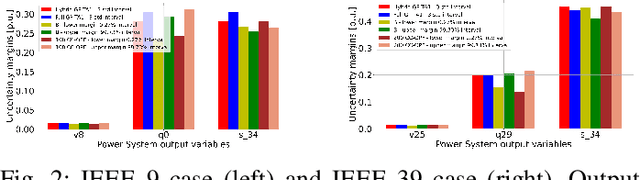
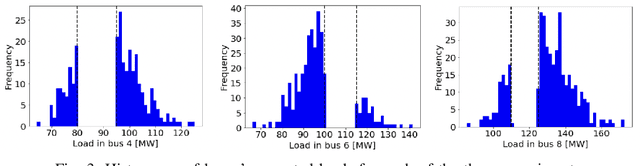
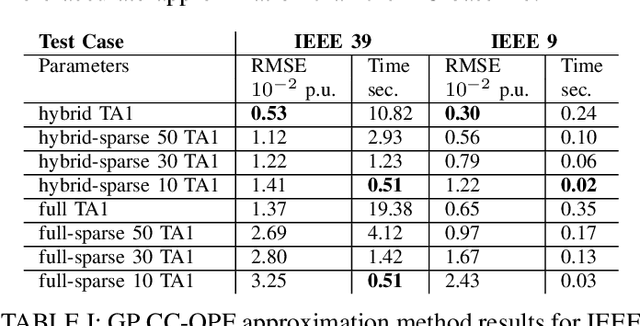
The alternating current (AC) chance-constrained optimal power flow (CC-OPF) problem addresses the economic efficiency of electricity generation and delivery under generation uncertainty. The latter is intrinsic to modern power grids because of the high amount of renewables. Despite its academic success, the AC CC-OPF problem is highly nonlinear and computationally demanding, which limits its practical impact. For improving the AC-OPF problem complexity/accuracy trade-off, the paper proposes a fast data-driven setup that uses the sparse and hybrid Gaussian processes (GP) framework to model the power flow equations with input uncertainty. We advocate the efficiency of the proposed approach by a numerical study over multiple IEEE test cases showing up to two times faster and more accurate solutions compared to the state-of-the-art methods.