 Add to Chrome
 Add to Firefox
 Add to Edge
Swimming with Whales: Analysis of Power Imbalances in Stake-Weighted Governance
May 19, 2026
Voting methods weighted by stakes are the fundamental governance paradigm in Proof-of-Stake (PoS) blockchains. Such a paradigm is known to be prone to power distortions: a few users possessing large stakes may completely control decision making, even without owning the totality of the stakes. We study this phenomenon through the lens of computational social choice, focusing on the extent of power imbalances in stake-weighted voting when power is quantified using the Penrose-Banzhaf power index. Our work presents both analytical and empirical contributions. Analytically, we demonstrate that while a perfect alignment between power and relative stake ownership is generally unattainable, it can be approximated in expectation under specific conditions. Empirically, using data from a real-world on-chain governance system (Project Catalyst), we provide a more fine-grained understanding of the power imbalances that are likely to occur in current stake-weighted governance systems.

Probably Approximately Consensus: On the Learning Theory of Finding Common Ground
Apr 23, 2026A primary goal of online deliberation platforms is to identify ideas that are broadly agreeable to a community of users through their expressed preferences. Yet, consensus elicitation should ideally extend beyond the specific statements provided by users and should incorporate the relative salience of particular topics. We address this issue by modelling consensus as an interval in a one-dimensional opinion space derived from potentially high-dimensional data via embedding and dimensionality reduction. We define an objective that maximizes expected agreement within a hypothesis interval where the expectation is over an underlying distribution of issues, implicitly taking into account their salience. We propose an efficient Empirical Risk Minimization (ERM) algorithm and establish PAC-learning guarantees. Our initial experiments demonstrate the performance of our algorithm and examine more efficient approaches to identifying optimal consensus regions. We find that through selectively querying users on an existing sample of statements, we can reduce the number of queries needed to a practical number.
Centrally Coordinated Multi-Agent Reinforcement Learning for Power Grid Topology Control
Feb 12, 2025Power grid operation is becoming more complex due to the increase in generation of renewable energy. The recent series of Learning To Run a Power Network (L2RPN) competitions have encouraged the use of artificial agents to assist human dispatchers in operating power grids. However, the combinatorial nature of the action space poses a challenge to both conventional optimizers and learned controllers. Action space factorization, which breaks down decision-making into smaller sub-tasks, is one approach to tackle the curse of dimensionality. In this study, we propose a centrally coordinated multi-agent (CCMA) architecture for action space factorization. In this approach, regional agents propose actions and subsequently a coordinating agent selects the final action. We investigate several implementations of the CCMA architecture, and benchmark in different experimental settings against various L2RPN baseline approaches. The CCMA architecture exhibits higher sample efficiency and superior final performance than the baseline approaches. The results suggest high potential of the CCMA approach for further application in higher-dimensional L2RPN as well as real-world power grid settings.
Learning in Multi-Objective Public Goods Games with Non-Linear Utilities
Aug 01, 2024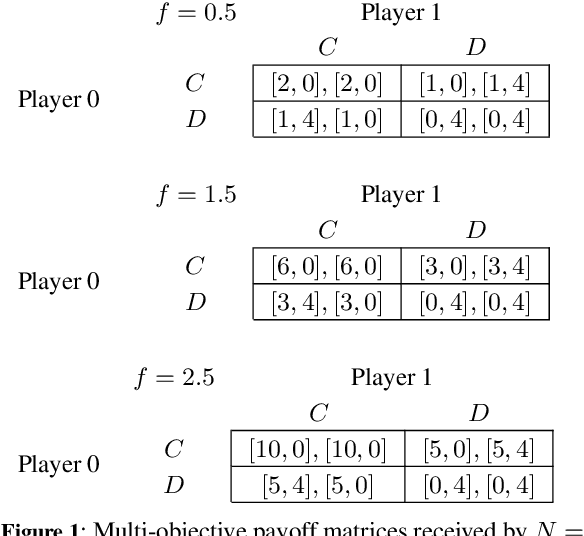
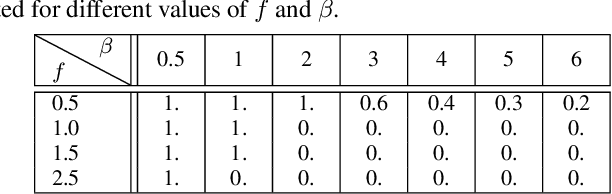
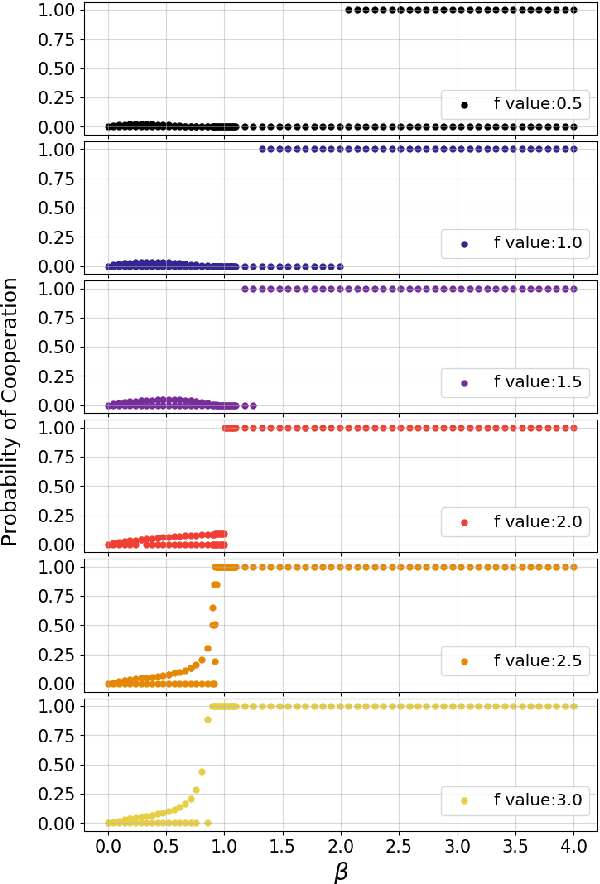
Addressing the question of how to achieve optimal decision-making under risk and uncertainty is crucial for enhancing the capabilities of artificial agents that collaborate with or support humans. In this work, we address this question in the context of Public Goods Games. We study learning in a novel multi-objective version of the Public Goods Game where agents have different risk preferences, by means of multi-objective reinforcement learning. We introduce a parametric non-linear utility function to model risk preferences at the level of individual agents, over the collective and individual reward components of the game. We study the interplay between such preference modelling and environmental uncertainty on the incentive alignment level in the game. We demonstrate how different combinations of individual preferences and environmental uncertainties sustain the emergence of cooperative patterns in non-cooperative environments (i.e., where competitive strategies are dominant), while others sustain competitive patterns in cooperative environments (i.e., where cooperative strategies are dominant).
Emergent Cooperation under Uncertain Incentive Alignment
Jan 23, 2024Understanding the emergence of cooperation in systems of computational agents is crucial for the development of effective cooperative AI. Interaction among individuals in real-world settings are often sparse and occur within a broad spectrum of incentives, which often are only partially known. In this work, we explore how cooperation can arise among reinforcement learning agents in scenarios characterised by infrequent encounters, and where agents face uncertainty about the alignment of their incentives with those of others. To do so, we train the agents under a wide spectrum of environments ranging from fully competitive, to fully cooperative, to mixed-motives. Under this type of uncertainty we study the effects of mechanisms, such as reputation and intrinsic rewards, that have been proposed in the literature to foster cooperation in mixed-motives environments. Our findings show that uncertainty substantially lowers the agents' ability to engage in cooperative behaviour, when that would be the best course of action. In this scenario, the use of effective reputation mechanisms and intrinsic rewards boosts the agents' capability to act nearly-optimally in cooperative environments, while greatly enhancing cooperation in mixed-motive environments as well.
Social Choice Around the Block: On the Computational Social Choice of Blockchain
Mar 15, 2022One of the most innovative aspects of blockchain technology consists in the introduction of an incentive layer to regulate the behavior of distributed protocols. The designer of a blockchain system faces therefore issues that are akin to those relevant for the design of economic mechanisms, and faces them in a computational setting. From this perspective the present paper argues for the importance of computational social choice in blockchain research. It identifies a few challenges at the interface of the two fields that illustrate the strong potential for cross-fertilization between them.
Power in Liquid Democracy
Oct 14, 2020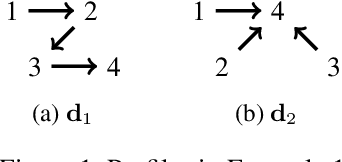
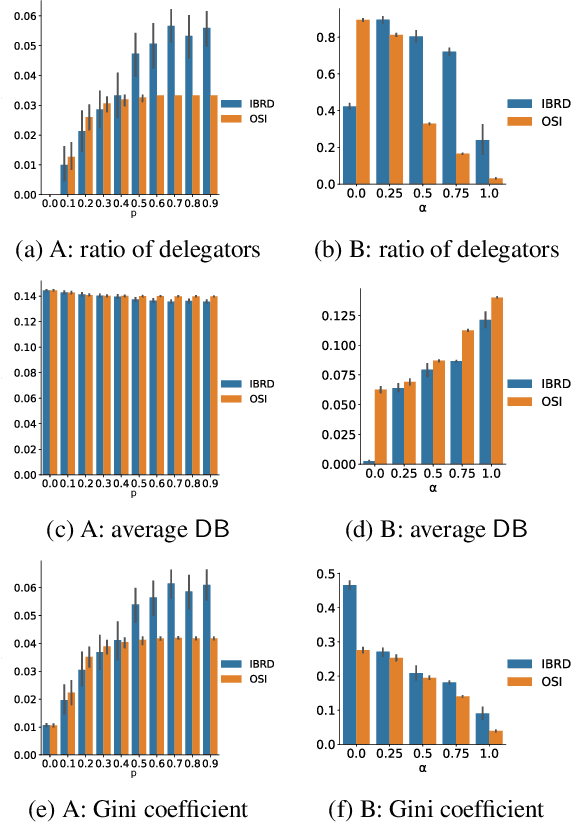
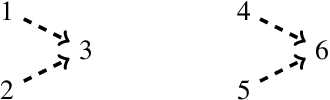
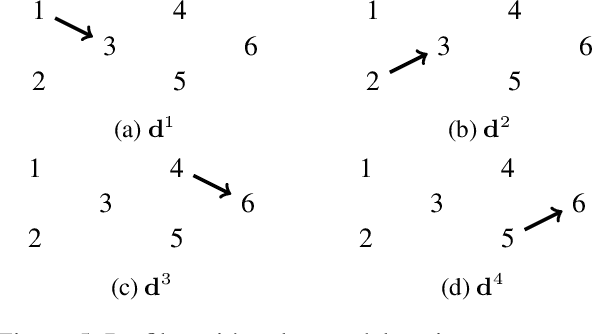
The paper develops a theory of power for delegable proxy voting systems. We define a power index able to measure the influence of both voters and delegators. Using this index, which we characterize axiomatically, we extend an earlier game-theoretic model by incorporating power-seeking behavior by agents. We analytically study the existence of pure strategy Nash equilibria in such a model. Finally, by means of simulations, we study the effect of relevant parameters on the emergence of power inequalities in the model.
On the Graded Acceptability of Arguments in Abstract and Instantiated Argumentation
Nov 08, 2018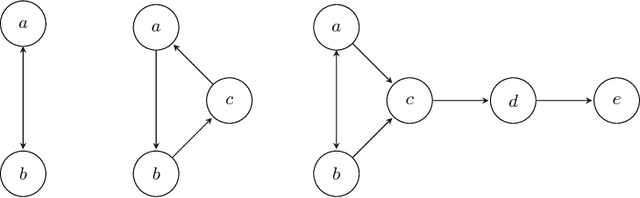
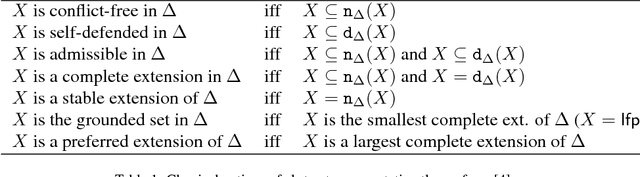
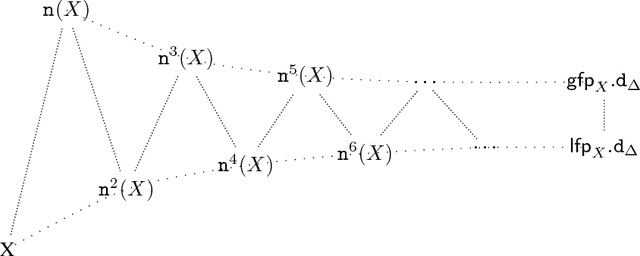
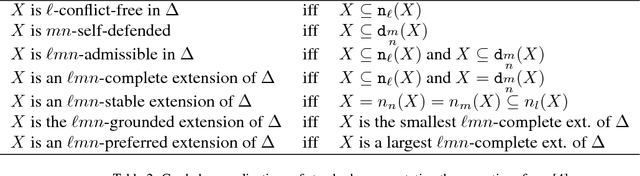
The paper develops a formal theory of the degree of justification of arguments, which relies solely on the structure of an argumentation framework, and which can be successfully interfaced with approaches to instantiated argumentation. The theory is developed in three steps. First, the paper introduces a graded generalization of the two key notions underpinning Dung's semantics: self-defense and conflict-freeness. This leads to a natural generalization of Dung's semantics, whereby standard extensions are weakened or strengthened depending on the level of self-defense and conflict-freeness they meet. The paper investigates the fixpoint theory of these semantics, establishing existence results for them. Second, the paper shows how graded semantics readily provide an approach to argument rankings, offering a novel contribution to the recently growing research programme on ranking-based semantics. Third, this novel approach to argument ranking is applied and studied in the context of instantiated argumentation frameworks, and in so doing is shown to account for a simple form of accrual of arguments within the Dung paradigm. Finally, the theory is compared in detail with existing approaches.
A Note on Nesting in Dyadic Deontic Logic
Oct 10, 2017The paper reports on some results concerning Aqvist's dyadic logic known as system G, which is one of the most influential logics for reasoning with dyadic obligations ("it ought to be the case that ... if it is the case that ..."). Although this logic has been known in the literature for a while, many of its properties still await in-depth consideration. In this short paper we show: that any formula in system G including nested modal operators is equivalent to some formula with no nesting; that the universal modality introduced by Aqvist in the first presentation of the system is definable in terms of the deontic modality.
Binary Voting with Delegable Proxy: An Analysis of Liquid Democracy
Jul 27, 2017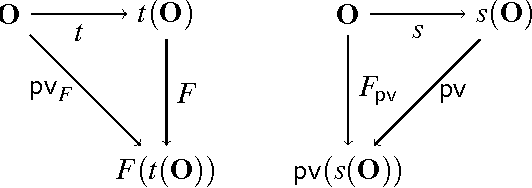
The paper provides an analysis of the voting method known as delegable proxy voting, or liquid democracy. The analysis first positions liquid democracy within the theory of binary aggregation. It then focuses on two issues of the system: the occurrence of delegation cycles; and the effect of delegations on individual rationality when voting on logically interdependent propositions. It finally points to proposals on how the system may be modified in order to address the above issues.
* In Proceedings TARK 2017, arXiv:1707.08250