 Add to Chrome
 Add to Firefox
 Add to Edge
Robust Counterfactual Policy Optimisation via Nondeterministic Causal Models
Aug 03, 2026
Counterfactual inference approaches for sequential decision-making typically assume deterministic causal models, where all randomness stems from latent variables. However, Markov Decision Processes (MDPs) are inherently stochastic. We address this by formalising counterfactual policy optimisation under probabilistic nondeterministic causal models, which properly separates latent confounding from irreducible stochasticity, and here propose a first practical optimisation problem for identifying robust counterfactual policies under a sensitivity analysis framework. We validate our approach on a sepsis treatment simulator, where diabetes status acts as a hidden global confounder.

Which Modality Decides? Counterfactual Modality Attribution for Multimodal LLMs
Jul 29, 2026Multimodal large language models (MLLMs) increasingly support high-stakes decision making by combining complementary information from images and text. While existing explainability methods identify influential image regions or text tokens, they cannot answer a fundamental question: which modality drives a prediction? Consequently, a model may produce the correct output while relying on the wrong source of evidence, masking shortcut learning and unsafe reasoning. We formulate modality attribution as a complementary explainability objective for multimodal foundation models and propose Counterfactual Modality Attribution (CMA), the first framework for quantifying modality-level contributions in MLLMs. CMA generates image-only, text-only, and joint multimodal counterfactuals using coupled diffusion priors and converts them into principled modality attribution scores through a cooperative game-theoretic formulation based on Shapley values. We evaluate CMA on controlled synthetic benchmarks with known ground-truth modality reliance and on a real-world multimodal clinical dataset. CMA correctly identifies the decision-driving modality in 98% of controlled cases and consistently outperforms baselines, revealing failures of cross-modal reasoning that remain invisible to predictive accuracy alone. Our results establish modality attribution as a complementary dimension of explainability beyond feature attribution, providing a principled framework for auditing multimodal foundation models in safety-critical applications.
Causal ASCEND: Scalable Two-tier Causal Discovery on High Dimensional Multi-omics Data
Jul 05, 2026Biological systems exhibit a hierarchical structure, characterised by directed flow from upstream regulators to downstream effects. Although this ordering provides a natural scaffold for causal inference, most causal discovery and GRN methods either ignore the tiered organisation or condition on all upstream variables, which becomes infeasible for high-dimensional omics data. We present ASCEND (Ancestral Scalable Causal discovEry via iNherited Descent), a constraint-based framework that leverages known two-tiered structure to enable genome-scale causal discovery. ASCEND introduces a divide-and-conquer strategy that maintains dynamically updated ancestral conditioning sets for each downstream variable, dramatically reducing the number of conditional independence tests required, and achieves polynomial-time complexity where traditional approaches face exponential blow-up. Through extensive simulations and real biological data, we demonstrate that ASCEND accurately recovers ancestral relationships, scales properly and much faster, and outperforms existing gene regulatory network inference methods in both causal precision and computational efficiency. The algorithm's ability to resolve directionality makes it particularly suited for integrating multi-omic data where upstream regulators (e.g., SNPs, methylation sites) and downstream responses (e.g., gene expression) are measured jointly.
Explainable Control Framework (XCF) based on Fuzzy Model-Agnostic Explanation and LLM Agent-Supported Interface
Jun 24, 2026Increasing demand for precise and reliable control in complex scenarios has led to the development of increasingly sophisticated controllers, including data-driven approaches employing closed box models and mathematically rigorous yet complex designs. This complexity highlights the needs for explainable control that can provide human-understandable insights into controller behavior. In this paper, an explainable control framework (XCF) along with supporting algorithms and user interface are proposed to explain how controllers determine their control actions and their underlying working mechanism. The novel contributions of this work are threefold: First, the XCF is designed to provide model-agnostic explanations for controllers in closed-loop systems and can optionally refine local explanations by system response dynamics. Second, a novel explanation method, hierarchical fuzzy model-agnostic explanation for control systems (HFMAE-C), is proposed based on the designed framework. The HFMAE-C employs a fuzzy logic system to approximate the controller's behavior and system dynamics, providing sample, local, domain and universe level explanations via IF-THEN rules revealing the controller's decision logic and salience values quantifying the contribution of system states to control actions. Third, a large language model agent-supported user interface is developed to automatically analyze user requirements, select appropriate algorithms, interpret the generated explanations to a natural language report, and provide interactive consultation. Case studies on inverted pendulum system and Turtlebot obstacle avoidance demonstrate the effectiveness of the proposed method through simulated user experiments and quantitative comparisons with mainstream explainable control approaches.
Fairness under uncertainty in sequential decisions
Apr 23, 2026Fair machine learning (ML) methods help identify and mitigate the risk that algorithms encode or automate social injustices. Algorithmic approaches alone cannot resolve structural inequalities, but they can support socio-technical decision systems by surfacing discriminatory biases, clarifying trade-offs, and enabling governance. Although fairness is well studied in supervised learning, many real ML applications are online and sequential, with prior decisions informing future ones. Each decision is taken under uncertainty due to unobserved counterfactuals and finite samples, with dire consequences for under-represented groups, systematically under-observed due to historical exclusion and selective feedback. A bank cannot know whether a denied loan would have been repaid, and may have less data on marginalized populations. This paper introduces a taxonomy of uncertainty in sequential decision-making -- model, feedback, and prediction uncertainty -- providing shared vocabulary for assessing systems where uncertainty is unevenly distributed across groups. We formalize model and feedback uncertainty via counterfactual logic and reinforcement learning, and illustrate harms to decision makers (unrealized gains/losses) and subjects (compounding exclusion, reduced access) of policies that ignore the unobserved space. Algorithmic examples show it is possible to reduce outcome variance for disadvantaged groups while preserving institutional objectives (e.g. expected utility). Experiments on data simulated with varying bias show how unequal uncertainty and selective feedback produce disparities, and how uncertainty-aware exploration alters fairness metrics. The framework equips practitioners to diagnose, audit, and govern fairness risks. Where uncertainty drives unfairness rather than incidental noise, accounting for it is essential to fair and effective decision-making.
Calibrate-Then-Delegate: Safety Monitoring with Risk and Budget Guarantees via Model Cascades
Apr 15, 2026Monitoring LLM safety at scale requires balancing cost and accuracy: a cheap latent-space probe can screen every input, but hard cases should be escalated to a more expensive expert. Existing cascades delegate based on probe uncertainty, but uncertainty is a poor proxy for delegation benefit, as it ignores whether the expert would actually correct the error. To address this problem, we introduce Calibrate-Then-Delegate (CTD), a model-cascade approach that provides probabilistic guarantees on the computation cost while enabling instance-level (streaming) decisions. CTD builds on a novel delegation value (DV) probe, a lightweight model operating on the same internal representations as the safety probe that directly predicts the benefit of escalation. To enforce budget constraints, CTD calibrates a threshold on the DV signal using held-out data via multiple hypothesis testing, yielding finite-sample guarantees on the delegation rate. Evaluated on four safety datasets, CTD consistently outperforms uncertainty-based delegation at every budget level, avoids harmful over-delegation, and adapts budget allocation to input difficulty without requiring group labels.
What Kind of Reasoning (if any) is an LLM actually doing? On the Stochastic Nature and Abductive Appearance of Large Language Models
Dec 10, 2025This article looks at how reasoning works in current Large Language Models (LLMs) that function using the token-completion method. It examines their stochastic nature and their similarity to human abductive reasoning. The argument is that these LLMs create text based on learned patterns rather than performing actual abductive reasoning. When their output seems abductive, this is largely because they are trained on human-generated texts that include reasoning structures. Examples are used to show how LLMs can produce plausible ideas, mimic commonsense reasoning, and give explanatory answers without being grounded in truth, semantics, verification, or understanding, and without performing any real abductive reasoning. This dual nature, where the models have a stochastic base but appear abductive in use, has important consequences for how LLMs are evaluated and applied. They can assist with generating ideas and supporting human thinking, but their outputs must be critically assessed because they cannot identify truth or verify their explanations. The article concludes by addressing five objections to these points, noting some limitations in the analysis, and offering an overall evaluation.
Multi-omic Causal Discovery using Genotypes and Gene Expression
May 21, 2025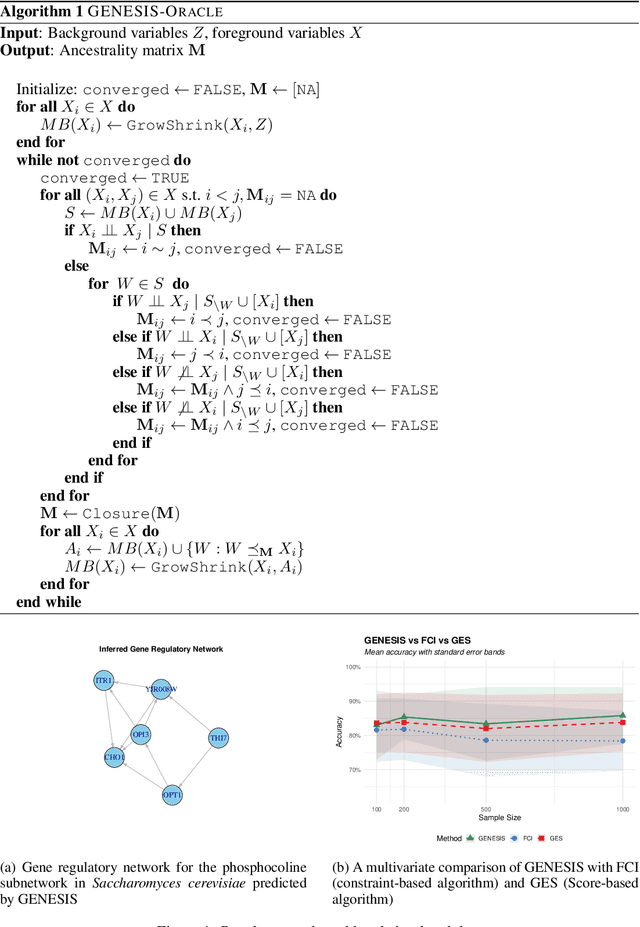
Causal discovery in multi-omic datasets is crucial for understanding the bigger picture of gene regulatory mechanisms, but remains challenging due to high dimensionality, differentiation of direct from indirect relationships, and hidden confounders. We introduce GENESIS (GEne Network inference from Expression SIgnals and SNPs), a constraint-based algorithm that leverages the natural causal precedence of genotypes to infer ancestral relationships in transcriptomic data. Unlike traditional causal discovery methods that start with a fully connected graph, GENESIS initialises an empty ancestrality matrix and iteratively populates it with direct, indirect or non-causal relationships using a series of provably sound marginal and conditional independence tests. By integrating genotypes as fixed causal anchors, GENESIS provides a principled ``head start'' to classical causal discovery algorithms, restricting the search space to biologically plausible edges. We test GENESIS on synthetic and real-world genomic datasets. This framework offers a powerful avenue for uncovering causal pathways in complex traits, with promising applications to functional genomics, drug discovery, and precision medicine.
The US Algorithmic Accountability Act of 2022 vs. The EU Artificial Intelligence Act: What can they learn from each other?
Jul 07, 2024On the whole, the U.S. Algorithmic Accountability Act of 2022 (US AAA) is a pragmatic approach to balancing the benefits and risks of automated decision systems. Yet there is still room for improvement. This commentary highlights how the US AAA can both inform and learn from the European Artificial Intelligence Act (EU AIA).
The Switch, the Ladder, and the Matrix: Models for Classifying AI Systems
Jul 07, 2024Organisations that design and deploy artificial intelligence (AI) systems increasingly commit themselves to high-level, ethical principles. However, there still exists a gap between principles and practices in AI ethics. One major obstacle organisations face when attempting to operationalise AI Ethics is the lack of a well-defined material scope. Put differently, the question to which systems and processes AI ethics principles ought to apply remains unanswered. Of course, there exists no universally accepted definition of AI, and different systems pose different ethical challenges. Nevertheless, pragmatic problem-solving demands that things should be sorted so that their grouping will promote successful actions for some specific end. In this article, we review and compare previous attempts to classify AI systems for the purpose of implementing AI governance in practice. We find that attempts to classify AI systems found in previous literature use one of three mental model. The Switch, i.e., a binary approach according to which systems either are or are not considered AI systems depending on their characteristics. The Ladder, i.e., a risk-based approach that classifies systems according to the ethical risks they pose. And the Matrix, i.e., a multi-dimensional classification of systems that take various aspects into account, such as context, data input, and decision-model. Each of these models for classifying AI systems comes with its own set of strengths and weaknesses. By conceptualising different ways of classifying AI systems into simple mental models, we hope to provide organisations that design, deploy, or regulate AI systems with the conceptual tools needed to operationalise AI governance in practice.