 Add to Chrome
 Add to Firefox
 Add to Edge
What is Left for Us? Second Scholarship Against the Degradation of Research by AI
Jul 04, 2026
We argue that generative AI can degrade research by eroding the very practices through which scholarly judgement is formed and academic trust is built. As constitutive conditions for the production and validation of knowledge, these practices cannot be reduced to the final outputs of research, which is what AI so effectively simulate. Accordingly, when researchers delegate central tasks of inquiry to systems like Large Language Models, they may stop enacting these practices and, with them, lose access to the formation they provide. An individual research output generated by AI may even appear improved but the researcher behind it fails to develop. Against this risk, merely keeping humans in the loop as prompters or quality checkers of AI outputs is insufficient to preserve research as a site of intellectual formation. What is needed instead is a renewed commitment to research as a lived practice in which judgement is formed gradually, often through frictions, and participation in a scholarly community. We defend it because it rests on four sources and warrants of research that cannot be automated: tacit knowledge, personal commitment, socialisation, and deep reading. This practice enacts what we call second scholarship, by which we understand the reappropriation of scholarly craft, chosen out of a critical experience of what generative AI can and cannot do. What cannot and should not be delegated becomes what research communities must value and answer for. This is what is left for us.

What Kind of Reasoning (if any) is an LLM actually doing? On the Stochastic Nature and Abductive Appearance of Large Language Models
Dec 10, 2025This article looks at how reasoning works in current Large Language Models (LLMs) that function using the token-completion method. It examines their stochastic nature and their similarity to human abductive reasoning. The argument is that these LLMs create text based on learned patterns rather than performing actual abductive reasoning. When their output seems abductive, this is largely because they are trained on human-generated texts that include reasoning structures. Examples are used to show how LLMs can produce plausible ideas, mimic commonsense reasoning, and give explanatory answers without being grounded in truth, semantics, verification, or understanding, and without performing any real abductive reasoning. This dual nature, where the models have a stochastic base but appear abductive in use, has important consequences for how LLMs are evaluated and applied. They can assist with generating ideas and supporting human thinking, but their outputs must be critically assessed because they cannot identify truth or verify their explanations. The article concludes by addressing five objections to these points, noting some limitations in the analysis, and offering an overall evaluation.
A Categorical Analysis of Large Language Models and Why LLMs Circumvent the Symbol Grounding Problem
Dec 09, 2025This paper presents a formal, categorical framework for analysing how humans and large language models (LLMs) transform content into truth-evaluated propositions about a state space of possible worlds W , in order to argue that LLMs do not solve but circumvent the symbol grounding problem.
Cyber Risks to Next-Gen Brain-Computer Interfaces: Analysis and Recommendations
Aug 18, 2025Brain-computer interfaces (BCIs) show enormous potential for advancing personalized medicine. However, BCIs also introduce new avenues for cyber-attacks or security compromises. In this article, we analyze the problem and make recommendations for device manufacturers to better secure devices and to help regulators understand where more guidance is needed to protect patient safety and data confidentiality. Device manufacturers should implement the prior suggestions in their BCI products. These recommendations help protect BCI users from undue risks, including compromised personal health and genetic information, unintended BCI-mediated movement, and many other cybersecurity breaches. Regulators should mandate non-surgical device update methods, strong authentication and authorization schemes for BCI software modifications, encryption of data moving to and from the brain, and minimize network connectivity where possible. We also design a hypothetical, average-case threat model that identifies possible cybersecurity threats to BCI patients and predicts the likeliness of risk for each category of threat. BCIs are at less risk of physical compromise or attack, but are vulnerable to remote attack; we focus on possible threats via network paths to BCIs and suggest technical controls to limit network connections.
A Conjecture on a Fundamental Trade-Off between Certainty and Scope in Symbolic and Generative AI
Jun 11, 2025This article introduces a conjecture that formalises a fundamental trade-off between provable correctness and broad data-mapping capacity in Artificial Intelligence (AI) systems. When an AI system is engineered for deductively watertight guarantees (demonstrable certainty about the error-free nature of its outputs) -- as in classical symbolic AI -- its operational domain must be narrowly circumscribed and pre-structured. Conversely, a system that can input high-dimensional data to produce rich information outputs -- as in contemporary generative models -- necessarily relinquishes the possibility of zero-error performance, incurring an irreducible risk of errors or misclassification. By making this previously implicit trade-off explicit and open to rigorous verification, the conjecture significantly reframes both engineering ambitions and philosophical expectations for AI. After reviewing the historical motivations for this tension, the article states the conjecture in information-theoretic form and contextualises it within broader debates in epistemology, formal verification, and the philosophy of technology. It then offers an analysis of its implications and consequences, drawing on notions of underdetermination, prudent epistemic risk, and moral responsibility. The discussion clarifies how, if correct, the conjecture would help reshape evaluation standards, governance frameworks, and hybrid system design. The conclusion underscores the importance of eventually proving or refuting the inequality for the future of trustworthy AI.
Agentic AI Optimisation (AAIO): what it is, how it works, why it matters, and how to deal with it
Apr 16, 2025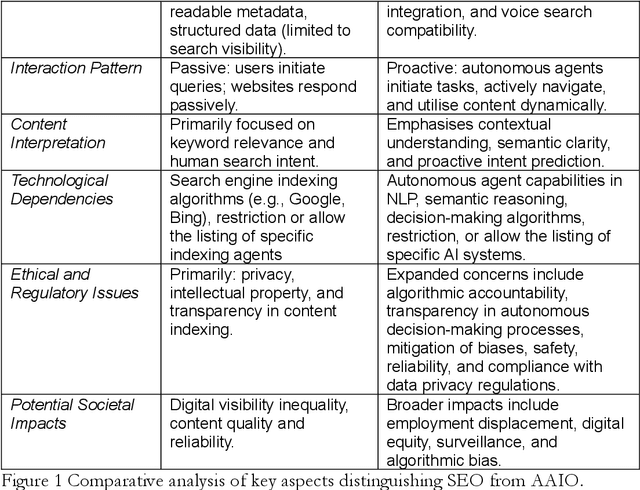
The emergence of Agentic Artificial Intelligence (AAI) systems capable of independently initiating digital interactions necessitates a new optimisation paradigm designed explicitly for seamless agent-platform interactions. This article introduces Agentic AI Optimisation (AAIO) as an essential methodology for ensuring effective integration between websites and agentic AI systems. Like how Search Engine Optimisation (SEO) has shaped digital content discoverability, AAIO can define interactions between autonomous AI agents and online platforms. By examining the mutual interdependency between website optimisation and agentic AI success, the article highlights the virtuous cycle that AAIO can create. It further explores the governance, ethical, legal, and social implications (GELSI) of AAIO, emphasising the necessity of proactive regulatory frameworks to mitigate potential negative impacts. The article concludes by affirming AAIO's essential role as part of a fundamental digital infrastructure in the era of autonomous digital agents, advocating for equitable and inclusive access to its benefits.
Challenges and Best Practices in Corporate AI Governance:Lessons from the Biopharmaceutical Industry
Jul 07, 2024While the use of artificial intelligence (AI) systems promises to bring significant economic and social benefits, it is also coupled with ethical, legal, and technical challenges. Business leaders thus face the question of how to best reap the benefits of automation whilst managing the associated risks. As a first step, many companies have committed themselves to various sets of ethics principles aimed at guiding the design and use of AI systems. So far so good. But how can well-intentioned ethical principles be translated into effective practice? And what challenges await companies that attempt to operationalize AI governance? In this article, we address these questions by drawing on our first-hand experience of shaping and driving the roll-out of AI governance within AstraZeneca, a biopharmaceutical company. The examples we discuss highlight challenges that any organization attempting to operationalize AI governance will have to face. These include questions concerning how to define the material scope of AI governance, how to harmonize standards across decentralized organizations, and how to measure the impact of specific AI governance initiatives. By showcasing how AstraZeneca managed these operational questions, we hope to provide project managers, CIOs, AI practitioners, and data privacy officers responsible for designing and implementing AI governance frameworks within other organizations with generalizable best practices. In essence, companies seeking to operationalize AI governance are encouraged to build on existing policies and governance structures, use pragmatic and action-oriented terminology, focus on risk management in development and procurement, and empower employees through continuous education and change management.
The Switch, the Ladder, and the Matrix: Models for Classifying AI Systems
Jul 07, 2024Organisations that design and deploy artificial intelligence (AI) systems increasingly commit themselves to high-level, ethical principles. However, there still exists a gap between principles and practices in AI ethics. One major obstacle organisations face when attempting to operationalise AI Ethics is the lack of a well-defined material scope. Put differently, the question to which systems and processes AI ethics principles ought to apply remains unanswered. Of course, there exists no universally accepted definition of AI, and different systems pose different ethical challenges. Nevertheless, pragmatic problem-solving demands that things should be sorted so that their grouping will promote successful actions for some specific end. In this article, we review and compare previous attempts to classify AI systems for the purpose of implementing AI governance in practice. We find that attempts to classify AI systems found in previous literature use one of three mental model. The Switch, i.e., a binary approach according to which systems either are or are not considered AI systems depending on their characteristics. The Ladder, i.e., a risk-based approach that classifies systems according to the ethical risks they pose. And the Matrix, i.e., a multi-dimensional classification of systems that take various aspects into account, such as context, data input, and decision-model. Each of these models for classifying AI systems comes with its own set of strengths and weaknesses. By conceptualising different ways of classifying AI systems into simple mental models, we hope to provide organisations that design, deploy, or regulate AI systems with the conceptual tools needed to operationalise AI governance in practice.
The US Algorithmic Accountability Act of 2022 vs. The EU Artificial Intelligence Act: What can they learn from each other?
Jul 07, 2024On the whole, the U.S. Algorithmic Accountability Act of 2022 (US AAA) is a pragmatic approach to balancing the benefits and risks of automated decision systems. Yet there is still room for improvement. This commentary highlights how the US AAA can both inform and learn from the European Artificial Intelligence Act (EU AIA).
Generative AI in EU Law: Liability, Privacy, Intellectual Property, and Cybersecurity
Jan 14, 2024The advent of Generative AI, particularly through Large Language Models (LLMs) like ChatGPT and its successors, marks a paradigm shift in the AI landscape. Advanced LLMs exhibit multimodality, handling diverse data formats, thereby broadening their application scope. However, the complexity and emergent autonomy of these models introduce challenges in predictability and legal compliance. This paper delves into the legal and regulatory implications of Generative AI and LLMs in the European Union context, analyzing aspects of liability, privacy, intellectual property, and cybersecurity. It critically examines the adequacy of the existing and proposed EU legislation, including the Artificial Intelligence Act (AIA) draft, in addressing the unique challenges posed by Generative AI in general and LLMs in particular. The paper identifies potential gaps and shortcomings in the legislative framework and proposes recommendations to ensure the safe and compliant deployment of generative models, ensuring they align with the EU's evolving digital landscape and legal standards.