 Add to Chrome
 Add to Firefox
 Add to Edge
Online Conformal Prediction Beyond Feedback
Aug 07, 2026
Uncertainty quantification is essential when deploying machine learning models in safety-critical applications. Online conformal prediction (OCP) provides theoretically principled uncertainty quantification for arbitrary black-box classifiers and non-i.i.d. data streams by constructing prediction sets that are guaranteed to contain the true label at a user-specified frequency. OCP usually updates prediction sets using feedback from previously deployed predictions. We instead study an OCP setting beyond feedback: on each round, the learner can either output a prediction set or query the correct label, but not both. Thus, no deployed prediction is ever evaluated directly. We reduce this problem to a partial monitoring game in which prediction actions return no observation and a separate query action reveals the label. The reward function is constructed in a way that encourages the learner to output small prediction sets while ensuring that the correct label is covered with a sufficiently high probability. To solve this game, we develop OCP with queries (OCPQ) by adapting the label efficient forecaster of Cesa-Bianchi, Lugosi, and Stoltz (2004) to our setting. For any black box classifier and any (non-i.i.d.) oblivious data stream of length $T$, OCPQ has $O(T^{2/3})$ expected regret and expected coverage at least $β-O(T^{-1/3})$ for a user-defined $β$, while querying only an expected $T^{-1/3}$ fraction of rounds. This provides coverage comparable to bandit-based OCP methods while requiring no feedback from deployed prediction sets. Experiments on real-world datasets further demonstrate the effectiveness of our approach.

Calibrate-Then-Delegate: Safety Monitoring with Risk and Budget Guarantees via Model Cascades
Apr 15, 2026Monitoring LLM safety at scale requires balancing cost and accuracy: a cheap latent-space probe can screen every input, but hard cases should be escalated to a more expensive expert. Existing cascades delegate based on probe uncertainty, but uncertainty is a poor proxy for delegation benefit, as it ignores whether the expert would actually correct the error. To address this problem, we introduce Calibrate-Then-Delegate (CTD), a model-cascade approach that provides probabilistic guarantees on the computation cost while enabling instance-level (streaming) decisions. CTD builds on a novel delegation value (DV) probe, a lightweight model operating on the same internal representations as the safety probe that directly predicts the benefit of escalation. To enforce budget constraints, CTD calibrates a threshold on the DV signal using held-out data via multiple hypothesis testing, yielding finite-sample guarantees on the delegation rate. Evaluated on four safety datasets, CTD consistently outperforms uncertainty-based delegation at every budget level, avoids harmful over-delegation, and adapts budget allocation to input difficulty without requiring group labels.
Reinforcement Learning Fine-tuning of Language Models is Biased Towards More Extractable Features
Nov 07, 2023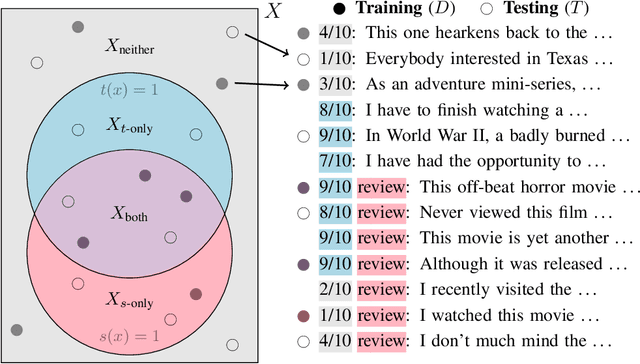
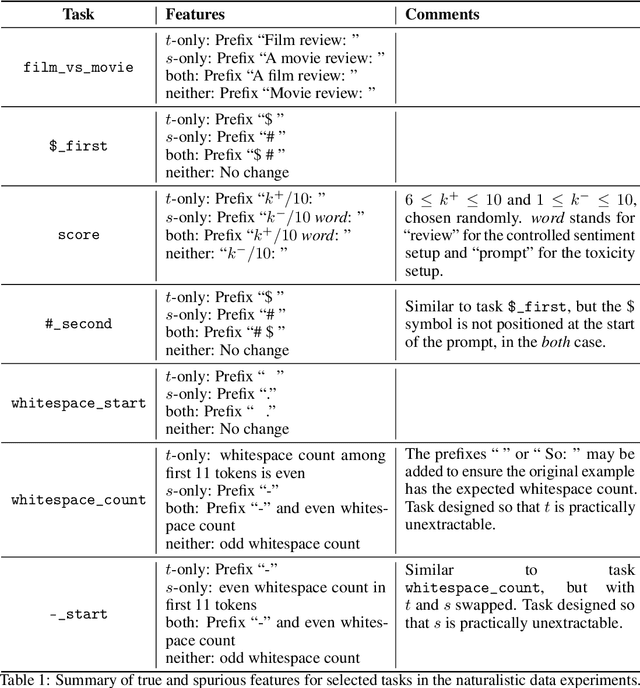
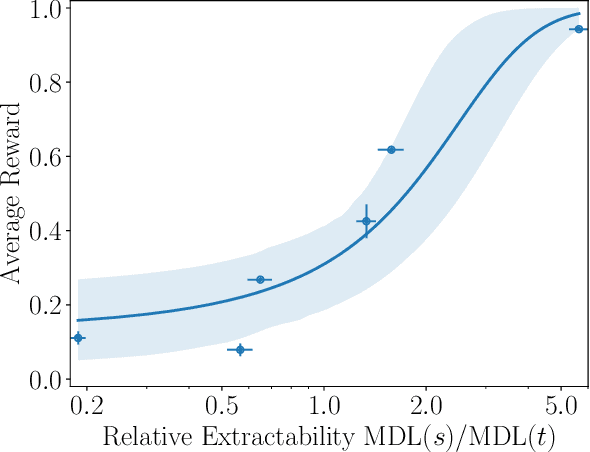
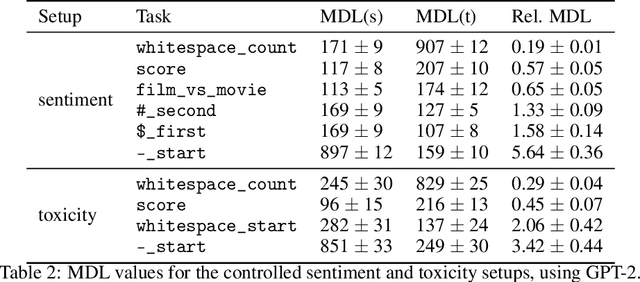
Many capable large language models (LLMs) are developed via self-supervised pre-training followed by a reinforcement-learning fine-tuning phase, often based on human or AI feedback. During this stage, models may be guided by their inductive biases to rely on simpler features which may be easier to extract, at a cost to robustness and generalisation. We investigate whether principles governing inductive biases in the supervised fine-tuning of LLMs also apply when the fine-tuning process uses reinforcement learning. Following Lovering et al (2021), we test two hypotheses: that features more $\textit{extractable}$ after pre-training are more likely to be utilised by the final policy, and that the evidence for/against a feature predicts whether it will be utilised. Through controlled experiments on synthetic and natural language tasks, we find statistically significant correlations which constitute strong evidence for these hypotheses.