 Add to Chrome
 Add to Firefox
 Add to Edge
Causal ASCEND: Scalable Two-tier Causal Discovery on High Dimensional Multi-omics Data
Jul 05, 2026
Biological systems exhibit a hierarchical structure, characterised by directed flow from upstream regulators to downstream effects. Although this ordering provides a natural scaffold for causal inference, most causal discovery and GRN methods either ignore the tiered organisation or condition on all upstream variables, which becomes infeasible for high-dimensional omics data. We present ASCEND (Ancestral Scalable Causal discovEry via iNherited Descent), a constraint-based framework that leverages known two-tiered structure to enable genome-scale causal discovery. ASCEND introduces a divide-and-conquer strategy that maintains dynamically updated ancestral conditioning sets for each downstream variable, dramatically reducing the number of conditional independence tests required, and achieves polynomial-time complexity where traditional approaches face exponential blow-up. Through extensive simulations and real biological data, we demonstrate that ASCEND accurately recovers ancestral relationships, scales properly and much faster, and outperforms existing gene regulatory network inference methods in both causal precision and computational efficiency. The algorithm's ability to resolve directionality makes it particularly suited for integrating multi-omic data where upstream regulators (e.g., SNPs, methylation sites) and downstream responses (e.g., gene expression) are measured jointly.

Multi-omic Causal Discovery using Genotypes and Gene Expression
May 21, 2025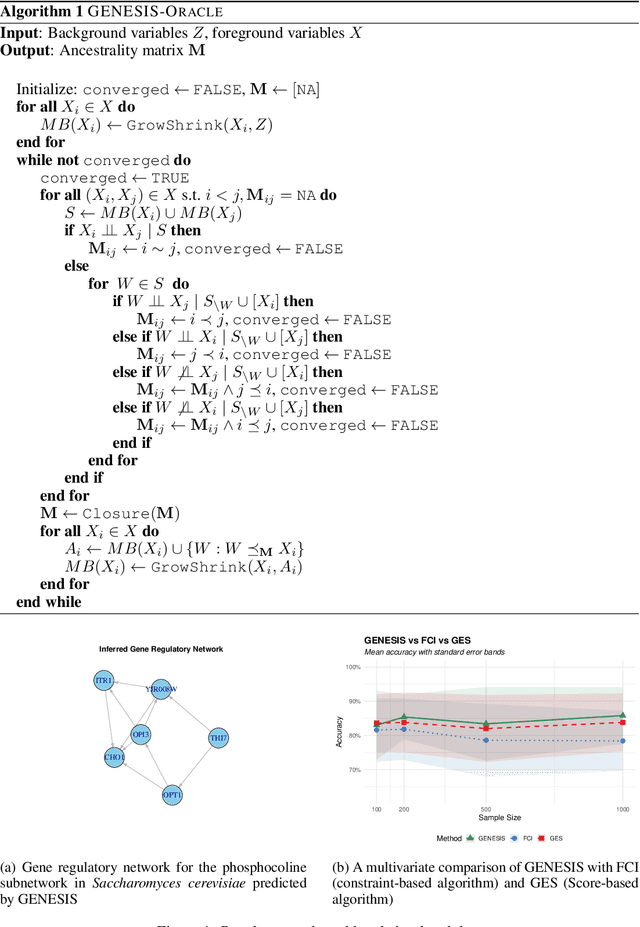
Causal discovery in multi-omic datasets is crucial for understanding the bigger picture of gene regulatory mechanisms, but remains challenging due to high dimensionality, differentiation of direct from indirect relationships, and hidden confounders. We introduce GENESIS (GEne Network inference from Expression SIgnals and SNPs), a constraint-based algorithm that leverages the natural causal precedence of genotypes to infer ancestral relationships in transcriptomic data. Unlike traditional causal discovery methods that start with a fully connected graph, GENESIS initialises an empty ancestrality matrix and iteratively populates it with direct, indirect or non-causal relationships using a series of provably sound marginal and conditional independence tests. By integrating genotypes as fixed causal anchors, GENESIS provides a principled ``head start'' to classical causal discovery algorithms, restricting the search space to biologically plausible edges. We test GENESIS on synthetic and real-world genomic datasets. This framework offers a powerful avenue for uncovering causal pathways in complex traits, with promising applications to functional genomics, drug discovery, and precision medicine.