 Add to Chrome
 Add to Firefox
 Add to Edge
What is Left for Us? Second Scholarship Against the Degradation of Research by AI
Jul 04, 2026
We argue that generative AI can degrade research by eroding the very practices through which scholarly judgement is formed and academic trust is built. As constitutive conditions for the production and validation of knowledge, these practices cannot be reduced to the final outputs of research, which is what AI so effectively simulate. Accordingly, when researchers delegate central tasks of inquiry to systems like Large Language Models, they may stop enacting these practices and, with them, lose access to the formation they provide. An individual research output generated by AI may even appear improved but the researcher behind it fails to develop. Against this risk, merely keeping humans in the loop as prompters or quality checkers of AI outputs is insufficient to preserve research as a site of intellectual formation. What is needed instead is a renewed commitment to research as a lived practice in which judgement is formed gradually, often through frictions, and participation in a scholarly community. We defend it because it rests on four sources and warrants of research that cannot be automated: tacit knowledge, personal commitment, socialisation, and deep reading. This practice enacts what we call second scholarship, by which we understand the reappropriation of scholarly craft, chosen out of a critical experience of what generative AI can and cannot do. What cannot and should not be delegated becomes what research communities must value and answer for. This is what is left for us.

How to Detect and Measure the AI Dangers to Democracy
Jun 14, 2026Research on artificial intelligence and democracy has grown quickly over the last decade. A shared conclusion in this literature is that AI does not create new democratic problems so much as it makes old ones worse. We now see this across information ecosystems, in elections, and in public administration. However, despite growing evidence, we lack a clear way to prioritize risks in this area, compare them across domains, and identify where democratic control is most likely to break down. So, our problem is: How can we systematize the problems that AI systems pose to democratic processes? This paper argues that principal agent theory may fit the task. In many phases of democratic systems, principals delegate key functions to AI systems and their providers without really being able to monitor how these systems operate or the outputs they produce. Treating AI as a delegation problem helps identify accountability gaps and other governance failures. Most importantly, as we shall illustrate, it provides metrics for empirical assessments of AI impact on democracy. As a second analytical element, we draw on the NIST AI Risk Management Framework and its seven characteristics of trustworthy AI, which supply substantive criteria for evaluating delegated tasks. Operationalized across the three domains through measurable indicators and domain specific trustworthiness criteria, we propose an analytical framework that centers on institutional assessability as the central condition for democratic control over AI. However, we stress that how severe a harm is, and how much risk is acceptable, are evaluative judgments that current methodologies neither acknowledge nor operationalize. This becomes acute when such evaluative judgments are (silently) delegated to private vendors. We identify this as a strong limitation left for future work.
What Kind of Reasoning (if any) is an LLM actually doing? On the Stochastic Nature and Abductive Appearance of Large Language Models
Dec 10, 2025This article looks at how reasoning works in current Large Language Models (LLMs) that function using the token-completion method. It examines their stochastic nature and their similarity to human abductive reasoning. The argument is that these LLMs create text based on learned patterns rather than performing actual abductive reasoning. When their output seems abductive, this is largely because they are trained on human-generated texts that include reasoning structures. Examples are used to show how LLMs can produce plausible ideas, mimic commonsense reasoning, and give explanatory answers without being grounded in truth, semantics, verification, or understanding, and without performing any real abductive reasoning. This dual nature, where the models have a stochastic base but appear abductive in use, has important consequences for how LLMs are evaluated and applied. They can assist with generating ideas and supporting human thinking, but their outputs must be critically assessed because they cannot identify truth or verify their explanations. The article concludes by addressing five objections to these points, noting some limitations in the analysis, and offering an overall evaluation.
Agentic AI Optimisation (AAIO): what it is, how it works, why it matters, and how to deal with it
Apr 16, 2025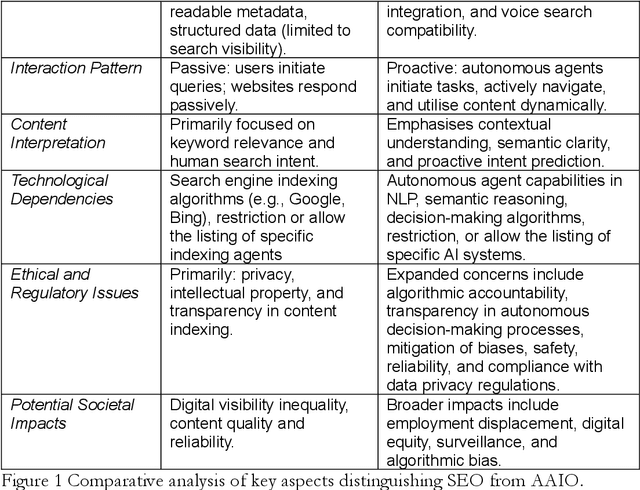
The emergence of Agentic Artificial Intelligence (AAI) systems capable of independently initiating digital interactions necessitates a new optimisation paradigm designed explicitly for seamless agent-platform interactions. This article introduces Agentic AI Optimisation (AAIO) as an essential methodology for ensuring effective integration between websites and agentic AI systems. Like how Search Engine Optimisation (SEO) has shaped digital content discoverability, AAIO can define interactions between autonomous AI agents and online platforms. By examining the mutual interdependency between website optimisation and agentic AI success, the article highlights the virtuous cycle that AAIO can create. It further explores the governance, ethical, legal, and social implications (GELSI) of AAIO, emphasising the necessity of proactive regulatory frameworks to mitigate potential negative impacts. The article concludes by affirming AAIO's essential role as part of a fundamental digital infrastructure in the era of autonomous digital agents, advocating for equitable and inclusive access to its benefits.
Digital Democracy in the Age of Artificial Intelligence
Nov 26, 2024This chapter explores the influence of Artificial Intelligence (AI) on digital democracy, focusing on four main areas: citizenship, participation, representation, and the public sphere. It traces the evolution from electronic to virtual and network democracy, underscoring how each stage has broadened democratic engagement through technology. Focusing on digital citizenship, the chapter examines how AI can improve online engagement and promote ethical behaviour while posing privacy risks and fostering identity stereotyping. Regarding political participation, it highlights AI's dual role in mobilising civic actions and spreading misinformation. Regarding representation, AI's involvement in electoral processes can enhance voter registration, e-voting, and the efficiency of result tabulation but raises concerns regarding privacy and public trust. Also, AI's predictive capabilities shift the dynamics of political competition, posing ethical questions about manipulation and the legitimacy of democracy. Finally, the chapter examines how integrating AI and digital technologies can facilitate democratic political advocacy and personalised communication. However, this also comes with higher risks of misinformation and targeted propaganda.
Generative AI in EU Law: Liability, Privacy, Intellectual Property, and Cybersecurity
Jan 14, 2024The advent of Generative AI, particularly through Large Language Models (LLMs) like ChatGPT and its successors, marks a paradigm shift in the AI landscape. Advanced LLMs exhibit multimodality, handling diverse data formats, thereby broadening their application scope. However, the complexity and emergent autonomy of these models introduce challenges in predictability and legal compliance. This paper delves into the legal and regulatory implications of Generative AI and LLMs in the European Union context, analyzing aspects of liability, privacy, intellectual property, and cybersecurity. It critically examines the adequacy of the existing and proposed EU legislation, including the Artificial Intelligence Act (AIA) draft, in addressing the unique challenges posed by Generative AI in general and LLMs in particular. The paper identifies potential gaps and shortcomings in the legislative framework and proposes recommendations to ensure the safe and compliant deployment of generative models, ensuring they align with the EU's evolving digital landscape and legal standards.