 Add to Chrome
 Add to Firefox
 Add to Edge
CalArena: A Large-Scale Post-Hoc Calibration Benchmark
May 28, 2026
Reliable probability estimates are critical in many machine learning applications, yet modern classifiers are often poorly calibrated. Post-hoc calibration provides a simple and widely used solution, but the large number of proposed methods, combined with small-scale and inconsistent evaluations, makes it difficult to determine which approaches are truly effective in practice. We introduce a large-scale, standardized benchmark for post-hoc calibration, covering nearly 2000 experiments across tabular and computer vision tasks, including binary, multiclass, and large-scale classification settings. Our benchmark aggregates predictions from a diverse set of classical models, modern deep learning architectures, and foundation models, and provides unified, reproducible implementations of dozens of calibration methods within a common evaluation framework. We argue that Post-Hoc Improvement (PHI) in proper scoring rules offers a principled alternative to traditional calibration error estimators for comparing post-hoc methods, capturing both calibration quality and potential degradation to the model's predictive performance. Using this framework, we conduct the most comprehensive empirical study of post-hoc calibration to date. Our results reveal consistent patterns across domains: smooth calibration functions outperform binning-based approaches, dedicated multiclass methods are essential in high-dimensional settings, and generic machine learning models are not competitive without calibration-specific design. To facilitate future research, we release all data, code, and evaluation tools, providing a plug-and-play benchmark for developing and comparing calibration methods.

STRABLE: Benchmarking Tabular Machine Learning with Strings
May 12, 2026Benchmarking tabular learning has revealed the benefit of dedicated architectures, pushing the state of the art. But real-world tables often contain string entries, beyond numbers, and these settings have been understudied due to a lack of a solid benchmarking suite. They lead to new research questions: Are dedicated learners needed, with end-to-end modeling of strings and numbers? Or does it suffice to encode strings as numbers, as with a categorical encoding? And if so, do the resulting tables resemble numerical tabular data, calling for the same learners? To enable these studies, we contribute STRABLE, a benchmarking corpus of 108 tables, all real-world learning problems with strings and numbers across diverse application fields. We run the first large-scale empirical study of tabular learning with strings, evaluating 445 pipelines. These pipelines span end-to-end architectures and modular pipelines, where strings are first encoded, then post-processed, and finally passed to a tabular learner. We find that, because most tables in the wild are categorical-dominant, advanced tabular learners paired with simple string embeddings achieve good predictions at low computational cost. On free-text-dominant tables, large LLM encoders become competitive. Their performance also appears sensitive to post-processing, with differences across LLM families. Finally, we show that STRABLE is a good set of tables to study "string tabular" learning as it leads to generalizable pipeline rankings that are close to the oracle rankings. We thus establish STRABLE as a foundation for research on tabular learning with strings, an important yet understudied area.
MulTaBench: Benchmarking Multimodal Tabular Learning with Text and Image
May 11, 2026Tabular Foundation Models have recently established the state of the art in supervised tabular learning, by leveraging pretraining to learn generalizable representations of numerical and categorical structured data. However, they lack native support for unstructured modalities such as text and image, and rely on frozen, pretrained embeddings to process them. On established Multimodal Tabular Learning benchmarks, we show that tuning the embeddings to the task improves performance. Existing benchmarks, however, often focus on the mere co-occurrence of modalities; this leads to high variance across datasets and masks the benefits of task-specific tuning. To address this gap, we introduce MulTaBench, a benchmark of 40 datasets, split equally between image-tabular and text-tabular tasks. We focus on predictive tasks where the modalities provide complementary predictive signal, and where generic embeddings lose critical information, necessitating Target-Aware Representations that are aligned with the task. Our experimental results demonstrate that the gains from target-aware representation tuning generalize across both text and image modalities, several tabular learners, encoder scales, and embedding dimensions. MulTaBench constitutes the largest image-tabular benchmarking effort to date, spanning high-impact domains such as healthcare and e-commerce. It is designed to enable the research of novel architectures which incorporate joint modeling and target-aware representations, paving the way for the development of novel Multimodal Tabular Foundation Models.
A Variational Estimator for $L_p$ Calibration Errors
Feb 27, 2026Calibration$\unicode{x2014}$the problem of ensuring that predicted probabilities align with observed class frequencies$\unicode{x2014}$is a basic desideratum for reliable prediction with machine learning systems. Calibration error is traditionally assessed via a divergence function, using the expected divergence between predictions and empirical frequencies. Accurately estimating this quantity is challenging, especially in the multiclass setting. Here, we show how to extend a recent variational framework for estimating calibration errors beyond divergences induced induced by proper losses, to cover a broad class of calibration errors induced by $L_p$ divergences. Our method can separate over- and under-confidence and, unlike non-variational approaches, avoids overestimation. We provide extensive experiments and integrate our code in the open-source package probmetrics (https://github.com/dholzmueller/probmetrics) for evaluating calibration errors.
TabICLv2: A better, faster, scalable, and open tabular foundation model
Feb 11, 2026Tabular foundation models, such as TabPFNv2 and TabICL, have recently dethroned gradient-boosted trees at the top of predictive benchmarks, demonstrating the value of in-context learning for tabular data. We introduce TabICLv2, a new state-of-the-art foundation model for regression and classification built on three pillars: (1) a novel synthetic data generation engine designed for high pretraining diversity; (2) various architectural innovations, including a new scalable softmax in attention improving generalization to larger datasets without prohibitive long-sequence pretraining; and (3) optimized pretraining protocols, notably replacing AdamW with the Muon optimizer. On the TabArena and TALENT benchmarks, TabICLv2 without any tuning surpasses the performance of the current state of the art, RealTabPFN-2.5 (hyperparameter-tuned, ensembled, and fine-tuned on real data). With only moderate pretraining compute, TabICLv2 generalizes effectively to million-scale datasets under 50GB GPU memory while being markedly faster than RealTabPFN-2.5. We provide extensive ablation studies to quantify these contributions and commit to open research by first releasing inference code and model weights at https://github.com/soda-inria/tabicl, with synthetic data engine and pretraining code to follow.
Conditional Coverage Diagnostics for Conformal Prediction
Dec 12, 2025Evaluating conditional coverage remains one of the most persistent challenges in assessing the reliability of predictive systems. Although conformal methods can give guarantees on marginal coverage, no method can guarantee to produce sets with correct conditional coverage, leaving practitioners without a clear way to interpret local deviations. To overcome sample-inefficiency and overfitting issues of existing metrics, we cast conditional coverage estimation as a classification problem. Conditional coverage is violated if and only if any classifier can achieve lower risk than the target coverage. Through the choice of a (proper) loss function, the resulting risk difference gives a conservative estimate of natural miscoverage measures such as L1 and L2 distance, and can even separate the effects of over- and under-coverage, and non-constant target coverages. We call the resulting family of metrics excess risk of the target coverage (ERT). We show experimentally that the use of modern classifiers provides much higher statistical power than simple classifiers underlying established metrics like CovGap. Additionally, we use our metric to benchmark different conformal prediction methods. Finally, we release an open-source package for ERT as well as previous conditional coverage metrics. Together, these contributions provide a new lens for understanding, diagnosing, and improving the conditional reliability of predictive systems.
Structured Matrix Scaling for Multi-Class Calibration
Nov 05, 2025Post-hoc recalibration methods are widely used to ensure that classifiers provide faithful probability estimates. We argue that parametric recalibration functions based on logistic regression can be motivated from a simple theoretical setting for both binary and multiclass classification. This insight motivates the use of more expressive calibration methods beyond standard temperature scaling. For multi-class calibration however, a key challenge lies in the increasing number of parameters introduced by more complex models, often coupled with limited calibration data, which can lead to overfitting. Through extensive experiments, we demonstrate that the resulting bias-variance tradeoff can be effectively managed by structured regularization, robust preprocessing and efficient optimization. The resulting methods lead to substantial gains over existing logistic-based calibration techniques. We provide efficient and easy-to-use open-source implementations of our methods, making them an attractive alternative to common temperature, vector, and matrix scaling implementations.
LOGLO-FNO: Efficient Learning of Local and Global Features in Fourier Neural Operators
Apr 05, 2025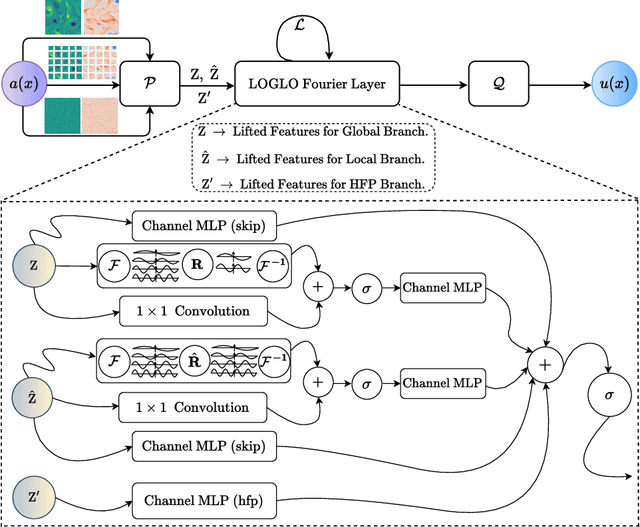
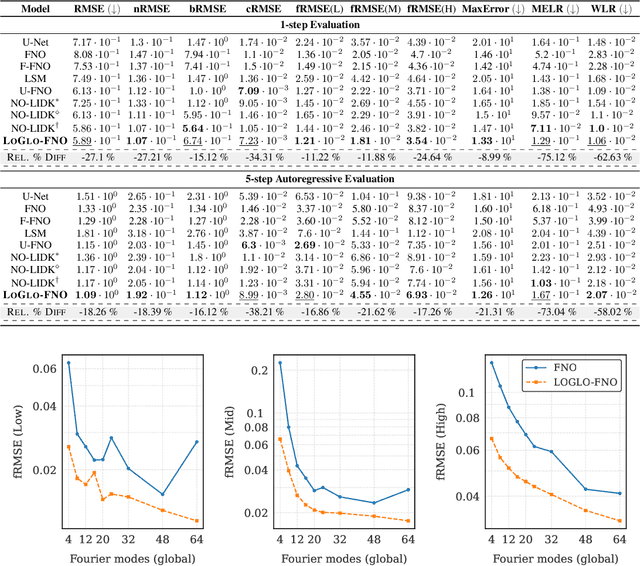

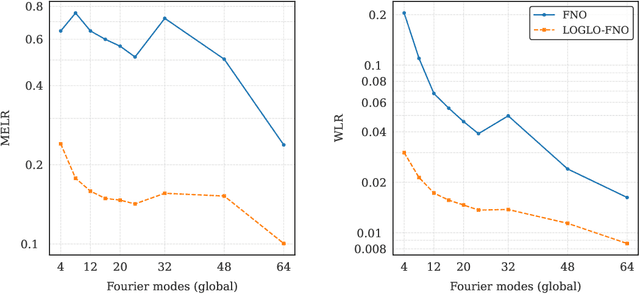
Modeling high-frequency information is a critical challenge in scientific machine learning. For instance, fully turbulent flow simulations of Navier-Stokes equations at Reynolds numbers 3500 and above can generate high-frequency signals due to swirling fluid motions caused by eddies and vortices. Faithfully modeling such signals using neural networks depends on accurately reconstructing moderate to high frequencies. However, it has been well known that deep neural nets exhibit the so-called spectral bias toward learning low-frequency components. Meanwhile, Fourier Neural Operators (FNOs) have emerged as a popular class of data-driven models in recent years for solving Partial Differential Equations (PDEs) and for surrogate modeling in general. Although impressive results have been achieved on several PDE benchmark problems, FNOs often perform poorly in learning non-dominant frequencies characterized by local features. This limitation stems from the spectral bias inherent in neural networks and the explicit exclusion of high-frequency modes in FNOs and their variants. Therefore, to mitigate these issues and improve FNO's spectral learning capabilities to represent a broad range of frequency components, we propose two key architectural enhancements: (i) a parallel branch performing local spectral convolutions (ii) a high-frequency propagation module. Moreover, we propose a novel frequency-sensitive loss term based on radially binned spectral errors. This introduction of a parallel branch for local convolutions reduces number of trainable parameters by up to 50% while achieving the accuracy of baseline FNO that relies solely on global convolutions. Experiments on three challenging PDE problems in fluid mechanics and biological pattern formation, and the qualitative and spectral analysis of predictions show the effectiveness of our method over the state-of-the-art neural operator baselines.
TabICL: A Tabular Foundation Model for In-Context Learning on Large Data
Feb 08, 2025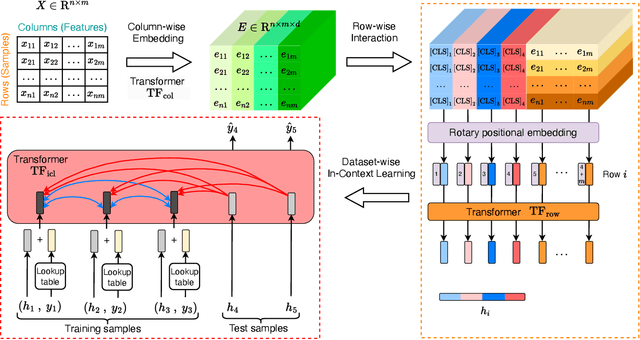
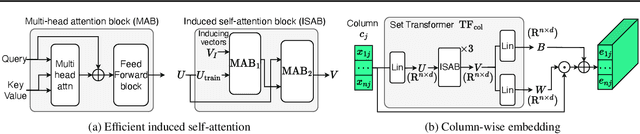
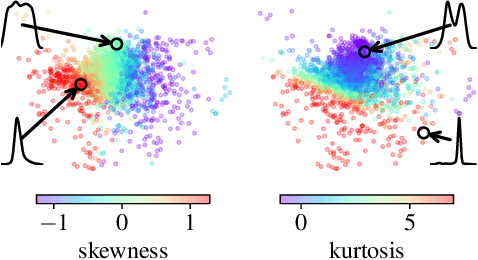
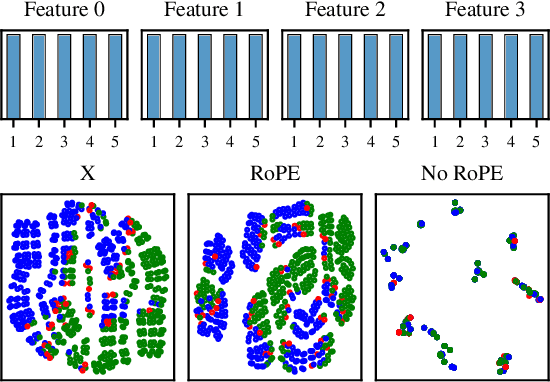
The long-standing dominance of gradient-boosted decision trees on tabular data is currently challenged by tabular foundation models using In-Context Learning (ICL): setting the training data as context for the test data and predicting in a single forward pass without parameter updates. While the very recent TabPFNv2 foundation model (2025) excels on tables with up to 10K samples, its alternating column- and row-wise attentions make handling large training sets computationally prohibitive. So, can ICL be effectively scaled and deliver a benefit for larger tables? We introduce TabICL, a tabular foundation model for classification, pretrained on synthetic datasets with up to 60K samples and capable of handling 500K samples on affordable resources. This is enabled by a novel two-stage architecture: a column-then-row attention mechanism to build fixed-dimensional embeddings of rows, followed by a transformer for efficient ICL. Across 200 classification datasets from the TALENT benchmark, TabICL is on par with TabPFNv2 while being systematically faster (up to 10 times), and significantly outperforms all other approaches. On 56 datasets with over 10K samples, TabICL surpasses both TabPFNv2 and CatBoost, demonstrating the potential of ICL for large data.
Rethinking Early Stopping: Refine, Then Calibrate
Jan 31, 2025Machine learning classifiers often produce probabilistic predictions that are critical for accurate and interpretable decision-making in various domains. The quality of these predictions is generally evaluated with proper losses like cross-entropy, which decompose into two components: calibration error assesses general under/overconfidence, while refinement error measures the ability to distinguish different classes. In this paper, we provide theoretical and empirical evidence that these two errors are not minimized simultaneously during training. Selecting the best training epoch based on validation loss thus leads to a compromise point that is suboptimal for both calibration error and, most importantly, refinement error. To address this, we introduce a new metric for early stopping and hyperparameter tuning that makes it possible to minimize refinement error during training. The calibration error is minimized after training, using standard techniques. Our method integrates seamlessly with any architecture and consistently improves performance across diverse classification tasks.