 Add to Chrome
 Add to Firefox
 Add to Edge
Pre-training vision models for the classification of alerts from wide-field time-domain surveys
Dec 12, 2025
Modern wide-field time-domain surveys facilitate the study of transient, variable and moving phenomena by conducting image differencing and relaying alerts to their communities. Machine learning tools have been used on data from these surveys and their precursors for more than a decade, and convolutional neural networks (CNNs), which make predictions directly from input images, saw particularly broad adoption through the 2010s. Since then, continually rapid advances in computer vision have transformed the standard practices around using such models. It is now commonplace to use standardized architectures pre-trained on large corpora of everyday images (e.g., ImageNet). In contrast, time-domain astronomy studies still typically design custom CNN architectures and train them from scratch. Here, we explore the affects of adopting various pre-training regimens and standardized model architectures on the performance of alert classification. We find that the resulting models match or outperform a custom, specialized CNN like what is typically used for filtering alerts. Moreover, our results show that pre-training on galaxy images from Galaxy Zoo tends to yield better performance than pre-training on ImageNet or training from scratch. We observe that the design of standardized architectures are much better optimized than the custom CNN baseline, requiring significantly less time and memory for inference despite having more trainable parameters. On the eve of the Legacy Survey of Space and Time and other image-differencing surveys, these findings advocate for a paradigm shift in the creation of vision models for alerts, demonstrating that greater performance and efficiency, in time and in data, can be achieved by adopting the latest practices from the computer vision field.

Mapping smallholder cashew plantations to inform sustainable tree crop expansion in Benin
Jan 01, 2023

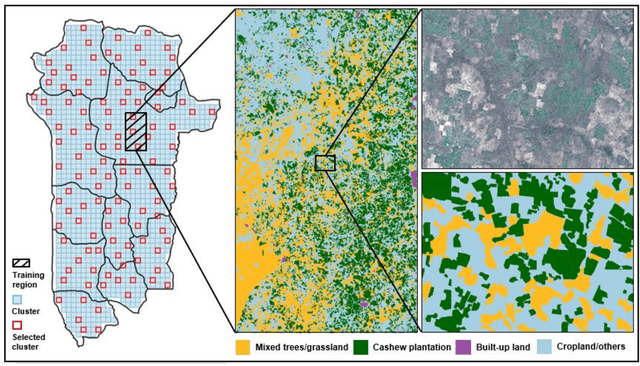

Cashews are grown by over 3 million smallholders in more than 40 countries worldwide as a principal source of income. As the third largest cashew producer in Africa, Benin has nearly 200,000 smallholder cashew growers contributing 15% of the country's national export earnings. However, a lack of information on where and how cashew trees grow across the country hinders decision-making that could support increased cashew production and poverty alleviation. By leveraging 2.4-m Planet Basemaps and 0.5-m aerial imagery, newly developed deep learning algorithms, and large-scale ground truth datasets, we successfully produced the first national map of cashew in Benin and characterized the expansion of cashew plantations between 2015 and 2021. In particular, we developed a SpatioTemporal Classification with Attention (STCA) model to map the distribution of cashew plantations, which can fully capture texture information from discriminative time steps during a growing season. We further developed a Clustering Augmented Self-supervised Temporal Classification (CASTC) model to distinguish high-density versus low-density cashew plantations by automatic feature extraction and optimized clustering. Results show that the STCA model has an overall accuracy of 80% and the CASTC model achieved an overall accuracy of 77.9%. We found that the cashew area in Benin has doubled from 2015 to 2021 with 60% of new plantation development coming from cropland or fallow land, while encroachment of cashew plantations into protected areas has increased by 70%. Only half of cashew plantations were high-density in 2021, suggesting high potential for intensification. Our study illustrates the power of combining high-resolution remote sensing imagery and state-of-the-art deep learning algorithms to better understand tree crops in the heterogeneous smallholder landscape.