 Add to Chrome
 Add to Firefox
 Add to Edge
CAAL: Confidence-Aware Active Learning for Heteroscedastic Atmospheric Regression
Feb 12, 2026
Quantifying the impacts of air pollution on health and climate relies on key atmospheric particle properties such as toxicity and hygroscopicity. However, these properties typically require complex observational techniques or expensive particle-resolved numerical simulations, limiting the availability of labeled data. We therefore estimate these hard-to-measure particle properties from routinely available observations (e.g., air pollutant concentrations and meteorological conditions). Because routine observations only indirectly reflect particle composition and structure, the mapping from routine observations to particle properties is noisy and input-dependent, yielding a heteroscedastic regression setting. With a limited and costly labeling budget, the central challenge is to select which samples to measure or simulate. While active learning is a natural approach, most acquisition strategies rely on predictive uncertainty. Under heteroscedastic noise, this signal conflates reducible epistemic uncertainty with irreducible aleatoric uncertainty, causing limited budgets to be wasted in noise-dominated regions. To address this challenge, we propose a confidence-aware active learning framework (CAAL) for efficient and robust sample selection in heteroscedastic settings. CAAL consists of two components: a decoupled uncertainty-aware training objective that separately optimises the predictive mean and noise level to stabilise uncertainty estimation, and a confidence-aware acquisition function that dynamically weights epistemic uncertainty using predicted aleatoric uncertainty as a reliability signal. Experiments on particle-resolved numerical simulations and real atmospheric observations show that CAAL consistently outperforms standard AL baselines. The proposed framework provides a practical and general solution for the efficient expansion of high-cost atmospheric particle property databases.

Accelerating 3D Gaussian Splatting with Neural Sorting and Axis-Oriented Rasterization
Jun 08, 2025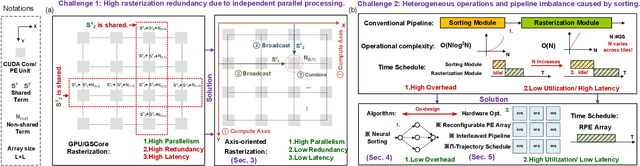
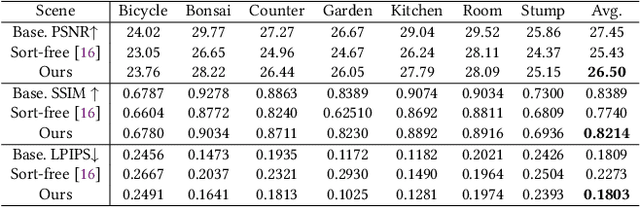
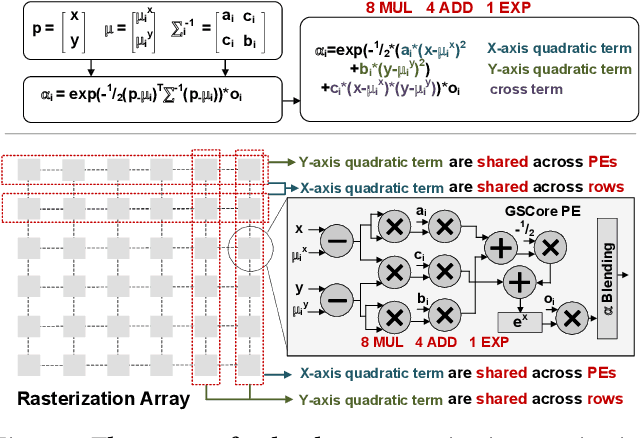
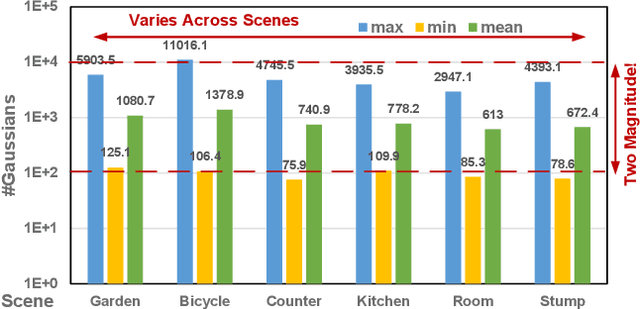
3D Gaussian Splatting (3DGS) has recently gained significant attention for high-quality and efficient view synthesis, making it widely adopted in fields such as AR/VR, robotics, and autonomous driving. Despite its impressive algorithmic performance, real-time rendering on resource-constrained devices remains a major challenge due to tight power and area budgets. This paper presents an architecture-algorithm co-design to address these inefficiencies. First, we reveal substantial redundancy caused by repeated computation of common terms/expressions during the conventional rasterization. To resolve this, we propose axis-oriented rasterization, which pre-computes and reuses shared terms along both the X and Y axes through a dedicated hardware design, effectively reducing multiply-and-add (MAC) operations by up to 63%. Second, by identifying the resource and performance inefficiency of the sorting process, we introduce a novel neural sorting approach that predicts order-independent blending weights using an efficient neural network, eliminating the need for costly hardware sorters. A dedicated training framework is also proposed to improve its algorithmic stability. Third, to uniformly support rasterization and neural network inference, we design an efficient reconfigurable processing array that maximizes hardware utilization and throughput. Furthermore, we introduce a $\pi$-trajectory tile schedule, inspired by Morton encoding and Hilbert curve, to optimize Gaussian reuse and reduce memory access overhead. Comprehensive experiments demonstrate that the proposed design preserves rendering quality while achieving a speedup of $23.4\sim27.8\times$ and energy savings of $28.8\sim51.4\times$ compared to edge GPUs for real-world scenes. We plan to open-source our design to foster further development in this field.